What is triethylamine used for?
Mostly as an acid scavenger and base catalyst in pharmaceutical, agrochemical and fine chemical synthesis, and as the vapour-phase catalyst in the foundry amine cold-box core-making process. It is also used in polyurethane and coating catalysis, quaternary ammonium manufacture, corrosion inhibitor packages, dye synthesis, and as an HPLC mobile-phase modifier.
Is triethylamine the same as triethanolamine?
No, and this is the most common mix-up in the family. Triethylamine (CAS 121-44-8) is a volatile, highly flammable liquid base boiling at 89.5 °C. Triethanolamine (CAS 102-71-6) is a viscous, high-boiling amino alcohol used in cement grinding aids, cosmetics and metalworking fluids. Both get shortened to "TEA", so always write the full name and CAS number on the order.
Why is triethylamine the default acid scavenger?
Three reasons. It is a strong base with a conjugate acid pKa near 10.75, so it takes up HCl reliably. It has no N–H bond, so it cannot be acylated and cannot end up in the product. And its hydrochloride is poorly soluble in most organic solvents, so it drops out and filters off, while excess amine strips away at 89.5 °C. Cost per mole is low, which settles the argument for routine work.
In which grades do you supply triethylamine?
Technical grade at 99% and above for foundry and general catalysis, commercial grade at 99.5% and above for pharmaceutical and agrochemical synthesis, a low-water grade for acid chloride and isocyanate chemistry, and LR, AR or HPLC-suitable laboratory grades in small packs.
How pure is your triethylamine, and what is controlled?
Assay is typically 99.5% and above, with diethylamine at 0.3% maximum, monoethylamine at 0.1% maximum, water at 0.2% maximum by Karl Fischer, APHA colour of 15 or less and a distillation range of 88 to 91 °C. If your process needs a tighter water or diethylamine limit, state it at enquiry and we will quote against your specification.
Why does the diethylamine content matter so much?
Because diethylamine is a secondary amine with an N–H bond, and that is precisely what triethylamine is chosen for not having. In an acylation the diethylamine present will react with your acid chloride and produce an N,N-diethyl amide impurity in the product. At a few tenths of a percent that is a visible peak, which is why regulated work specifies a tighter limit.
Which pack sizes are available?
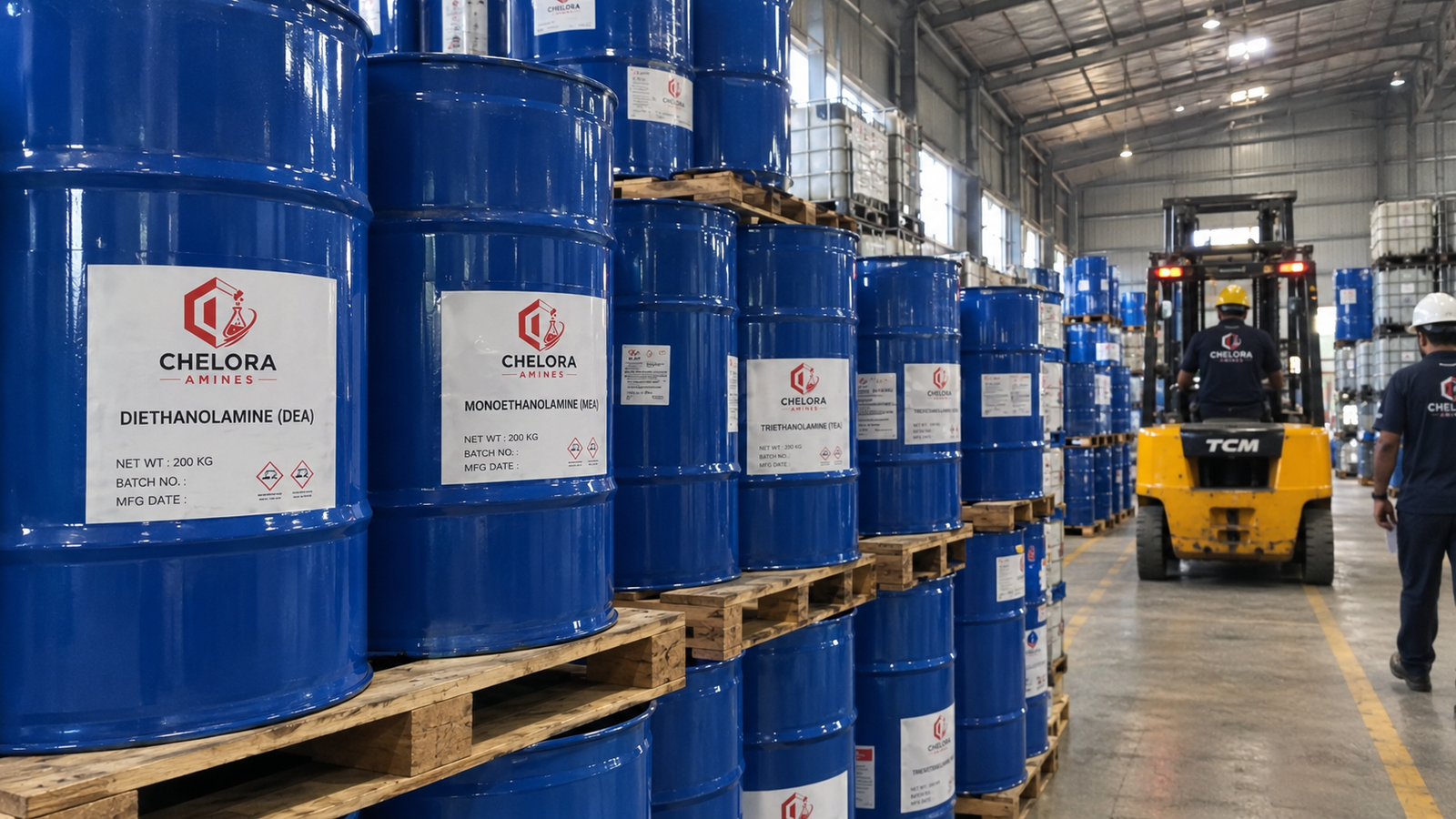
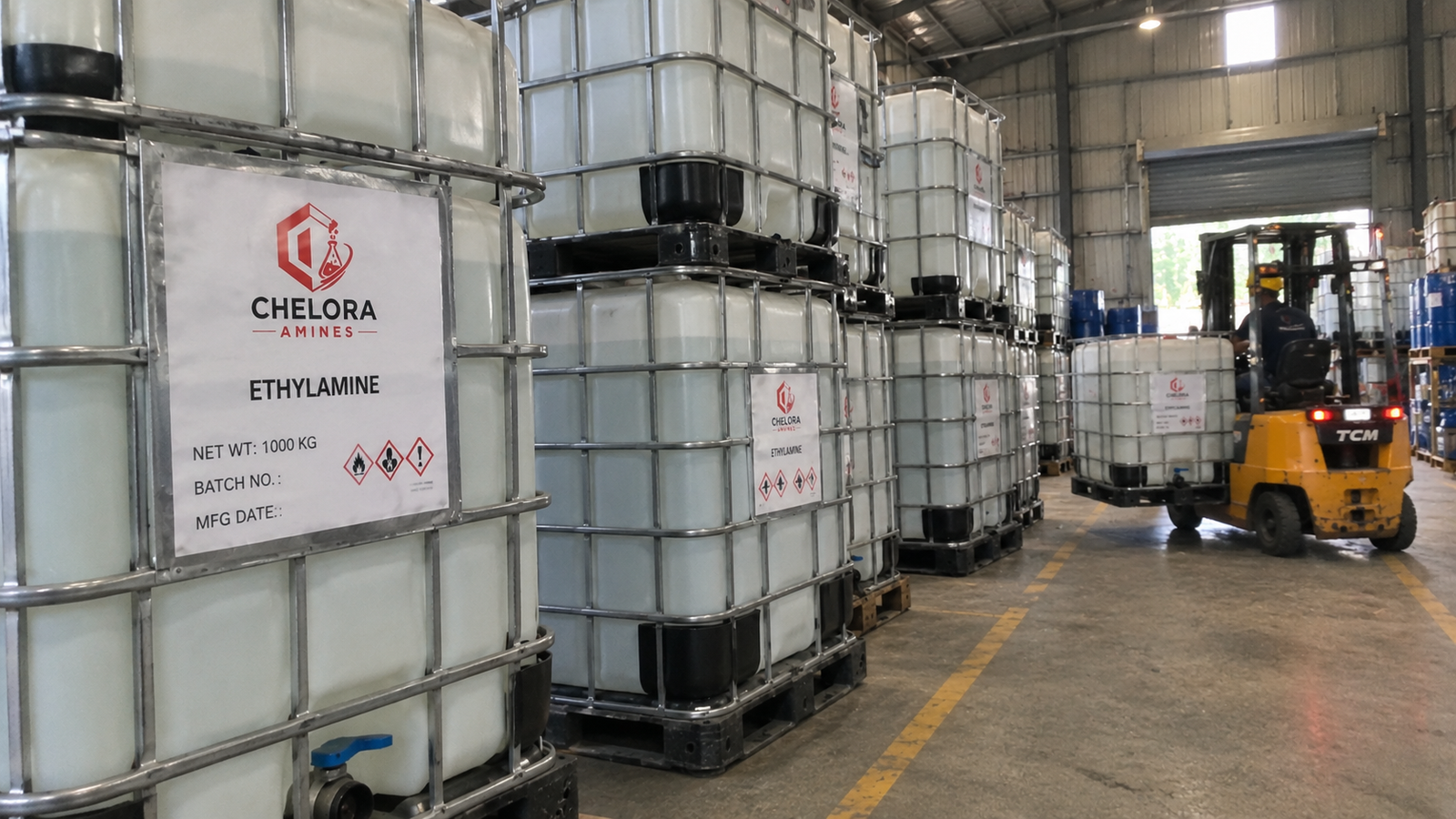
25 litre tinplate cans and HDPE carboys for trials, 200 litre MS drums holding about 145 kg net for production use, 1000 L IBC totes for weekly consumption, and ISO tanks or road tankers for bulk foundry and plant supply. Laboratory grades are available in 2.5 L, 5 L and 25 L packs.
How should triethylamine be stored and handled?
Treat it as a highly flammable liquid: cool, dry, well-ventilated flammable-liquid store, containers closed, area bunded, no ignition sources, and equipment earthed and bonded during transfer. Keep it away from acids, oxidisers, halogens and hypochlorites. Use stainless steel, carbon steel or HDPE and avoid copper, brass, zinc and galvanised surfaces. Handle with splash goggles, chemical-resistant gloves and an apron, with local exhaust ventilation, an eyewash and a safety shower nearby.
Is triethylamine hazardous to transport?
Yes. It ships under UN 1296 as a Class 3 flammable liquid with a subsidiary Class 8 corrosive risk, packing group II. Packs are labelled accordingly and export consignments go in UN-specification packaging with the correct hazard labelling and paperwork.
What is the HS code for triethylamine?
Triethylamine is classified under harmonised heading 2921 19, which covers other acyclic monoamines and their derivatives. National tariffs add a further two to four digits, and the full code for your destination is stated on the export documents and on the domestic invoice so GST input credit and customs clearance are not held up.
Why does my triethylamine solution go cloudy when it warms up?
Because its solubility in water falls as temperature rises, which is the opposite of most chemicals. A solution that is clear in a cold vessel can separate into two phases on warming and clear again on cooling. It is not a quality problem, but it does mean the temperature of an aqueous wash should be chosen deliberately rather than left to the weather.
What documents come with an order?
Every dispatch carries a batch-wise Certificate of Analysis, the Safety Data Sheet, HSN details on the invoice, and labels showing the grade, net weight, batch number, manufacturing date and UN number. Export orders also carry the shipping documentation for the destination.
Do you supply trial quantities of triethylamine?
Yes. A 25 litre can or a small laboratory pack can be arranged so your team can qualify the material before placing a regular order.
Request a sample with your application and water-limit details.
What is the shelf life of triethylamine?
In sealed original packing kept cool and out of sunlight, twelve months is the normal working figure. The material does not spoil so much as drift — air and carbon dioxide ingress raise the APHA colour and form carbonate, and moisture picks up from a part-used drum — so keep packs closed between draws and re-check assay, water and colour before a critical batch from older stock.
Do you also supply triethylamine hydrochloride?
Yes, triethylamine hydrochloride (CAS 554-68-7) can be supplied on request. It is the solid salt form, used as a reagent and catalyst in synthesis and easier to weigh and store than the liquid. Ask for it by name and quantity and we will quote pack sizes and lead time.
What is the minimum order quantity and the usual lead time?
A single 25 litre can is enough to start for trial and qualification work; production orders normally move in drums, IBC totes, container loads or ISO tanks. Ex-stock domestic dispatches typically leave within a few working days of order confirmation, and export or made-to-specification campaigns need longer depending on packing, permits and shipping schedules. We confirm the lead time on the quotation.
Which materials can I use for pumps, pipework and storage?
Stainless steel, carbon steel and HDPE are generally suitable, with PTFE gaskets and seals. Avoid copper, brass, bronze, zinc and galvanised surfaces — amines attack copper alloys, and the usual symptom is a failed pump or discoloured product rather than any problem with the chemical itself. Earth and bond equipment during transfer, because the vapour is flammable and heavier than air.
Which countries do you supply triethylamine to?
We ship worldwide. Regular destinations include the Middle East and Africa, South and South East Asia, East Asia, Australia and New Zealand, Europe and the CIS, and North and South America, alongside domestic supply throughout India. Shipments move in container loads or ISO tanks through Nhava Sheva and Mundra, packed to UN specification with the correct hazard labelling, and we quote on EXW, FOB, CFR, CIF or DAP terms.
Which Indian states do you deliver triethylamine to?
We dispatch by road from Mumbai to
Maharashtra,
Gujarat,
Telangana,
Andhra Pradesh,
Tamil Nadu,
Karnataka,
Kerala,
Madhya Pradesh,
West Bengal,
Punjab,
Haryana,
Uttar Pradesh,
Uttarakhand,
Himachal Pradesh,
Rajasthan and
Delhi.
How do I get a price for triethylamine?
Send the grade and water limit you need, the quantity, pack size and delivery location through our
contact page, by email to source@cheloraamines.com or by phone on +91 98191 11179. A complete enquiry usually gets a quote within 24 hours.