LDA formation
Deprotonated with n-butyllithium to give lithium diisopropylamide, a strong non-nucleophilic base.
iPr₂NH + BuLi → LDA
N-isopropylpropan-2-amine · DIPA · ≥99% commercial, LR and AR grades
Diisopropylamine is the hindered secondary amine behind lithium diisopropylamide (LDA), and a workhorse in herbicide, pharmaceutical and rubber chemistry. Chelora Amines supplies it worldwide and across India, in UN-specification packaging with a batch-wise COA and SDS.
72.06 + 14.11 + 14.01 + 1.01 = 101.19 g/mol
Diisopropylamine (DIPA) is a clear, colourless, flammable liquid with a strong ammoniacal odour, boiling at about 84 °C and moderately soluble in water.
It is a secondary amine with two branched substituents. The steric hindrance around nitrogen makes it a strong base but a weak nucleophile, so it is the standard precursor for LDA and useful wherever a hindered amine is needed.
It is manufactured by amination of isopropanol or acetone with ammonia and hydrogen over a supported catalyst, alongside isopropylamine. Residual isopropylamine, acetone, isopropanol and water are controlled in the specification.
| Chemical name | Diisopropylamine (N-isopropylpropan-2-amine) |
| Common synonyms | DIPA, N,N-diisopropylamine, 2-isopropylaminopropane |
| CAS number | 108-18-9 |
| EC / EINECS number | 203-558-5 |
| HS / HSN code | 2921 19 (acyclic monoamines and derivatives) |
| Molecular formula | [(CH₃)₂CH]₂NH (C₆H₁₅N) |
| Molecular weight | 101.19 g/mol |
| Appearance | Clear, colourless liquid |
| Odour | Ammoniacal, fish-like |
| Melting point | About −61 °C |
| Boiling point | 83–84 °C |
| Density | About 0.717 g/cm³ at 20 °C |
| Vapour pressure | About 100 mbar at 20 °C |
| Flash point | About −7 °C (closed cup) |
| Auto-ignition temperature | About 315 °C |
| Solubility in water | About 110 g/L at 20 °C |
| pKa of conjugate acid | About 11.05 at 25 °C |
| UN number | UN 1158, Class 3 (8), PG II |
Figures are typical literature values for orientation. Values for the material you order are stated on its Certificate of Analysis and Safety Data Sheet.
Diisopropylamine is a hindered secondary amine: strongly basic, weakly nucleophilic, and easy to handle as a liquid. That combination defines where it is used.
Deprotonated with n-butyllithium to give lithium diisopropylamide, a strong non-nucleophilic base.
iPr₂NH + BuLi → LDAReacts with carbonyl sulfide or thiocarbamoyl chloride to give diallate and triallate type herbicides.
R₂NH + COS → thiocarbamateNeutralises acids to give diisopropylammonium salts used in pharma and formulations.
acid + iPr₂NH → saltWith a conjugate-acid pKa near 11 it acts as a hindered base that does not compete as a nucleophile.
pKa ≈ 11.05 at 25 °CAcylation gives N,N-diisopropyl amides, useful where a bulky amide is wanted.
RCOCl + iPr₂NH → amideReacts with carbon disulfide and a base to give diisopropyldithiocarbamates.
R₂NH + CS₂ → R₂NCS₂⁻Alkylates slowly but cleanly to give Hünig's base and related hindered tertiary amines.
iPr₂NH + EtX → iPr₂NEtDeprotonated by sodium or potassium bases to give strong amide bases besides LDA.
iPr₂NH + M → iPr₂NMProcess notes. Additions are exothermic and the flash point is well below room temperature. Dose under control with cooling, keep transfers earthed and under nitrogen, and keep water out where the amine is used to make LDA.
Discuss your processDiisopropylamine is made by catalytic amination, and the route sets the impurity profile: related amines from over- or under-reaction, and residual feedstock from incomplete conversion.
Isopropanol or acetone is mixed with ammonia, with hydrogen fed in for the reductive route.
The mixture passes over a supported nickel or cobalt catalyst at elevated temperature and pressure.
The reactor delivers isopropylamine and diisopropylamine together, with water, unreacted ammonia and traces of triisopropylamine.
Ammonia is recovered and recycled, and distillation splits the mono- and di-isopropylamine, with the mix tuned by recycling.
Product is dried, tested for assay, isopropylamine, water and colour, then filled under nitrogen into carboys, drums, totes or bulk containers.
Isopropylamine is the co-product and the main related impurity, present at low levels after distillation. Residual acetone and isopropanol reflect incomplete conversion, and water matters wherever the amine goes into an organolithium step.
Where LDA is made in-house, water and isopropylamine are the two numbers that decide whether a batch is suitable. Send your limits with the enquiry and we will match the batch rather than send the standard cut.
Twelve months in sealed original packing, kept cool and out of sunlight, is the normal working figure, with a re-check of assay, water and colour before a critical batch from older stock.
Keep drums closed between draws, since carbon dioxide and moisture pickup are the usual causes of a rising APHA number. Blanket tanks with nitrogen where you can. A retained sample of every batch is held here.
Tell us the reaction and the limits that matter and we will confirm the grade. Commercial grade covers most production use; LR and AR grades are available for laboratory, method development and analytical work.
The standard production grade for intermediates, salt formation and general synthesis.
Tighter limits on related amines, water and colour for development and pilot work.
The tightest grade we offer, for analytical method work, standards and QC laboratories.
Batches selected or sourced against limits you name, such as water, related amines or colour.
| Parameter | Test method | Typical specification |
|---|---|---|
| Appearance | Visual | Clear, colourless liquid |
| Assay (diisopropylamine) | GC | ≥ 99.0 % w/w |
| Isopropylamine | GC | ≤ 0.3 % w/w |
| Acetone / isopropanol | GC | ≤ 0.1 % w/w each |
| Water | Karl Fischer | ≤ 0.3 % w/w |
| Colour | APHA | ≤ 15 |
| Density at 20 °C | Densitometer | 0.714 – 0.720 g/cm³ |
Indicative specification for planning. The controlling document is the Certificate of Analysis issued for your batch. If your process needs tighter limits, say so at enquiry stage and we will quote against your specification.
Diisopropylamine is often confused with other small amines, but its hindered secondary structure is what makes it a strong base and a poor nucleophile.
| Property | Diisopropylamine | Isopropylamine | Diethylamine | Triethylamine |
|---|---|---|---|---|
| CAS number | 108-18-9 | 75-31-0 | 109-89-7 | 121-44-8 |
| Structure | Secondary, two isopropyl groups | Primary, one isopropyl group | Secondary, two ethyl groups | Tertiary, three ethyl groups |
| Boiling point | 83–84 °C | 32–34 °C | 55–56 °C | 89–90 °C |
| pKa of conjugate acid | ≈ 11.05 | ≈ 10.6 | ≈ 11.0 | ≈ 10.75 |
| Amine class | Secondary, hindered | Primary | Secondary | Tertiary |
| Steric access at nitrogen | Strongly hindered | Moderately hindered | Little hindered | Hindered, no N–H |
| Typical outlets | LDA, thiocarbamate herbicides, rubber chemicals | Herbicide salts, pharma synthesis | Pharma, agro intermediates, rubber | Acid scavenger, catalyst, quats |
| Transport | UN 1158, Class 3 (8), PG II | UN 1221, Class 3 (8), PG I | UN 1154, Class 3 (8), PG II | UN 1296, Class 3 (8), PG II |
Order by full name and CAS number. State Diisopropylamine and CAS 108-18-9 on the enquiry and the purchase order. Short names and abbreviations are read differently by different suppliers.
See the full amine rangeFine chemicals and agrochemicals account for most of the volume, with LDA and pharma work taking the tighter grades.
Starting material for lithium diisopropylamide and related hindered-base chemistry.
Amine source for thiocarbamate herbicides such as diallate and triallate.
Goes into sulfenamide accelerators and dithiocarbamates for elastomers.
Supplies the diisopropylamino group in several drugs and forms diisopropylammonium salts.
Feeds inhibitor and volatile-corrosion-inhibitor packages.
Used in quaternary ammonium compounds and amphoteric surfactants.
Ethylated to N,N-diisopropylethylamine, a non-nucleophilic base for coupling chemistry.
A hindered base and acid scavenger for method development.
If you are mapping a value chain, or looking for the product one step down from where you are, this is where Diisopropylamine ends up. Several of these are chemicals we can also source for you.
| Derivative | Made by | End use |
|---|---|---|
| Lithium diisopropylamide (LDA) | Deprotonation with n-butyllithium | Strong non-nucleophilic base for fine chemicals |
| Diallate and triallate | Reaction with carbonyl sulfide and alkylating agent | Thiocarbamate herbicides |
| N,N-Diisopropylethylamine | Ethylation of diisopropylamine | Hindered base for peptide and API coupling |
| 2-(Diisopropylamino)ethyl chloride | Reaction with ethylene chlorohydrin or dichloroethane | Pharma intermediate |
| Diisopropylammonium salts | Neutralisation with organic or mineral acids | Pharma and formulation use |
| Diisopropylbenzothiazole sulfenamide | Oxidative coupling with mercaptobenzothiazole | Rubber accelerator |
| Diisopropyl dithiocarbamates | Reaction with carbon disulfide | Rubber accelerators and flotation collectors |
| N,N-Diisopropyl amides | Acylation with acid chlorides | Pharma and agro intermediates |
| Sodium and potassium diisopropylamide | Metalation | Specialty strong bases |
| Quaternary ammonium compounds | Exhaustive alkylation | Antistatic agents and phase-transfer catalysts |
Looking for one of these rather than the amine itself? Ask us — several sit within our sourcing network, and we can quote the derivative and the raw material together.
Every container carries the Chelora Amines label with product name, net weight, batch number, manufacturing date, UN number and hazard pictograms.
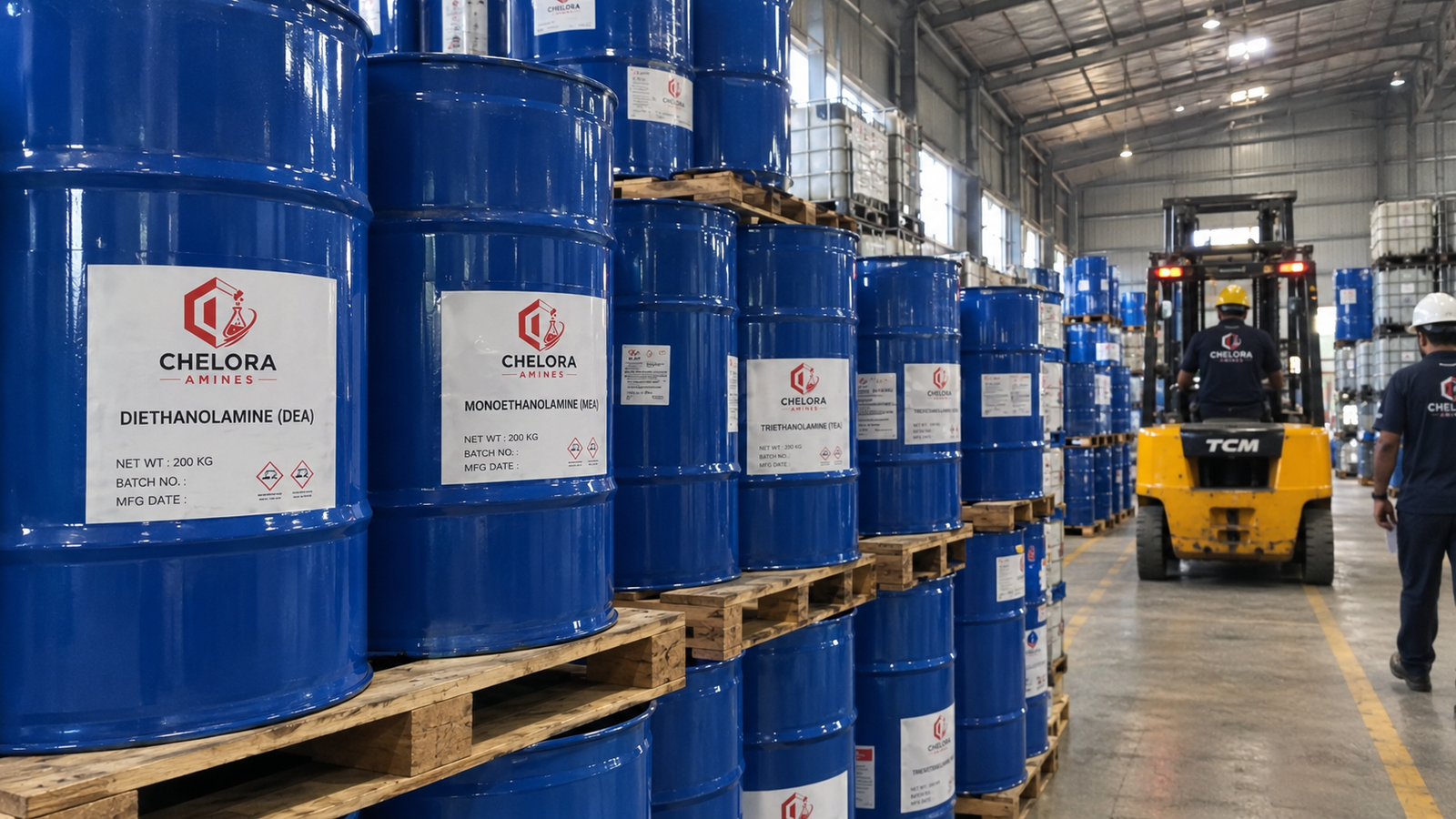
HDPE carboys for lab qualification, pilot batches and low-consumption users.
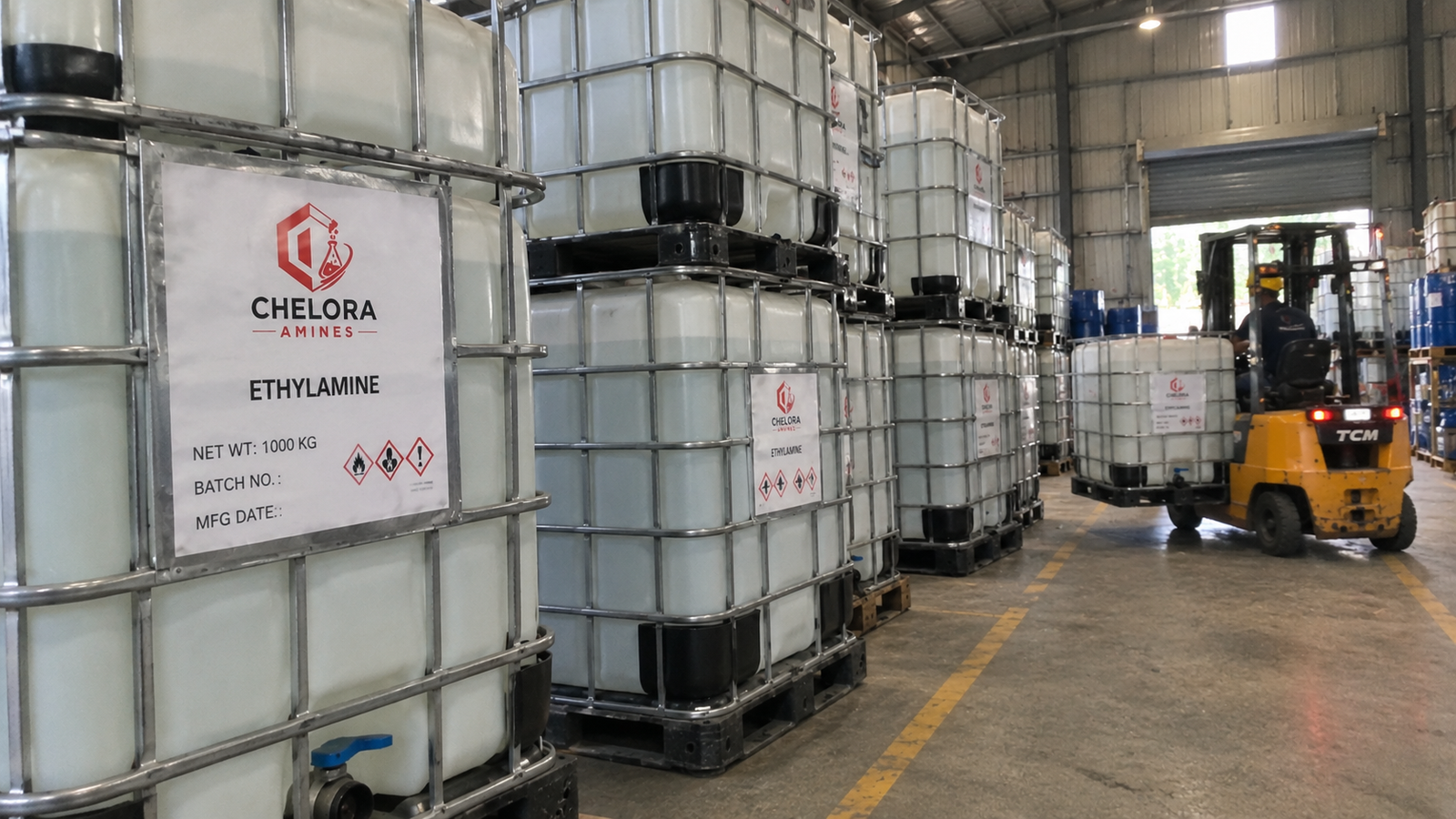
MS and HDPE drums, the standard production pack, with tamper-evident closures.
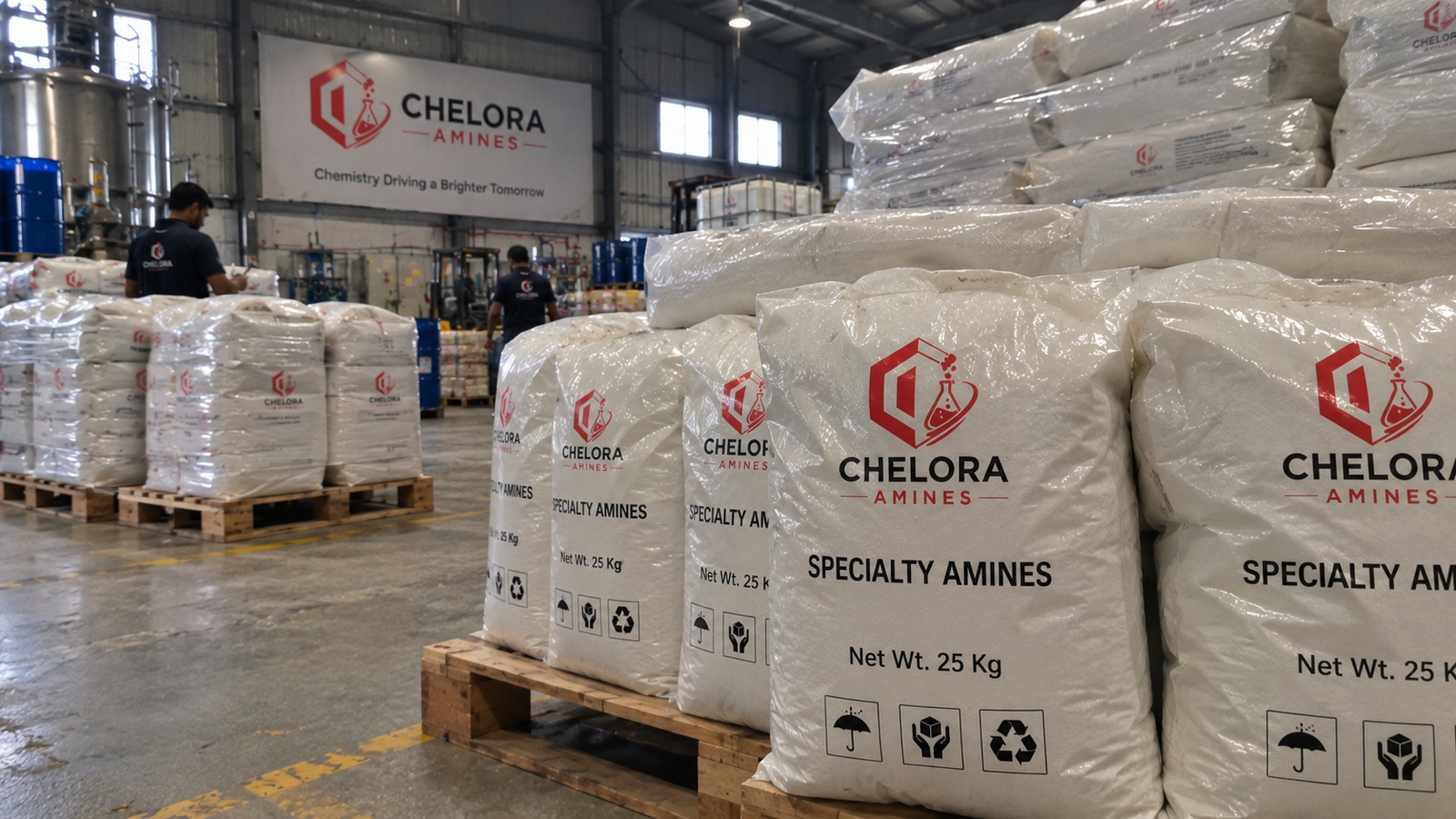
Forklift-ready totes with bottom valves for plants drawing material every week.
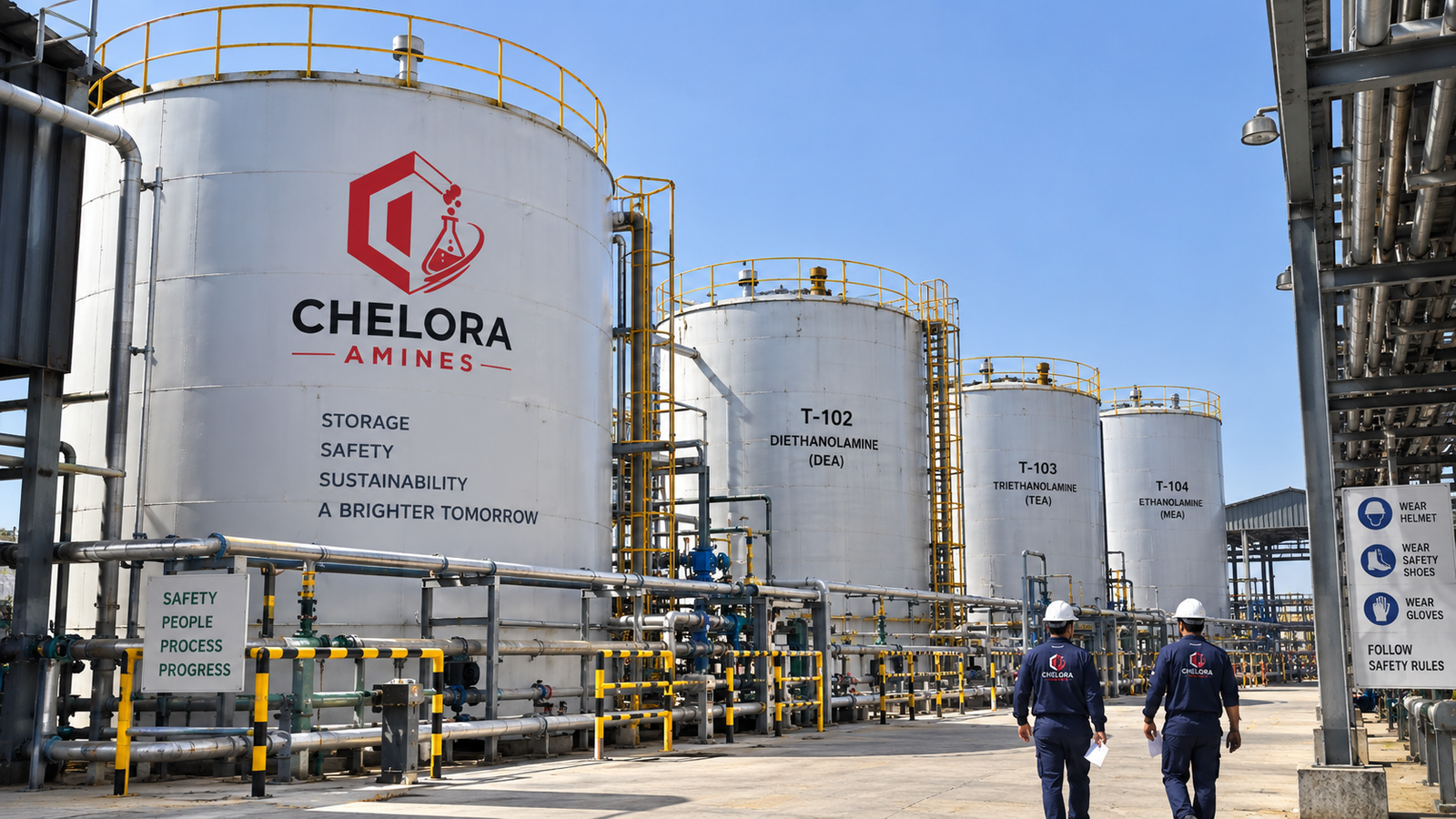
Bulk loads and ISO tank containers for continuous plants and large campaigns.
Tell us the monthly draw and how you store hazardous liquids, and we will recommend the grade, pack size and delivery schedule. Export consignments are packed in UN-specification drums and totes, palletised and stretch-wrapped, and shipped FOB, CIF or CFR through Nhava Sheva and Mundra.
Plan my supplyDiisopropylamine is a highly flammable, corrosive base with a flash point below room temperature. The notes below are a summary for planning only — work to the Safety Data Sheet supplied with your consignment and to your own site risk assessment.
Diisopropylamine is a regulated dangerous good in transport. That is routine for us, but it shapes what we need from you before a first shipment moves.
| Proper shipping name | Amines, flammable, corrosive, n.o.s. (diisopropylamine) — or the entry stated on the batch SDS |
| UN number / class | UN 1158, Class 3 (8), PG II |
| Packing group | II |
| Labels | Hazard pictograms, with the technical name shown in brackets |
| Modes | Road, rail and sea (IMDG); air movement within dangerous goods quantity limits |
| Segregation | Away from acids, oxidisers, halogens, hypochlorites and foodstuffs |
| Packaging | UN-specification drums, carboys and IBC totes, palletised and strapped for export |
We supply business to business only, against verified company credentials, consignee details and a signed end-use declaration, plus any import permit the destination country requires.
Start account opening| Parameter | Specification | Result |
|---|---|---|
| Appearance | Clear, colourless liquid | Complies |
| Assay (diisopropylamine) | ≥ 99.0 % w/w | Complies |
| Isopropylamine | ≤ 0.3 % w/w | Complies |
| Acetone / isopropanol | ≤ 0.1 % w/w each | Complies |
| Water | ≤ 0.3 % w/w | Complies |
Diisopropylamine is checked before dispatch and each consignment leaves with the paperwork your QC, stores and accounts teams need on day one.
The numbers on a Certificate of Analysis are only useful if you know how they were produced. These are the methods behind the figures on ours, and the checks worth repeating at your own goods-inward.
Separates the amine from related amines and residual solvents in one run, and gives both the assay and the impurity profile that matter to your reaction.
An independent check on total amine content, useful as a quick goods-inward confirmation before a drum is released to production.
Water determination, which matters wherever the next step is moisture sensitive or the amine feeds an anhydrous reaction.
A visual platinum–cobalt comparison. A rising colour value is the earliest sign that a pack has been exposed to air or held too long.
Fast confirmation of identity and strength, and a simple way to spot a wrong pack or a contaminated drum.
Gravimetric residue and trace metal checks, which matter for catalytic steps and regulated formulations.
A sample from every dispatched batch is held here, so a query months later can be settled against the original material.
The batch number on the label ties back to the COA, the test record and the supply lot, which is what your auditor will ask to see.
Where your customer or regulator needs an independent result, we can arrange analysis at a NABL-accredited laboratory before dispatch.
Five steps for a first order of Diisopropylamine. Repeat orders follow the same route on a schedule that matches your consumption.
Grade, quantity, pack size and delivery location.
We confirm the grade for your process and quote, usually within 24 hours.
The batch is tested and the COA, SDS and invoice details are prepared.
Labelled packs move by road, or in UN-spec packaging for export.
Material reaches your gate and repeat dispatches are scheduled to your usage.
Diisopropylamine is a line on a price list and a headache in a warehouse. What separates suppliers is the grade flexibility, the paperwork and the answer you get when something is not routine.
Diisopropylamine sits alongside the rest of our amine range, from ethanolamines to fatty amines. Your purchase team raises one enquiry, compares one quote and manages one vendor record instead of six.
Commercial, LR and AR material is available, so you are not forced to redesign a step around the only grade your supplier happens to carry.
COA, SDS, correct HSN and HS codes, dangerous goods declarations and certificates of origin are prepared with the consignment, not chased afterwards.
Tell us your limits on related amines, water or colour and we quote against them, rather than sending the standard cut and letting your QC find out.
Once we know your monthly draw we hold and release material on a schedule, so you carry less inventory of a hazardous product.
Describe the reaction rather than the product code and we will tell you which grade fits — and say so plainly when a different amine would serve you better.
Buyers who order Diisopropylamine usually source these from the same list. Open any product for its specification, grades and packing, or see the full product range.
Container shipments to buyers on five continents, plus road dispatch inside India. Tell us your country and destination port and we will quote landed terms, transit time and the documentation your customs broker will ask for.
United Arab Emirates, Saudi Arabia, Oman, Qatar, Kuwait, Bahrain, Jordan, Egypt, Morocco, Kenya, Tanzania, Ethiopia, Nigeria, Ghana and South Africa.
Bangladesh, Sri Lanka, Nepal, Pakistan, Vietnam, Thailand, Indonesia, Malaysia, Singapore, the Philippines, South Korea, Japan, Taiwan, Australia and New Zealand.
Germany, the Netherlands, Belgium, France, Italy, Spain, Portugal, Poland, Czechia, the United Kingdom, Ireland, Türkiye, Russia, Ukraine, Kazakhstan and Uzbekistan.
United States, Canada, Mexico, Brazil, Argentina, Chile, Colombia, Peru, Ecuador and the Caribbean, shipped in UN-specification packaging with full DG documentation.
| Incoterms quoted | EXW, FOB, CFR, CIF and DAP, depending on your destination and preference |
| Load ports | Nhava Sheva (JNPT) and Mundra, with Chennai and Kolkata used for eastbound routings |
| Container options | Full container loads, and consolidated LCL shipments for smaller quantities |
| Typical container fill | Around 80 drums, or roughly 18 to 20 IBC totes, in a 20 ft container |
| Packing for export | UN-specification drums and totes, palletised, strapped and stretch-wrapped, with DG labelling |
| Air freight | Possible for small quantities within dangerous goods limits; most volume moves by sea |
| Payment terms | Advance, irrevocable letter of credit or agreed credit terms for established accounts |
| Before first shipment | Company credentials, end-use declaration and any import permit the destination country requires |
Most delays in quoting Diisopropylamine come from a missing line in the enquiry, not from availability. Send these details and a firm price usually comes back the same day.
Not sure of some of it yet? Send what you have. A description of the reaction step and an approximate monthly volume is enough for us to come back with a recommended grade, a pack plan and an indicative price.
Send an enquiryPlain definitions of the words that appear on a Diisopropylamine specification, label and shipping document.
Short answers to what purchase, plant and QC teams ask us most about this product. Anything else, ask us directly.
Send the grade, quantity, pack size and your delivery address or destination port. We come back with a price, the documents that go with the batch and a dispatch or shipping plan, usually within 24 hours.