What is ethylamine used for?
Its biggest use is in crop protection, where it supplies the N-ethyl group in triazine herbicides and feeds into thiocarbamate and urea herbicides. It is also used for N-ethyl pharmaceutical intermediates, rubber chemicals, dye intermediates, corrosion inhibitors for oilfield and refinery service, flotation collectors, surfactants and fuel additives.
Is ethylamine the same as monoethanolamine?
No, and this is the most common mix-up in the family. Ethylamine (monoethylamine, CAS 75-04-7) is a volatile primary amine supplied mainly as a 70% aqueous solution. Monoethanolamine (MEA, CAS 141-43-5) is a viscous amino alcohol used in gas treating and detergents. Both get shortened to "MEA" in the trade, so always write the full name and CAS number on the order.
In which forms do you supply ethylamine?
Four forms: a 70% w/w aqueous solution, which is the standard commercial pack; 30–33% solutions in ethanol, methanol or THF for moisture-sensitive reactions; anhydrous material at 99.5% and above in cylinders, tonners and ISO tanks; and LR or AR laboratory grades in small packs. Tell us your solvent system and we will confirm which suits your process.
What is the difference between ethylamine, diethylamine and triethylamine?
They differ by how many ethyl groups sit on the nitrogen. Ethylamine has one and is a primary amine, diethylamine has two and is secondary, triethylamine has three and is tertiary. All three come out of the same ethanol-and-ammonia reaction and are separated by distillation, but they behave very differently in synthesis — only ethylamine leaves two N–H hydrogens available for further reaction.
How pure is your ethylamine, and what is controlled?
For the 70% aqueous grade, assay is typically 69–71% w/w with diethylamine at 0.5% maximum, triethylamine at 0.2% maximum, free ammonia at 0.2% maximum and APHA colour of 15 or less. Anhydrous material is typically 99.5% and above. If your process needs tighter limits on any of these, state them at enquiry and we will quote against your specification.
Which pack sizes are available?
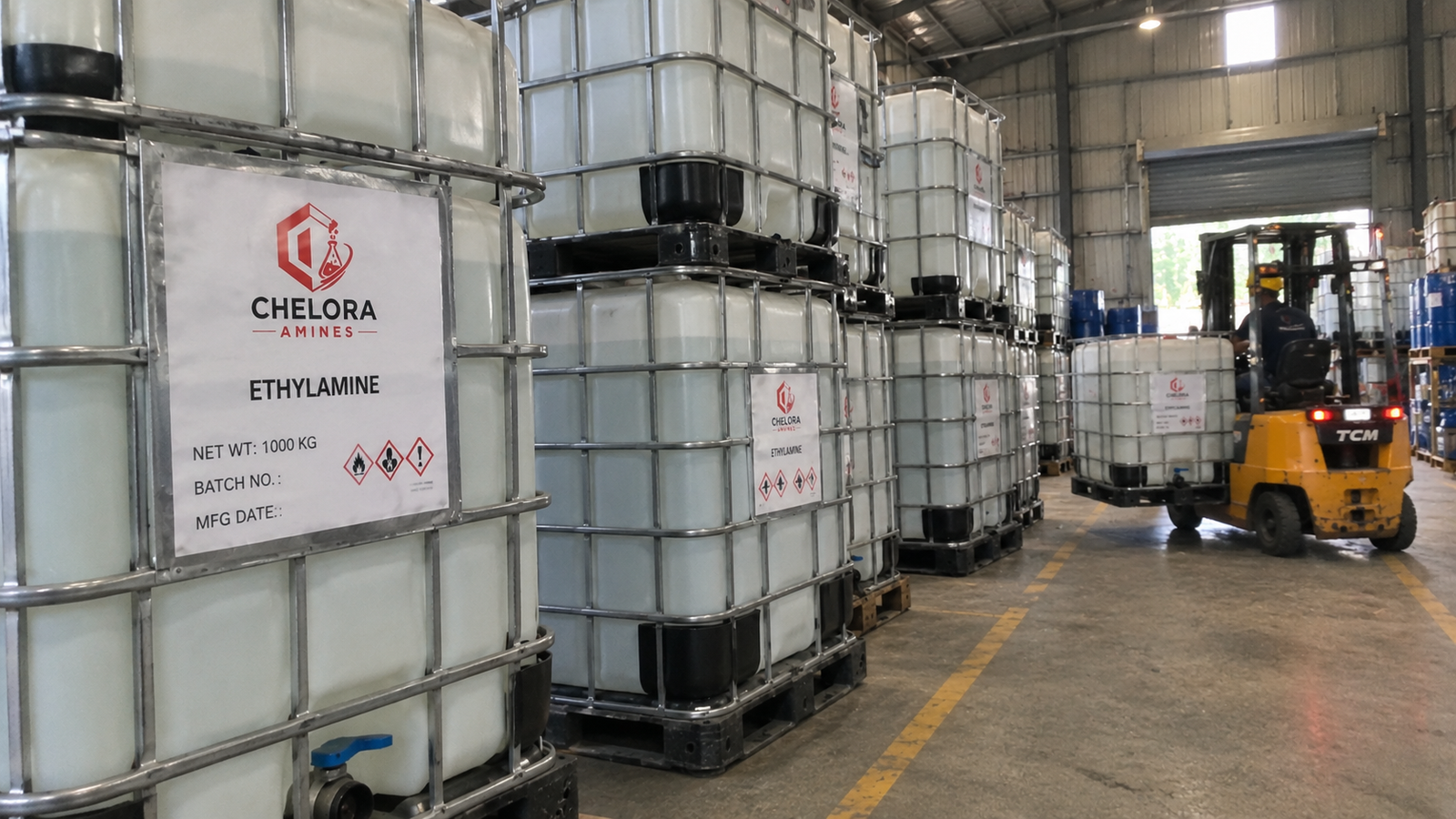
Solutions are supplied in 25 L HDPE carboys, drums of about 160 kg net and 1000 L IBC totes. Anhydrous ethylamine is supplied in pressure cylinders, tonners and ISO tanks. Laboratory grades are available in 2.5 L, 5 L and 25 L packs.
How should ethylamine be stored and handled?
Store in a cool, dry, well-ventilated area away from sunlight, heat and ignition sources, with containers closed and the area bunded. Keep it away from acids, oxidisers, halogens and hypochlorites. Use stainless steel, carbon steel or HDPE and avoid copper, brass, zinc and galvanised surfaces. Handle with splash goggles, chemical-resistant gloves and an apron, with local exhaust ventilation, an eyewash and a safety shower nearby. Work to the SDS supplied with your consignment.
Is ethylamine hazardous to transport?
Yes, it is a regulated dangerous good. The aqueous solution at 50 to 70 percent ships under UN 2270 as Class 3 with a subsidiary Class 8 risk, and anhydrous ethylamine ships under UN 1036 as a Class 2.1 flammable gas. Packs are labelled accordingly and export consignments go in UN-specification packaging with the correct hazard labelling and paperwork.
What is the HS code for ethylamine?
Ethylamine is classified under harmonised heading 2921 19, which covers other acyclic monoamines and their derivatives. National tariffs add a further two to four digits, and the full code for your destination is stated on the export documents and on the domestic invoice so GST input credit and customs clearance are not held up.
What documents come with an order?
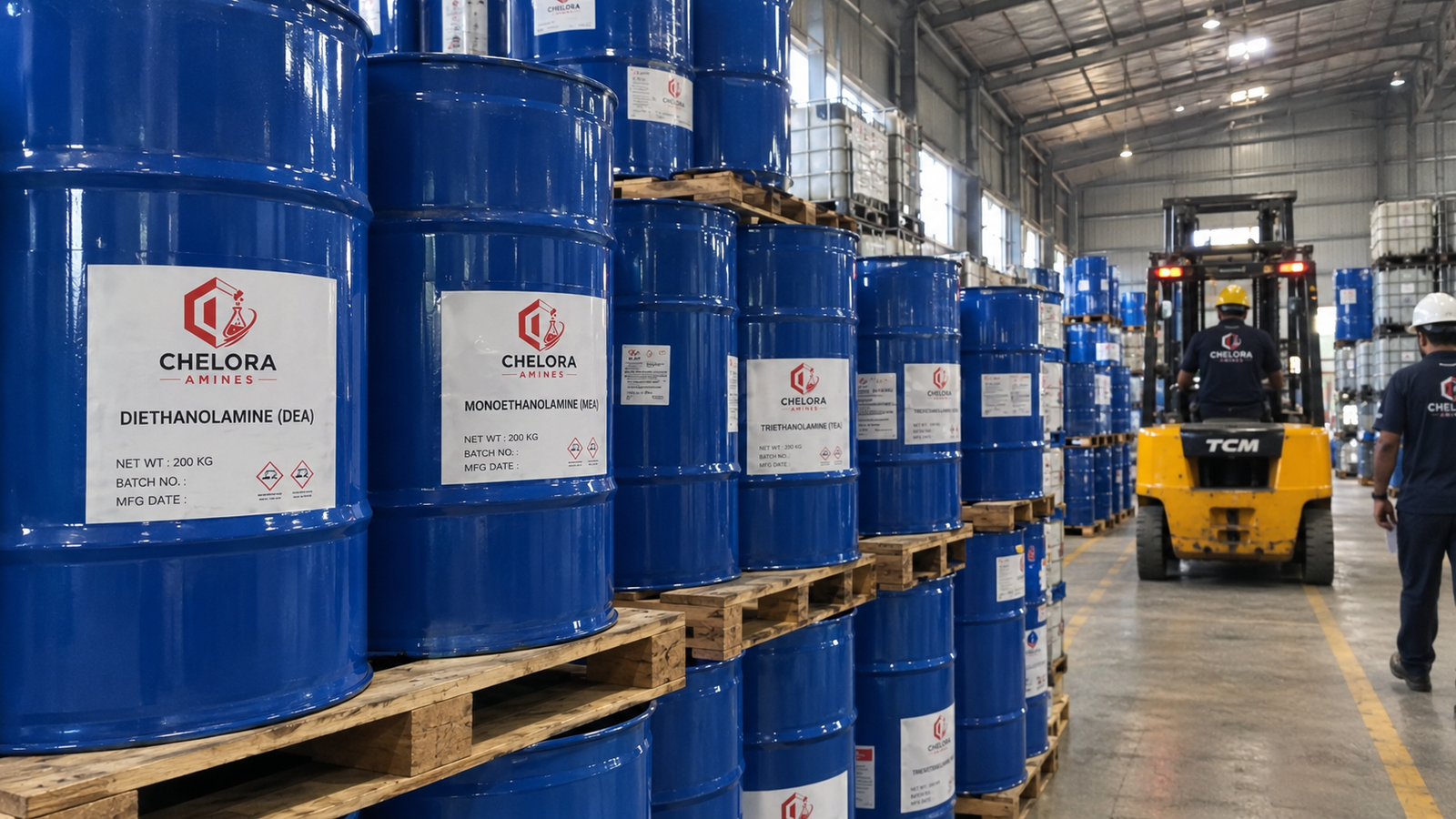
Every dispatch carries a batch-wise Certificate of Analysis, the Safety Data Sheet, HSN details on the invoice, and labels showing the strength, net weight, batch number, manufacturing date and UN number. Export orders also carry the shipping documentation for the destination.
Do you supply trial quantities of ethylamine?
Yes. A 25 L carboy or a small laboratory pack can be arranged so your team can qualify the material before placing a regular order.
Request a sample with your application and solvent details.
Which countries do you supply ethylamine to?
We ship worldwide. Regular destinations include the Middle East and Africa, South and South East Asia, East Asia, Australia and New Zealand, Europe and the CIS, and North and South America, alongside domestic supply throughout India. Shipments move in container loads through Nhava Sheva and Mundra, packed to UN specification with the correct hazard labelling, and we quote on EXW, FOB, CFR, CIF or DAP terms.
What is the shelf life of ethylamine solution?
In sealed original packing kept cool and out of sunlight, twelve months is the normal working figure. The material does not spoil so much as drift — air and carbon dioxide ingress raise the APHA colour and form carbonate — so keep drums closed between draws. Before a critical batch from older stock, re-check assay and colour, or ask us to test a retained sample.
Can I order on a 100% ethylamine basis instead of solution weight?
Yes, and it is often the clearer way to buy. One tonne of the 70% aqueous solution contains 700 kg of ethylamine, so comparing a solution price against an anhydrous price only works once both are converted to the 100% basis. Tell us which basis your requirement is written on and we will quote the same way.
Why does my drum build pressure, and what should I do?
Ethylamine boils at 16.6 °C, so vapour pressure rises quickly once the container warms past a cool morning. Store packs in a cool, shaded, ventilated area, never apply heat to a sealed container, and open closures slowly and away from your face, ideally when the pack is at its coolest. Bulk tanks should be relief-protected and nitrogen blanketed.
Do you also supply ethylamine hydrochloride?
Yes, ethylamine hydrochloride (CAS 557-66-4) can be supplied on request. It is the solid salt form, easier to weigh and store than the solution, and is often preferred for laboratory and small-scale pharmaceutical work. Ask for it by name and quantity and we will quote pack sizes and lead time.
What is the minimum order quantity and the usual lead time?
A single 25 litre carboy is enough to start for trial and qualification work; production orders normally move in drums, IBC totes or container loads. Ex-stock domestic dispatches typically leave within a few working days of order confirmation, and export or made-to-specification campaigns need longer depending on packing, permits and shipping schedules. We confirm the lead time on the quotation.
Which materials can I use for pumps, pipework and storage?
Stainless steel, carbon steel and HDPE are generally suitable, with PTFE gaskets and seals. Avoid copper, brass, bronze, zinc and galvanised surfaces — amines attack copper alloys, and the usual symptom is a failed pump or discoloured product rather than any problem with the chemical itself. Earth and bond equipment during transfer, because the vapour is flammable.
Which Indian states do you deliver ethylamine to?
We dispatch by road from Mumbai to
Maharashtra,
Gujarat,
Telangana,
Andhra Pradesh,
Tamil Nadu,
Karnataka,
Kerala,
Madhya Pradesh,
West Bengal,
Punjab,
Haryana,
Uttar Pradesh,
Uttarakhand,
Himachal Pradesh,
Rajasthan and
Delhi.
How do I get a price for ethylamine?
Send the form and strength you need, the grade, quantity, pack size and delivery location through our
contact page, by email to source@cheloraamines.com or by phone on +91 98191 11179. A complete enquiry usually gets a quote within 24 hours.