Amide formation
With acid chlorides, anhydrides and esters it gives N-butyl amides, the single most common use of the amine in pharmaceutical and crop-protection synthesis.
RCOCl + BuNH₂ → RCONHBu
Butan-1-amine · mono-n-butylamine · ≥99.5% commercial, LR and AR grades
n-Butylamine is the straight-chain four-carbon primary amine, the workhorse of the butylamine family and the one bought in the largest volume. Chelora Amines supplies it worldwide — to rubber chemical, agrochemical, pharmaceutical, dye, leather and emulsifier plants across Asia, the Middle East, Africa, Europe and the Americas, as well as throughout India. Packed in carboys, drums, IBC totes or bulk, shipped in UN-specification packaging with a batch-wise COA and SDS.
48.04 + 9.07 + 14.01 + 2.02 = 73.14 g/mol
n-Butylamine, also written as butan-1-amine or mono-n-butylamine, is a clear, colourless, flammable liquid with the sharp ammoniacal odour of the lower alkyl amines. It is completely miscible with water and with most organic solvents, and it boils high enough — just under 80 °C — to be noticeably easier to handle than the propylamines.
That extra boiling headroom is one reason it is the most widely used of the four butylamine isomers. A reaction can be run at reflux in an open, vented system, a drum does not pressurise on a warm afternoon the way a propylamine drum does, and the amine is still volatile enough to strip out under vacuum at the end of the batch.
Chemically the nitrogen is unhindered and strongly basic, with a conjugate acid pKa around 10.8. That combination makes n-butylamine a dependable nucleophile for amide, sulfonamide and urea formation, a good acid scavenger, and the standard starting point for the N-butyl group that appears throughout rubber chemicals, dyes, pesticides and sulfonylurea drugs.
It is manufactured by reacting n-butanol with ammonia over an acidic or supported metal catalyst, or by reductive amination of butyraldehyde. Both routes make di-n-butylamine and tri-n-butylamine alongside the primary amine, so every specification controls them together with residual ammonia and water.
| Chemical name | n-Butylamine (butan-1-amine) |
| Common synonyms | Mono-n-butylamine, 1-aminobutane, butylamine, n-BA |
| CAS number | 109-73-9 |
| EC / EINECS number | 203-699-2 |
| HS / HSN code | 2921 19 (acyclic monoamines and derivatives) |
| Molecular formula | CH₃(CH₂)₃NH₂ (C₄H₁₁N) |
| Molecular weight | 73.14 g/mol |
| Appearance | Clear, colourless, mobile liquid |
| Odour | Strong ammoniacal, fish-like |
| Melting point | About −49 °C |
| Boiling point | 77–79 °C |
| Density | About 0.740 g/cm³ at 20 °C |
| Vapour pressure | About 82–95 mbar at 20 °C |
| Flash point | About −12 °C (closed cup) |
| Auto-ignition temperature | About 312 °C |
| Flammability limits in air | Approximately 1.7 – 9.8 vol % |
| Solubility in water | Completely miscible |
| pKa of conjugate acid | About 10.8 at 25 °C |
| Refractive index | About 1.401 at 20 °C |
| pH | Strongly alkaline in aqueous solution |
| UN number | UN 1125, Class 3 with subsidiary risk 8, packing group II |
Figures are typical literature values for orientation. Values for the material you order are stated on its Certificate of Analysis and Safety Data Sheet.
n-Butylamine is bought for the same two reasons as the shorter amines — a strongly basic, accessible nitrogen — with the practical bonus of a higher boiling point. These are the reactions it is used to run.
With acid chlorides, anhydrides and esters it gives N-butyl amides, the single most common use of the amine in pharmaceutical and crop-protection synthesis.
RCOCl + BuNH₂ → RCONHBuReacts with sulfonyl chlorides to give N-butyl sulfonamides — the core of the sulfonylurea antidiabetic drugs and of several herbicide families.
RSO₂Cl + BuNH₂ → RSO₂NHBuWith carbon disulfide and a base it gives butyl dithiocarbamates used as rubber vulcanisation accelerators, fungicides and metal-flotation collectors.
CS₂ + BuNH₂ → dithiocarbamateAdds across isocyanates to give N-butyl ureas, and reacts with chloroformates to give carbamates that appear in herbicides and insecticides.
RNCO + BuNH₂ → ureaCondenses with aldehydes and ketones and is reduced in situ to secondary N-butyl amines used in surfactants, inhibitors and API side chains.
R₂C=O + BuNH₂ → R₂CH–NHBuDisplaces halide from alkyl and activated aryl halides, with over-alkylation controlled by an excess of amine and a lower temperature.
R–X + BuNH₂ → R–NHBuNeutralises fatty and mineral acids to give butylammonium soaps used as emulsifiers, corrosion inhibitors and leather auxiliaries.
RCOOH + BuNH₂ → saltWith the highest conjugate acid pKa of the common alkyl amines, around 10.8, it holds pH steady while the main chemistry runs.
pKa ≈ 10.8 at 25 °CProcess notes. Additions are exothermic and the heat of neutralisation with a strong acid is considerable, so dose under control with cooling in place. The higher boiling point makes refluxing straightforward, but the flash point is still −12 °C, so vapour is flammable at ambient and all transfers need earthing, bonding and ventilation. Excess amine strips cleanly under vacuum at the end of the batch.
Discuss your processCommercial n-butylamine comes from catalytic amination of n-butanol, or from reductive amination of butyraldehyde. Either way the mono, di and tri amines leave the reactor together, which is what the specification is written around.
n-Butanol, or butyraldehyde on the reductive route, is vaporised and mixed with a large excess of ammonia to favour the mono-substituted amine.
The mixture passes over an acidic alumina or a supported nickel, copper or cobalt catalyst at elevated temperature and pressure, with hydrogen on the reductive route.
The reactor produces n-butylamine together with di-n-butylamine, tri-n-butylamine, water, unconverted butanol and unreacted ammonia.
Ammonia is recovered and recycled, and a distillation train separates the mono, di and tri amines. Heavy and light cuts return to the reactor rather than being discarded.
Product is dried, tested for assay, isomers, water and colour, then filled under nitrogen into carboys, drums, totes or bulk containers.
Di-n-butylamine is the impurity that matters most in practice. It is a secondary amine, so in a reaction designed around a primary amine it gives a tertiary by-product that is often hard to separate from the wanted product, and in a dithiocarbamate or sulfonamide step it consumes reagent without giving the target molecule.
Tri-n-butylamine is tertiary and simply reports as unusable mass, free ammonia competes for the same electrophile, and isobutylamine — where the plant also runs the branched product — can carry through and change the crystal habit of a finished salt. If your step is sensitive to any of these, state the limit at enquiry stage.
Twelve months in sealed original packing, stored cool and out of sunlight, is the normal working figure, with a re-check of assay, water and colour after that before a critical batch. n-Butylamine is less volatile than the propylamines, so evaporation loss is smaller, but the same carbon dioxide pickup raises APHA colour and throws a carbamate haze.
Keep drums closed between draws, blanket tanks with nitrogen where you can, and keep packs out of direct sun. A retained sample of every batch is held here, so a query months later can be settled against the original material.
Tell us the reaction and the limits that matter and we will confirm the grade. Commercial grade covers most production use; LR and AR grades are available for laboratory, method development and analytical work.
The standard production grade for rubber chemicals, agrochemical intermediates, dyes and emulsifiers.
Tighter limits on di-n-butylamine, water and colour for development chemistry and pilot batches.
The tightest grade we offer, for analytical method work, standards and QC laboratories.
Selected or made against your own limits on isomers, ammonia, water or colour where a step is sensitive.
| Parameter | Test method | Typical specification |
|---|---|---|
| Appearance | Visual | Clear, colourless liquid, free from suspended matter |
| Assay (n-butylamine) | GC | ≥ 99.5 % w/w |
| Di-n-butylamine | GC | ≤ 0.3 % w/w |
| Tri-n-butylamine | GC | ≤ 0.1 % w/w |
| Isobutylamine | GC | ≤ 0.2 % w/w |
| Free ammonia | GC / titration | ≤ 0.2 % w/w |
| Water | Karl Fischer | ≤ 0.3 % w/w |
| Colour | APHA | ≤ 15 |
| Non-volatile matter | Gravimetric | ≤ 0.05 % w/w |
| Density at 20 °C | Densitometer | 0.737 – 0.743 g/cm³ |
| Iron (Fe) | AAS | ≤ 2 ppm |
Indicative specification for planning. The controlling document is the Certificate of Analysis issued for your batch. If your process needs tighter limits on isomers, water or colour, say so at enquiry stage and we will quote against your specification.
C₄H₁₁N describes four different molecules. They differ in where the nitrogen sits and how crowded it is, and that changes reactivity, boiling point and the behaviour of every derivative made from them. Ordering “butylamine” without the prefix is the most common and most expensive mistake in this family.
| Property | n-Butylamine | Isobutylamine | sec-Butylamine | tert-Butylamine |
|---|---|---|---|---|
| CAS number | 109-73-9 | 78-81-9 | 13952-84-6 | 75-64-9 |
| Structure | Straight chain, NH₂ on carbon 1 | Branched chain, NH₂ on a primary carbon | NH₂ on the second carbon, chiral | NH₂ on a fully substituted carbon |
| Amine class | Primary, unhindered | Primary, slightly hindered | Primary, hindered and chiral | Primary, strongly hindered |
| Boiling point | 77–79 °C | 67–69 °C | 62–64 °C | 44–46 °C |
| pKa of conjugate acid | ≈ 10.8 | ≈ 10.4 | ≈ 10.6 | ≈ 10.7 |
| Reactivity at nitrogen | Highest of the four | Slightly lower | Lower, and stereochemistry matters | Lowest — used where bulk is wanted |
| Typical outlets | Rubber accelerators, pesticides, dyes, emulsifiers, sulfonylureas | Pharma and agro intermediates, surfactants, fragrances | Post-harvest fungicides, triazine herbicides, chiral intermediates | TBBS rubber accelerator, MTBE chemistry, pharma |
Order by full name and CAS number. Write the full chemical name with the CAS number on the enquiry and the purchase order. “BA” and “butylamine” are read differently by different suppliers, and four products in this family look identical on a delivery note.
See the full amine rangen-Butylamine is almost entirely a synthesis intermediate, and it appears in more finished-product families than any other butylamine. Here is the picture sector by sector.
The feedstock for butyl dithiocarbamate and thiazole accelerators, antioxidants and antiozonants used in tyres, belting, footwear and moulded goods.
An intermediate for herbicides, fungicides and insecticides, including sulfonylurea and carbamate chemistry, and a salt former for liquid formulations.
Supplies the N-butyl group in sulfonylurea antidiabetics, diuretics, anaesthetics and a range of amide and sulfonamide intermediates.
Used to introduce a butylamino group into azo, anthraquinone and phthalocyanine intermediates, and in optical brighteners and ink additives.
Neutralises fatty acids to give butylammonium soaps and emulsifiers used in textile auxiliaries, polishes, leather finishing and agricultural adjuvants.
Goes into oilfield and refinery inhibitor packages, fuel additives and the alkalinity and inhibition system of water-miscible cutting fluids.
An intermediate for cationic polymers, biocides, scale inhibitors and neutralising amine blends for boiler and cooling circuits.
Used in leather tanning auxiliaries, as a chain terminator and catalyst in polymer and epoxy chemistry, and as a general base and derivatising reagent.
If you are mapping a value chain, or looking for the product one step down from where you are, this is where n-butylamine ends up. Several of these are chemicals we can also source for you.
| Derivative | Made by | End use |
|---|---|---|
| Butyl dithiocarbamates | Reaction with carbon disulfide and a base | Rubber vulcanisation accelerators, fungicides and flotation collectors |
| N-Butyl sulfonamides | Reaction with sulfonyl chlorides | Sulfonylurea antidiabetic drugs and herbicide intermediates |
| N-Butyl amides | Acylation with acid chlorides, anhydrides or esters | Pharmaceutical and agrochemical actives |
| N-Butyl ureas and carbamates | Addition to isocyanates or chloroformates | Herbicides, insecticides and polyurethane modifiers |
| Di-n-butylamine | Further alkylation or direct manufacture | Accelerators, corrosion inhibitors and extraction chemicals |
| Butylammonium soaps | Neutralisation of fatty acids | Emulsifiers, polishes, textile and leather auxiliaries |
| N-Butyl amino alcohols | Ring opening of epoxides | Surfactants, chelants and coating additives |
| Butylamino dye intermediates | Aromatic substitution | Reactive, disperse and solvent dyes and optical brighteners |
| Quaternary ammonium compounds | Exhaustive alkylation | Biocides, antistatic agents and phase-transfer catalysts |
| Cationic polymers | Polycondensation with epichlorohydrin-type reagents | Flocculants, wet-strength resins and colour removal chemicals |
Looking for one of these rather than the amine itself? Ask us — several sit within our sourcing network, and we can quote the derivative and the raw material together.
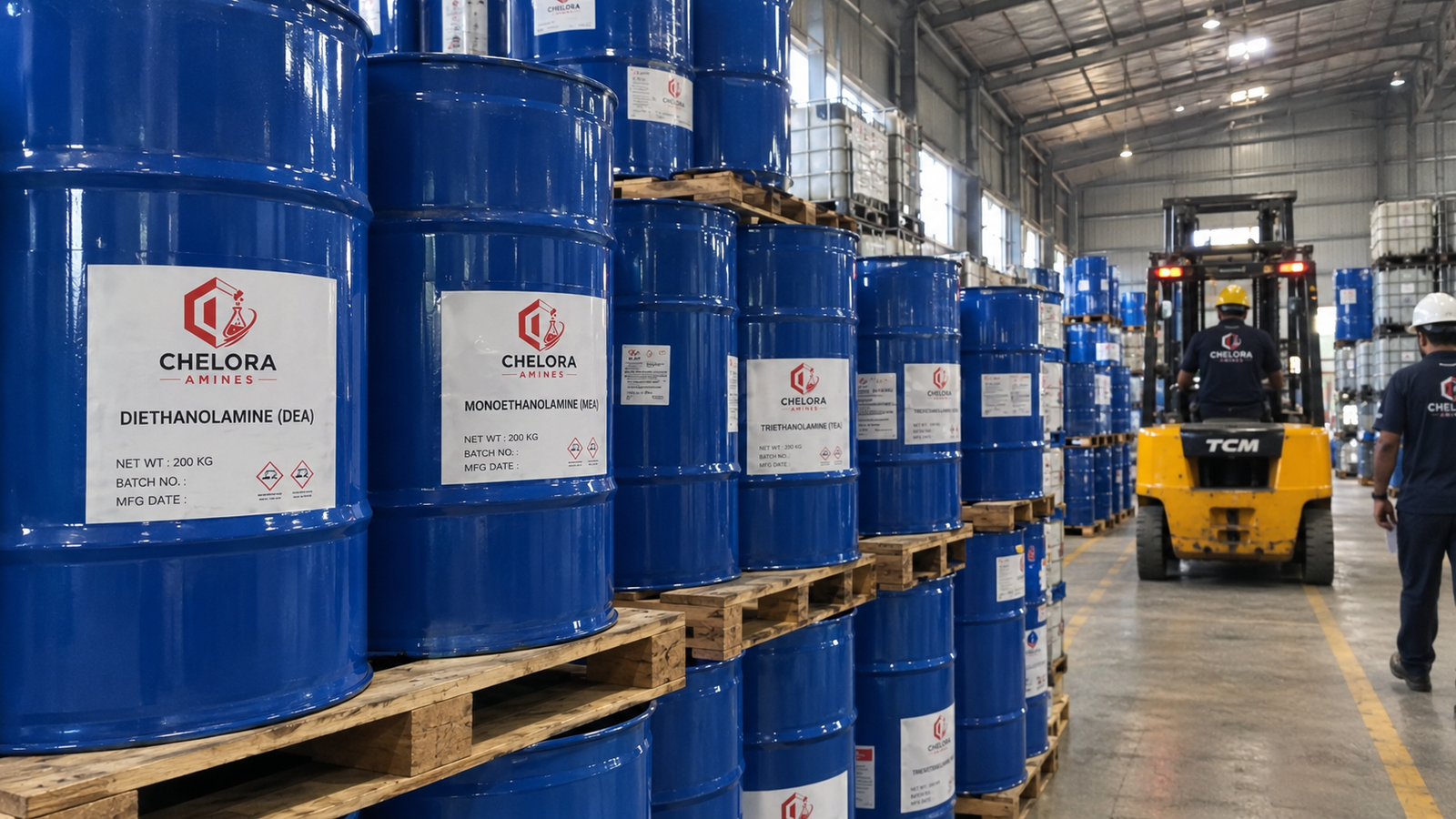
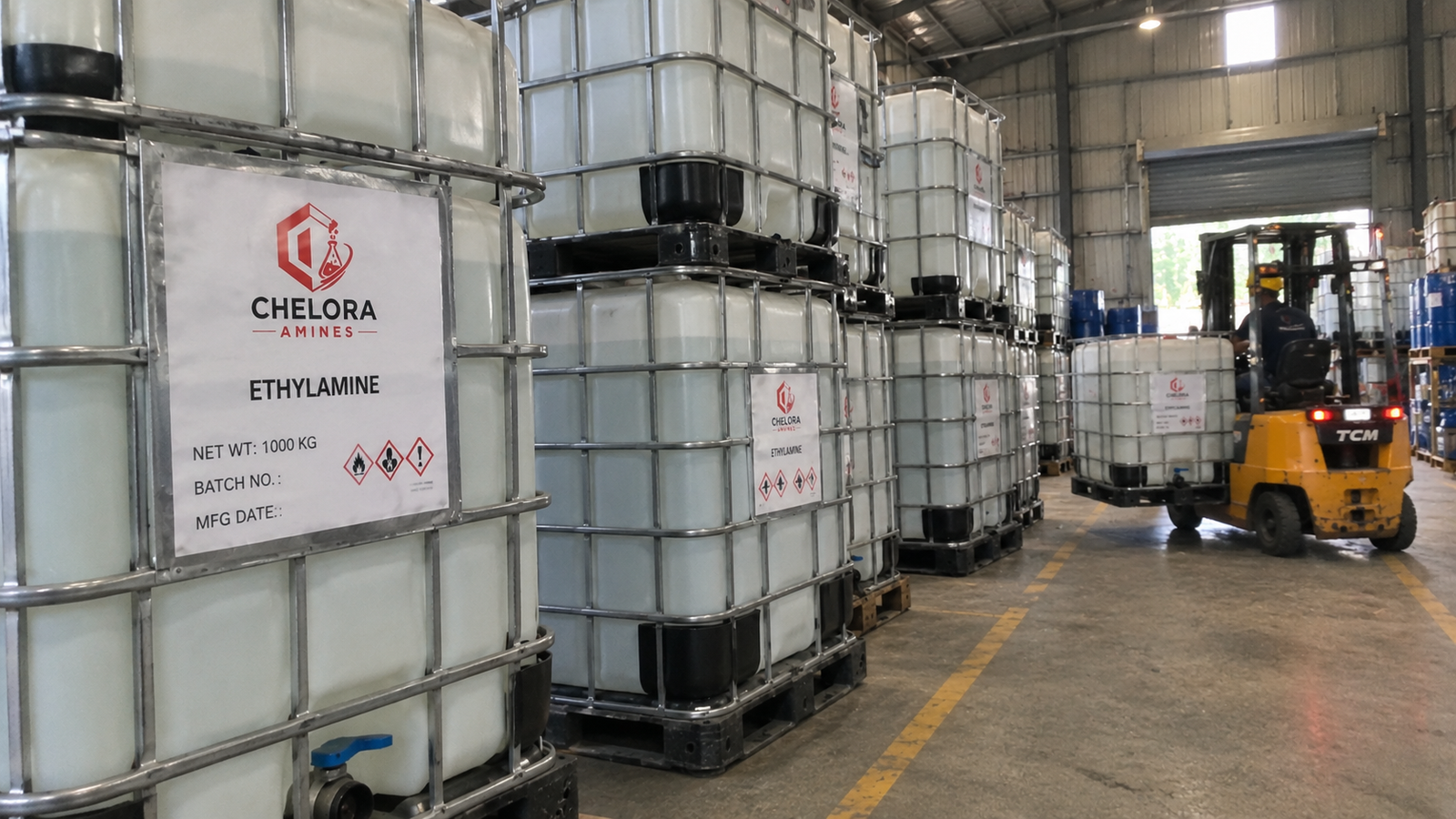
Every container carries the Chelora Amines label with product name, net weight, batch number, manufacturing date, UN number and hazard pictograms.
HDPE carboys for lab qualification, pilot batches and low-consumption users.
MS and HDPE drums, the standard production pack, with tamper-evident closures.
Forklift-ready totes with bottom valves for plants drawing material every week.
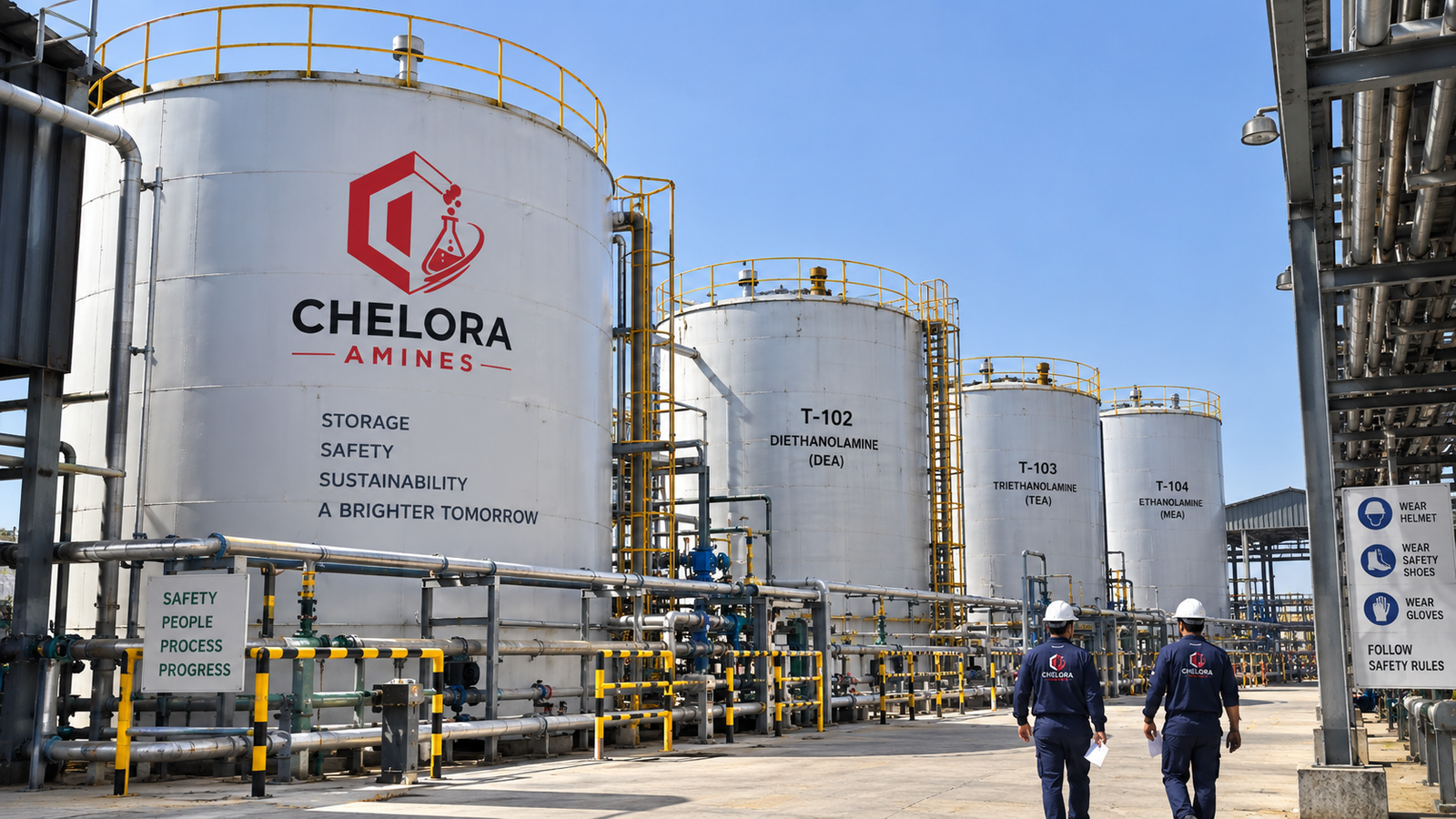
Bulk loads and ISO tank containers for continuous plants and large campaigns.
Tell us the monthly draw, the reaction the amine feeds and how you store flammables, and we will recommend the pack size and a delivery schedule that keeps production running without excess inventory. Export consignments are packed in UN-specification drums and totes, palletised and stretch-wrapped, and shipped FOB, CIF or CFR through Nhava Sheva and Mundra.
Plan my supplyn-Butylamine is a flammable, corrosive base with a flash point below zero. It is easier to handle than the propylamines only in the sense that it boils higher — every other control still applies. The notes below are a summary for planning; work to the Safety Data Sheet supplied with your consignment.
n-Butylamine is a regulated dangerous good in every mode of transport. The classification is routine for us, but it shapes the packaging, the paperwork and what we need from you before a first shipment moves.
| Proper shipping name | n-Butylamine |
| UN number | UN 1125 |
| Hazard class | Class 3 flammable liquid, subsidiary risk 8 corrosive |
| Packing group | II |
| Labels | Flame and corrosion pictograms, with orientation marks on combination packs |
| Modes | Road, rail and sea (IMDG); air movement within dangerous goods quantity limits |
| Segregation | Away from acids, oxidisers, halogens, hypochlorites and foodstuffs |
| Packaging | UN-specification drums, carboys and IBC totes, palletised and strapped for export |
We supply n-butylamine business to business only, against verified company credentials, consignee details and a stated industrial end use, plus any import permit the destination country requires. That keeps shipments moving through customs without delay and protects both sides.
Start account opening| Parameter | Specification | Result |
|---|---|---|
| Appearance | Clear, colourless liquid | Complies |
| Assay (GC) | ≥ 99.5 % | Complies |
| Di-n-butylamine | ≤ 0.3 % | Complies |
| Water (KF) | ≤ 0.3 % | Complies |
| Colour (APHA) | ≤ 15 | Complies |
n-butylamine is checked before dispatch and each consignment leaves with the paperwork your QC, stores and accounts teams need on day one.
The numbers on a Certificate of Analysis are only useful if you know how they were produced. These are the methods behind the figures on ours, and the checks worth repeating at your own goods-inward.
Separates n-butylamine from its isomers, homologues and residual ammonia in one run, and gives both the assay and the impurity profile that matter to your reaction.
An independent check on total amine content, useful as a quick goods-inward confirmation before a drum is released to production.
Water determination, which matters wherever the next step is moisture sensitive or the amine feeds an anhydrous reaction.
A visual platinum–cobalt comparison. A rising colour value is the earliest sign that a pack has been exposed to air or held too long.
Fast confirmation of identity and strength, and a simple way to spot a wrong pack or a contaminated drum.
Gravimetric residue and trace metal checks, which matter for catalytic steps and for any product going into a regulated formulation.
A sample from every dispatched batch is held here, so a query months later can be settled against the original material rather than an argument.
The batch number on the label ties back to the COA, the test record and the supply lot, which is what your auditor will ask to see.
Where your customer or regulator needs an independent result, we can arrange analysis at a NABL-accredited laboratory before dispatch.
Five steps for a first order of n-butylamine. Repeat orders follow the same route on a schedule that matches your consumption.
Grade, quantity, pack size and delivery location.
We confirm the grade for your process and quote, usually within 24 hours.
The batch is tested and the COA, SDS and invoice details are prepared.
Labelled packs move by road, or in UN-spec packaging for export.
Material reaches your gate and repeat dispatches are scheduled to your usage.
n-butylamine is a line on a price list and a headache in a warehouse. What separates suppliers is the grade flexibility, the paperwork and the answer you get when something is not routine.
n-Butylamine sits alongside the rest of our amine range, from ethanolamines to fatty amines. Your purchase team raises one enquiry, compares one quote and manages one vendor record instead of six.
Commercial, LR and AR material is available, so you are not forced to redesign a step around the only grade your supplier happens to carry.
COA, SDS, correct HSN and HS codes, dangerous goods declarations and certificates of origin are prepared with the consignment, not chased afterwards by your logistics team.
Tell us your limits on isomers, water, ammonia or colour and we quote against them, rather than sending the standard cut and letting your QC department find out.
Once we know your monthly draw we hold and release material on a schedule, so you carry less inventory of a flammable, corrosive product than you otherwise would.
Describe the reaction rather than the product code and we will tell you which grade fits — and say so plainly when a different amine would serve you better.
Buyers who order n-butylamine usually source these from the same list. Open any product for its specification, grades and packing, or see the full product range.
Container shipments to buyers on five continents, plus road dispatch inside India. Tell us your country and destination port and we will quote landed terms, transit time and the documentation your customs broker will ask for.
United Arab Emirates, Saudi Arabia, Oman, Qatar, Kuwait, Bahrain, Jordan, Egypt, Morocco, Kenya, Tanzania, Ethiopia, Nigeria, Ghana and South Africa.
Bangladesh, Sri Lanka, Nepal, Pakistan, Vietnam, Thailand, Indonesia, Malaysia, Singapore, the Philippines, South Korea, Japan, Taiwan, Australia and New Zealand.
Germany, the Netherlands, Belgium, France, Italy, Spain, Portugal, Poland, Czechia, the United Kingdom, Ireland, Türkiye, Russia, Ukraine, Kazakhstan and Uzbekistan.
United States, Canada, Mexico, Brazil, Argentina, Chile, Colombia, Peru, Ecuador and the Caribbean, shipped in UN-specification packaging with full DG documentation.
| Incoterms quoted | EXW, FOB, CFR, CIF and DAP, depending on your destination and preference |
| Load ports | Nhava Sheva (JNPT) and Mundra, with Chennai and Kolkata used for eastbound routings |
| Container options | Full container loads, and consolidated LCL shipments for smaller quantities |
| Typical container fill | Around 80 drums, or roughly 18 to 20 IBC totes, in a 20 ft container |
| Packing for export | UN-specification drums and totes, palletised, strapped and stretch-wrapped, with DG labelling |
| Air freight | Possible for small quantities within dangerous goods limits; most volume moves by sea |
| Payment terms | Advance, irrevocable letter of credit or agreed credit terms for established accounts |
| Before first shipment | Company credentials, end-use declaration and any import permit the destination country requires |
Road dispatch from our Mumbai base to industrial clusters in 16 states and Delhi. Open your state for the local industries we serve and the amines they order most.
Most delays in quoting n-butylamine come from a missing line in the enquiry, not from availability. Send these details and a firm price usually comes back the same day.
Not sure of some of it yet? Send what you have. A description of the reaction step and an approximate monthly volume is enough for us to come back with a recommended grade, a pack plan and an indicative price.
Send an enquiryPlain definitions of the words that appear on a n-butylamine specification, label and shipping document.
Short answers to what purchase, plant and QC teams ask us most about this product. Anything else, ask us directly.
Send the grade, quantity, pack size and your delivery address or destination port. We come back with a price, the documents that go with the batch and a dispatch or shipping plan, usually within 24 hours.