Need a quote?+91 9819 11 11 79
Request a Quote
Aliphatic amines · CAS 74-89-5

Methylamine supplier and exporter

Monomethylamine (MMA) · 40% aqueous solution, alcoholic solutions and anhydrous gas

Methylamine is the simplest primary aliphatic amine and the standard way to put an N-methyl group into a molecule. Chelora Amines supplies it worldwide — to pharmaceutical, agrochemical, solvent, surfactant and water-treatment plants across Asia, the Middle East, Africa, Europe and the Americas, as well as throughout India. Packed in carboys, drums, IBC totes or cylinders, shipped in UN-specification packaging with a batch-wise COA and SDS.

Molecular formulaCH₃NH₂ (CH₅N)
Molecular weight31.06 g/mol
Boiling point (anhydrous)−6.3 °C
Usual commercial form40% w/w in water
Commercial, LR and AR grades Batch-wise COA with every dispatch Shipped from Mumbai to customers worldwide
CH₃NH₂ CAS 74-89-5 H H H H H C N lone pair reacts as a base here CH₃ NH₂
  • C One carbon atom, the centre of the methyl group 12.01
  • H₃ Three hydrogens filling the carbon's remaining bonds 3 × 1.008
  • N One nitrogen, carrying the lone pair that makes it a base 14.01
  • H₂ Two hydrogens on that nitrogen, still free to react 2 × 1.008

12.01 + 3.02 + 14.01 + 2.02 = 31.06 g/mol

Methanamine, CH₃NH₂ — a primary amine Replace one hydrogen of ammonia (NH₃) with a methyl group and you have methylamine. Two N–H bonds remain free, and the pKa of the conjugate acid is 10.66, so it is a stronger base than ammonia.
74-89-5CAS number
2921 11HS / HSN tariff code
≥ 99.5%Anhydrous purity, typical
40% w/wStandard aqueous strength
WorldwideDomestic supply and export
24 hrsTypical quote response
What it is

Methylamine at a glance

Methylamine, also written as monomethylamine or MMA, is ammonia with one hydrogen replaced by a methyl group. That single change makes the nitrogen more electron-rich and more nucleophilic than ammonia, which is exactly why the chemical industry uses it: it attaches a methyl-substituted nitrogen to a molecule in one step.

In its pure form it is a colourless gas at room temperature with a sharp, fish-like ammoniacal smell, so almost nobody buys it as a gas unless they have the pressure handling to match. The practical forms are a 40% solution in water, a 25–33% solution in methanol, ethanol or THF for moisture-sensitive reactions, and anhydrous liquefied gas in cylinders and ISO tanks for large synthesis plants.

Industrially it is made by passing methanol and ammonia over an acidic alumina or zeolite catalyst at 350–500 °C. The reaction produces methylamine, dimethylamine and trimethylamine together, and the three are separated by distillation — which is why the same producers usually supply all three, and why purity specifications always state the dimethylamine and trimethylamine content.

Why buyers choose methylamine

  • Strong, clean base. The conjugate acid has a pKa of 10.66, so it neutralises acids and scavenges HCl reliably in synthesis.
  • Small and reactive. A low molecular weight of 31.06 means a high mole-per-kilogram yield compared with heavier amines.
  • Flexible form. Aqueous for general chemistry, alcoholic for anhydrous conditions, gas for continuous plants.
  • Well-defined specifications. Assay, free ammonia, dimethylamine and trimethylamine are all controlled and reported.
Identification and physical properties
Chemical nameMethylamine (methanamine)
Common synonymsMonomethylamine, MMA, aminomethane, carbinamine, mono-methyl amine
CAS number74-89-5
EC / EINECS number200-820-0
HS / HSN code2921 11 (harmonised heading used worldwide; HSN 2921 11 on Indian invoices)
Molecular formulaCH₃NH₂ (CH₅N)
Molecular weight31.06 g/mol
AppearanceColourless gas; clear colourless liquid as a solution
OdourStrong fish-like, ammoniacal
Melting point−93.5 °C
Boiling point−6.3 °C (anhydrous)
Density0.656 g/cm³ (liquefied, 25 °C); about 0.90 g/cm³ for the 40% aqueous solution
Vapour pressureAbout 2.6–3.1 bar at 20–25 °C (anhydrous)
Solubility in waterCompletely miscible, roughly 1080 g/L at 20 °C
pKa of conjugate acid10.66 at 25 °C
pHStrongly alkaline in aqueous solution
Flammability limits in airApproximately 4.9 – 20.7 vol %
Auto-ignition temperatureAbout 430 °C
UN numberUN 1061 (anhydrous, Class 2.1); UN 1235 (aqueous solution, Class 3 with subsidiary 8)

Figures are typical literature values for orientation. Values for the material you order are stated on its Certificate of Analysis and Safety Data Sheet.

Chemistry and reactivity

How methylamine behaves in a reaction

Two properties explain almost everything methylamine is used for: the nitrogen lone pair makes it a strong base, and the small methyl group leaves that nitrogen open and nucleophilic. These are the reaction types process chemists reach for it to do.

Salt formation

Reacts with mineral and organic acids to give water-soluble methylammonium salts. This is how methylamine hydrochloride is made, and how it is used to buffer acidic streams or form agrochemical salts for liquid formulations.

CH₃NH₂ + HCl → CH₃NH₃⁺Cl⁻

Amide formation

With acid chlorides, anhydrides and esters it forms N-methyl amides — one of the most common single steps in pharmaceutical and agrochemical synthesis. An excess of amine or a separate base soaks up the acid released.

RCOCl + CH₃NH₂ → RCONHCH₃

Reductive amination

Condenses with aldehydes and ketones to give an imine that is reduced in situ to a secondary N-methyl amine. Alcoholic methylamine solutions are preferred here, because water shifts the imine equilibrium backwards.

R₂C=O + CH₃NH₂ → R₂CH–NHCH₃

Ring opening of epoxides

Opens epoxides cleanly at the less hindered carbon to give N-methyl amino alcohols, used as intermediates for surfactants, chelants, coating additives and cationic polymers.

epoxide + CH₃NH₂ → amino alcohol

Urea and carbamate chemistry

Adds across isocyanates to give substituted ureas, and reacts with carbonates and chloroformates to give N-methyl carbamates — the backbone of a whole class of insecticides and of several drug intermediates.

RNCO + CH₃NH₂ → RNHCONHCH₃

Heterocycle building

Supplies the N-methylated nitrogen in rings such as N-methylpyrrolidone, N-methylimidazoles, N-methylpiperazines and N-methylated pyrazoles, usually by cyclising with a lactone, diketone or dihalide.

GBL + CH₃NH₂ → NMP

Nucleophilic substitution

Displaces halide from alkyl and activated aryl halides to give secondary amines. Over-alkylation is the usual risk, and it is controlled by running a large excess of methylamine and keeping the temperature down.

R–X + CH₃NH₂ → R–NHCH₃

Acid scavenging

Because the conjugate acid has a pKa of 10.66, methylamine mops up HCl and other acids generated during a reaction, keeping the pH where the main chemistry works. Cheaper by the mole than most alternatives.

pKa 10.66 at 25 °C

Process notes. Reactions with methylamine are usually exothermic, so add it under control and keep cooling available. Sealed vessels build pressure quickly because of the low boiling point — vent or design for pressure rather than heating a closed drum. Where water interferes, move from the aqueous grade to an alcoholic solution or anhydrous gas rather than trying to dry the solution on site.

Discuss your process
How it is made

From methanol and ammonia to a finished drum

Practically all commercial methylamine comes from the same catalytic route. Knowing how it is made explains why the specification always controls dimethylamine, trimethylamine and free ammonia — they are made in the same reactor.

Stage 1

Feedstock

Methanol and ammonia are vaporised and mixed, with the ammonia in excess to push the equilibrium towards the mono-substituted product.

Stage 2

Catalytic amination

The mixture passes over an amorphous silica-alumina or shape-selective zeolite catalyst at roughly 350–500 °C and moderate pressure.

Stage 3

Mixed amines

The reactor delivers methylamine, dimethylamine and trimethylamine together with unreacted ammonia and water.

Stage 4

Separation

A distillation train, including an extractive column that uses water to break the trimethylamine–ammonia azeotrope, splits the three amines. Off-spec cuts are recycled to the reactor.

Stage 5

Finishing

Product is dried for anhydrous grade or diluted to 40% in water, tested, then filled into carboys, drums, totes or cylinders under nitrogen.

Why the impurity profile matters

Because all three methylamines leave the reactor together, the real quality question is not simply "how much methylamine" but "what else came with it". Residual dimethylamine can form a secondary-amine by-product in your reaction, trimethylamine is a tertiary amine that will not react at all and simply reports as unusable mass, and free ammonia competes for the same electrophile.

Modern shape-selective zeolite catalysts raise the proportion of methylamine in the reactor output, which is why the tighter grades carry lower dimethylamine limits. If your downstream step is sensitive to any of these, say so at enquiry stage and we will match the batch rather than send the standard commercial cut.

Storage life and colour

In sealed original packing, stored cool and out of sunlight, methylamine solutions are normally used within twelve months, and we recommend a re-check of assay and colour after that before a critical batch. The material does not "go off" so much as drift: air and carbon dioxide ingress form carbonate and raise the APHA colour, and repeated opening of a part-used drum is the usual cause.

Keep drums closed between draws, blanket bulk tanks with nitrogen where you can, and avoid storing part-used packs next to a heat source. A retained sample of each batch is held here, so if a consignment is ever queried we can test against the original.

Grades and specification

Four supply forms, matched to your process

Tell us the reaction and the solvent system and we will confirm the form, strength and grade. Commercial grade covers most production use; LR and AR grades are available for laboratory and analytical work.

40%

Aqueous solution

The everyday commercial form. Easy to pump, store and dose, and suitable wherever water is tolerated in the reaction.

Assay
39.5–40.5%
Packs
25 L to 1000 L
30–33%

Alcoholic solution

Methylamine in methanol, ethanol or THF for moisture-sensitive synthesis, reductive amination and peptide work.

Water
Low, to spec
Packs
Carboys, drums
≥99.5%

Anhydrous gas

Liquefied gas for continuous plants and high-volume methylation, supplied in cylinders, tonners and ISO tanks.

Form
Liquefied gas
Packs
Cylinder, ISO tank
LR / AR

Laboratory grades

Tighter limits on ammonia, dimethylamine and trimethylamine for R&D, method development and QC use.

Packs
2.5 L, 5 L, 25 L
Docs
Batch COA
Typical specification — methylamine 40% aqueous solution, commercial grade
ParameterTest methodTypical specification
AppearanceVisualClear, colourless liquid, free from suspended matter
Assay (methylamine)Titration / GC39.5 – 40.5 % w/w
DimethylamineGC≤ 0.5 % w/w
TrimethylamineGC≤ 0.2 % w/w
Free ammoniaGC≤ 0.3 % w/w
ColourAPHA≤ 15
Non-volatile matterGravimetric≤ 0.05 % w/w
Density at 25 °CDensitometer0.895 – 0.905 g/cm³
Iron (Fe)AAS≤ 2 ppm

Indicative specification for planning. The controlling document is the Certificate of Analysis issued for your batch. If your process needs tighter limits on dimethylamine, trimethylamine or water, say so at enquiry stage and we will quote against your specification.

Choosing the right form

Aqueous, alcoholic or anhydrous?

This is the single most common question at enquiry stage, and the answer is decided by your reaction rather than by price. Use the table to narrow it down, then send us the step you are running and we will confirm.

Comparing the three supply forms
Point of comparison40% aqueous solution30–33% alcoholic solutionAnhydrous liquefied gas
Best suited toGeneral synthesis, salt formation, neutralisation, formulations where water is fineReductive amination, amide coupling, organometallic and moisture-sensitive stepsContinuous plants, high-volume methylation, gas-phase and pressure reactions
Water contentAbout 60% by weightLow, controlled to specificationEssentially none
HandlingPump or gravity decant; ordinary liquid handlingAs for aqueous, plus flammable-solvent controlsPressure equipment, trained operators, gas detection
StorageCool, ventilated, bunded, sealed containersFlammable-liquid store with earthing and bondingGas store or bulk tank, pressure-rated and relief-protected
Packs25 L carboy, 200 kg drum, 1000 L IBCCarboys and drumsCylinders, tonners, ISO tanks
Amine per kilogram deliveredLowest — you also pay to move waterMiddleHighest
Transport classificationUN 1235, Class 3 with subsidiary 8UN 1235 or solvent-dependent, Class 3 with subsidiary 8UN 1061, Class 2.1 flammable gas

Pick aqueous if…

  • Water is already present in your reaction or work-up.
  • You are forming a salt, adjusting pH or scavenging acid.
  • You want the simplest storage and handling on site.
  • Your volumes are moderate and drums or totes suit you.

Pick alcoholic if…

  • Water would hydrolyse a reagent or reverse an imine.
  • You need the amine dissolved in a solvent you already use.
  • You are running reductive amination or peptide-type coupling.
  • Your site can handle flammable solvents properly.

Pick anhydrous if…

  • You consume tonnes a month and freight on water is a real cost.
  • Your reaction runs under pressure or in the gas phase.
  • You have pressure storage, relief systems and trained operators.
  • You need the tightest possible water specification.
Know the difference

Methylamine, dimethylamine and trimethylamine

Three products, one reactor, very different chemistry. Ordering the wrong one is the most expensive mistake a purchase team can make with this family, and abbreviations are usually how it happens.

Side by side
PropertyMethylamine (MMA)Dimethylamine (DMA)Trimethylamine (TMA)
CAS number74-89-5124-40-375-50-3
FormulaCH₃NH₂(CH₃)₂NH(CH₃)₃N
Molecular weight31.0645.0859.11
Amine classPrimary — two N–H bonds freeSecondary — one N–H bond freeTertiary — no N–H bond
Boiling point−6.3 °C7.4 °C2.9 °C
pKa of conjugate acid10.6610.739.81
Typical outletsNMP, carbamate insecticides, N-methyl pharma intermediates, surfactantsDMF and DMAc solvents, rubber accelerators, water-treatment polymers, surfactantsCholine chloride, quaternary ammonium compounds, betaines, resins
Can it be further substituted?Yes, twiceYes, onceNo — only quaternised

A warning about "MMA". In the chemical trade the same three letters are used for methylamine and for methyl methacrylate, which is an entirely different product. Two more traps sit in the same family: TEA can mean triethanolamine or triethylamine, and DEA can mean diethanolamine or diethylamine. Always write the full chemical name with the CAS number on the enquiry and the purchase order.

See the full amine range
Applications

Where methylamine is used

Most methylamine consumption sits in three places: solvent manufacture, agrochemical intermediates and pharmaceutical synthesis. Here is the full picture, sector by sector.

Pharmaceuticals and APIs

An N-methylating agent and building block for bulk drugs — methylated xanthines, anaesthetics, antihistamines, diuretics and a long list of N-methyl amide and sulfonamide intermediates. Alcoholic solutions are preferred where water would interfere.

Agrochemicals

A feedstock for carbamate insecticides, and an intermediate for triazine and urea herbicides, fungicides and plant growth regulators. It also forms water-soluble salts used in liquid formulations.

Solvents and specialty chemicals

The nitrogen source for N-methyl-2-pyrrolidone (NMP) from gamma-butyrolactone, and for N-methylformamide, N-methylacetamide and other polar aprotic solvents used in electronics, pharma and polymer processing.

Surfactants and personal care

Raw material for N-methyl taurate surfactants, amphoteric betaines and mild cleansing bases used in face washes, shampoos and toothpaste formulations.

Water treatment and paper

An intermediate for cationic polymers, flocculants, wet-strength resins and scale inhibitors used in effluent plants, paper mills and cooling systems.

Rubber and polymers

Feeds into accelerators, vulcanisation aids and antioxidants, and into blocked-amine curatives and chain modifiers for coatings and adhesives.

Dyes, pigments and imaging

Used in methylamino dye intermediates and in photographic developers such as N-methyl-p-aminophenol sulfate, as well as in optical brighteners.

Fuel, leather and general industry

Goes into fuel and lubricant additives, corrosion inhibitors, tanning auxiliaries, paint removers and as a laboratory base and acid scavenger.

Downstream chemistry

What gets made from methylamine

If you are mapping a value chain or looking for the product one step down from where you are, this is where methylamine ends up. Several of these are chemicals we can also source for you.

Principal derivatives and where they go
DerivativeMade byEnd use
N-Methyl-2-pyrrolidone (NMP)Reaction with gamma-butyrolactonePolar aprotic solvent for electronics, pharma, petrochemical extraction, paint stripping and polymer casting
N-Methylformamide and N-methylacetamideReaction with formate or acetate estersSolvents and intermediates for pharma and fine chemicals
Methylamine hydrochloride (CAS 593-51-1)Neutralisation with hydrochloric acidSolid, easy-to-weigh reagent for laboratory and pharmaceutical synthesis
N-Methyl carbamatesReaction with chloroformates or via isocyanate chemistryInsecticides and acaricides used in crop protection
Sarcosine (N-methylglycine)Reaction with chloroacetic acidSarcosinate surfactants for mild cleansers and toothpaste
N-Methyl taurine and methyl tauratesReaction with sodium isethionate or similarMild anionic surfactants for face washes and shampoos
Methylamino dye intermediatesAromatic substitutionReactive and disperse dyes, optical brighteners, pigments
N-Methyl-p-aminophenol sulfateReaction with hydroquinone chemistryPhotographic and imaging developers
Cationic water-treatment polymersPolycondensation with epichlorohydrin-type reagentsFlocculants, wet-strength resins and colour-removal chemicals
N-Methyl heterocyclesCyclisation with diketones, dihalides and lactamsAPI cores, catalysts, ionic liquids and battery electrolyte additives

Looking for one of these rather than the amine itself? Ask us — several are within our sourcing network, and we can quote the derivative and the raw material together.

Packing and supply

Packs for a trial batch or a full campaign

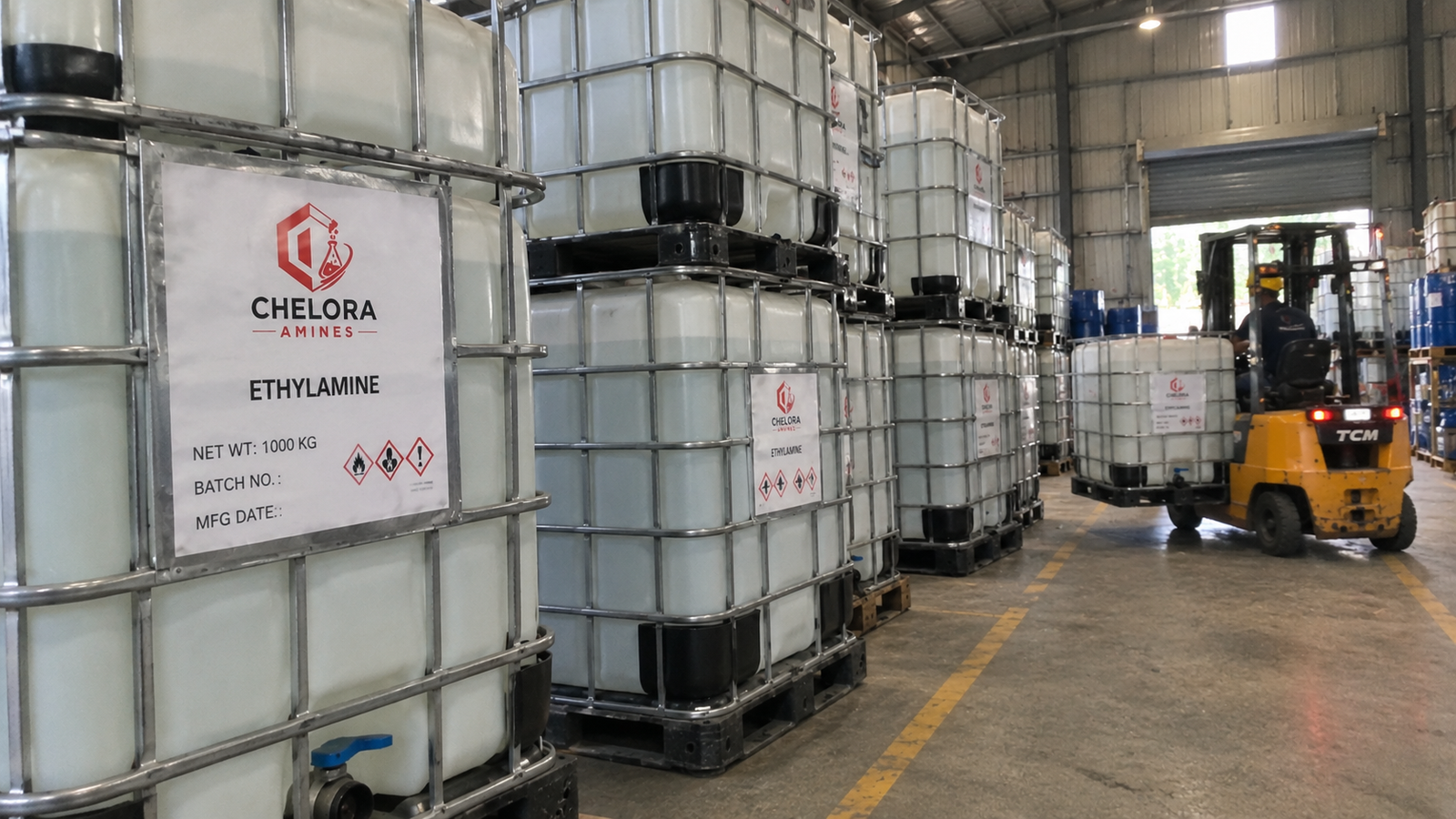
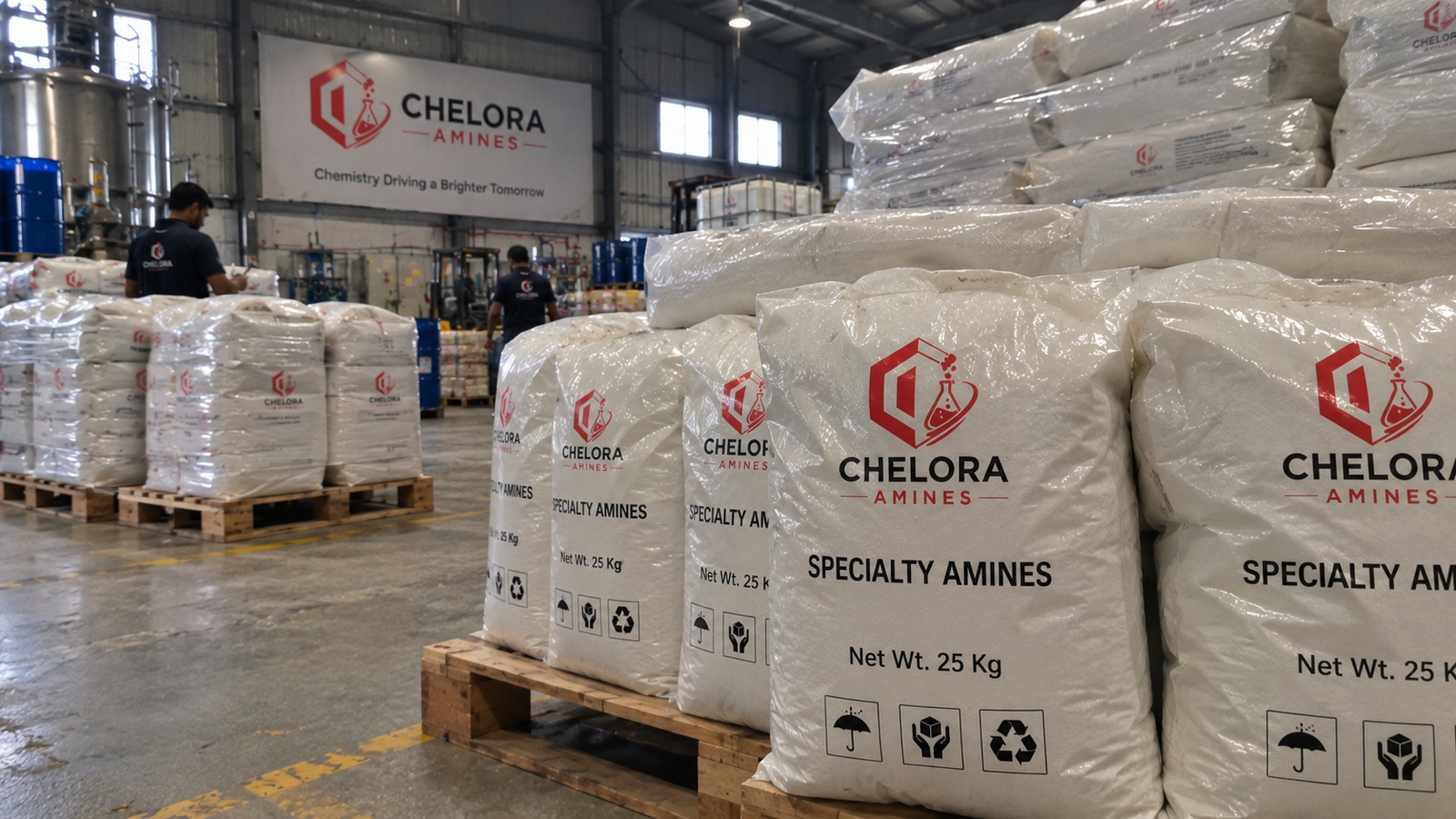
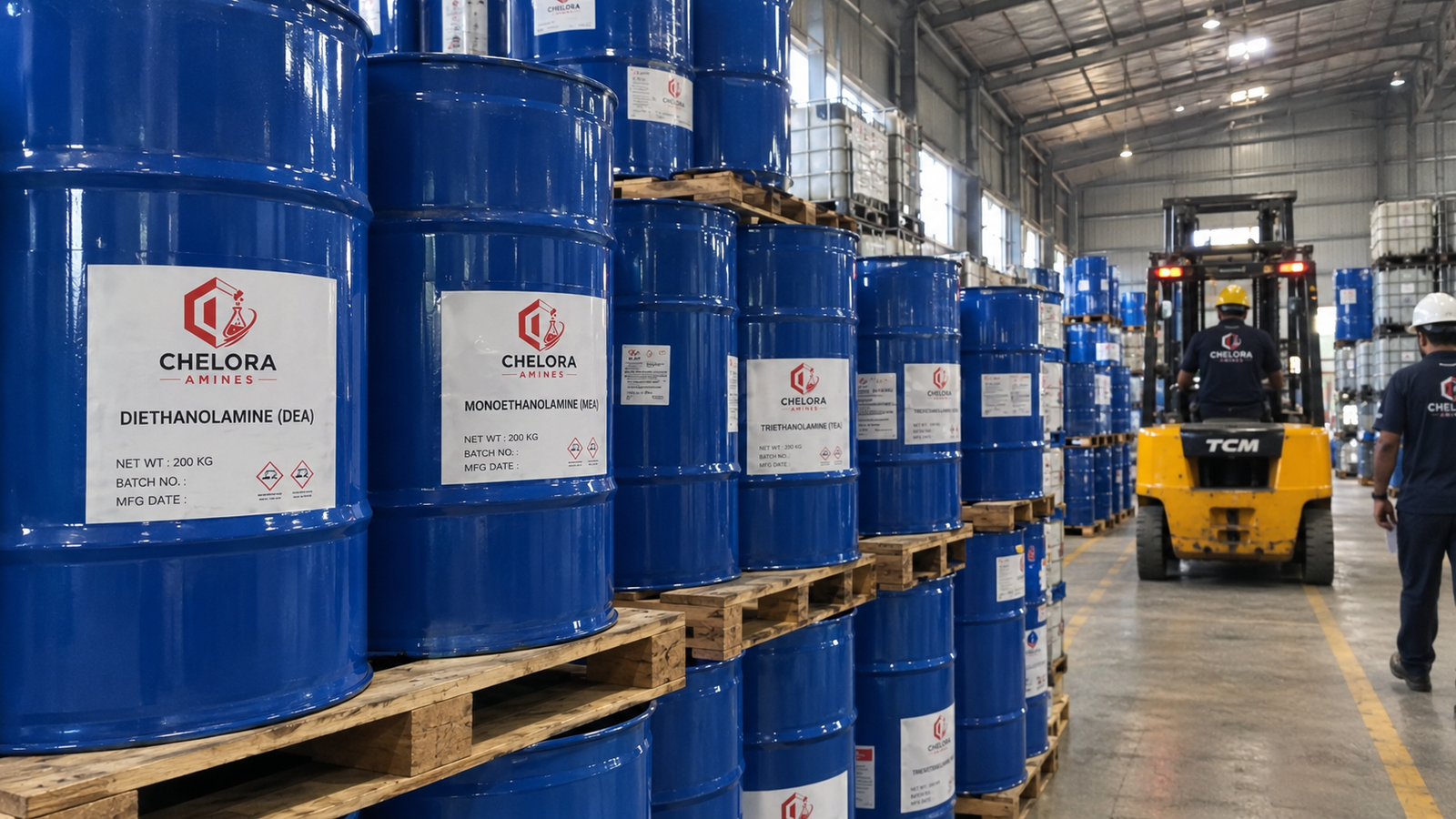
Every container carries the Chelora Amines label with product name, strength, net weight, batch number, manufacturing date, UN number and hazard pictograms.

Methylamine 25 litre carboys and drums stacked in the Chelora Amines warehouse
25 L

Carboys

HDPE carboys for lab qualification, pilot batches and low-consumption users.

200 kg HDPE drums of methylamine aqueous solution on pallets
200 kg

Drums

HDPE and MS drums for the 40% aqueous and alcoholic solutions — the most common pack.

1000 litre IBC totes of methylamine solution handled by forklift
1000 L

IBC totes

Forklift-ready totes with bottom valves for plants drawing methylamine every week.

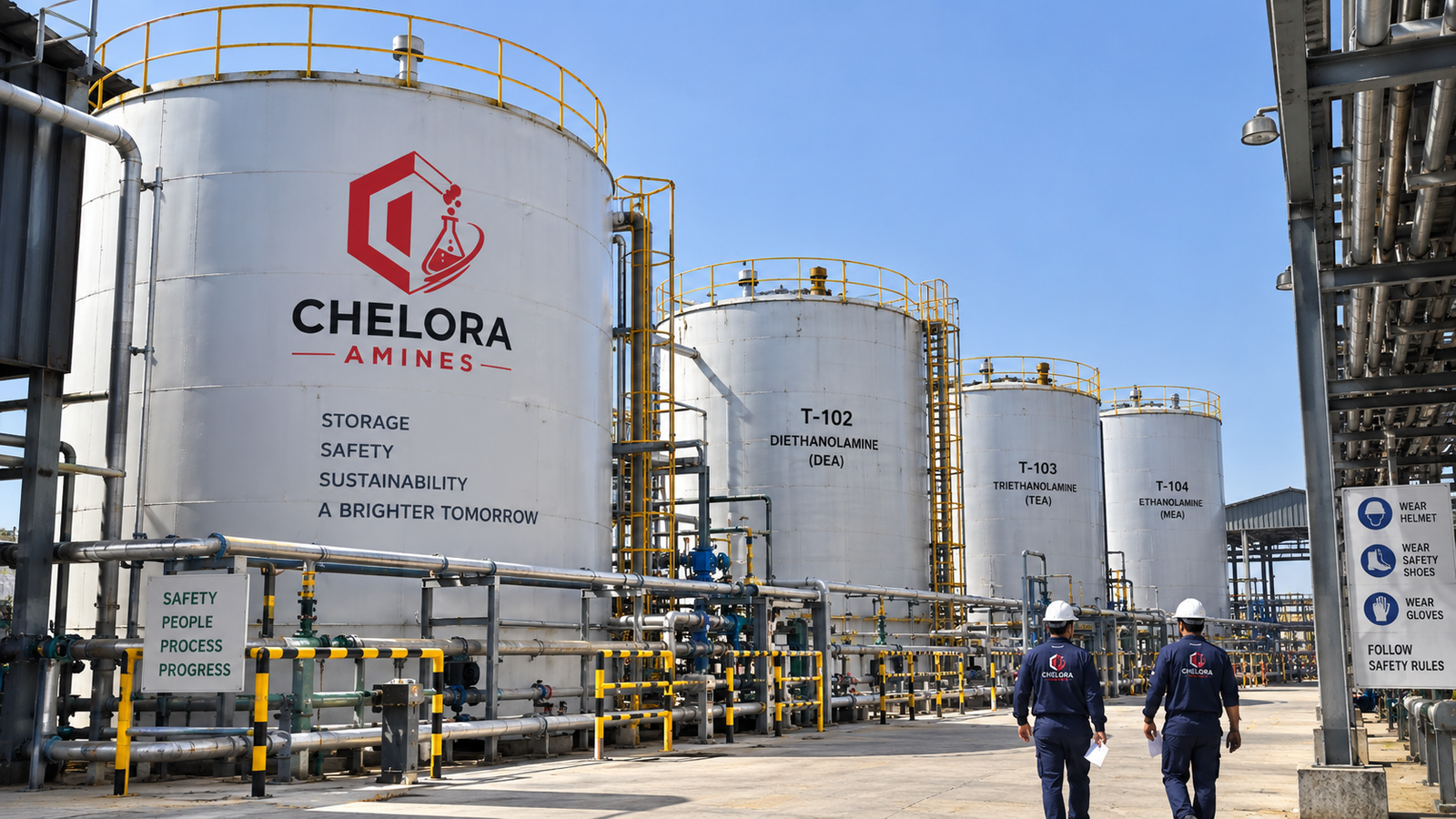
Bulk storage tanks for anhydrous methylamine
Bulk

Cylinders & ISO tanks

Anhydrous methylamine in pressure cylinders, tonners and ISO tanks for continuous plants.

Share your monthly consumption, the solvent your process uses and your storage setup, and we will recommend the form, pack size and delivery schedule that keeps your plant running without excess inventory. Export consignments are packed in UN-specification containers, palletised and stretch-wrapped, and shipped FOB, CIF or CFR through Nhava Sheva and Mundra.

Plan my supply
Handling, storage and safety

Flammable, corrosive and worth respecting

Methylamine is a flammable, corrosive base with a low boiling point. The notes below are a summary for planning only — always work to the Safety Data Sheet supplied with your consignment and your own site risk assessment.

Storage

  • Cool, dry, well-ventilated store away from direct sun and heat sources.
  • Keep containers tightly closed; nitrogen blanketing is preferred for bulk tanks.
  • Segregate from acids, oxidising agents, halogens and hypochlorites.
  • Bund the area and keep a spill kit with absorbent and neutralising material nearby.

Materials of construction

  • Stainless steel, carbon steel and HDPE are generally suitable.
  • Avoid copper, copper alloys, brass, zinc and galvanised surfaces — amines attack them.
  • Use gaskets and seals rated for amines, such as PTFE.
  • Earth and bond equipment when transferring; vapour is flammable.

Personal protection

  • Chemical splash goggles and a face shield when decanting or sampling.
  • Chemical-resistant gloves, apron and closed footwear.
  • Local exhaust ventilation; respiratory protection where vapour may build up.
  • Eyewash and safety shower within reach of the handling point.
Flammable liquid and vapour
Causes severe skin burns and eye damage
May cause respiratory irritation
UN 1235 · Class 3 (8) for the aqueous solution
Industrial use only — not for domestic sale
Transport, regulation and compliance

A dangerous good, handled as one

Methylamine is a regulated product in transport and, in several countries, a monitored chemical. Both are routine for us, but they shape what we need from you before a first shipment moves.

Transport classification
ItemAqueous solutionAnhydrous
Proper shipping nameMethylamine, aqueous solutionMethylamine, anhydrous
UN numberUN 1235UN 1061
Hazard classClass 3, subsidiary risk 8Class 2.1 flammable gas
Packing groupTypically IINot applicable to gases
LabelsFlame and corrosion pictogramsFlame pictogram, gas cylinder marking
ModesRoad, sea (IMDG) and air subject to quantity limitsRoad and sea; air movement heavily restricted
SegregationAway from acids, oxidisers, halogens and hypochloritesAway from oxidising and flammable-gas cylinders per site rules

What we need from a new buyer

  • Company registration and tax details — VAT, EIN, GST or the equivalent in your country.
  • A signed end-use declaration naming the process the material goes into.
  • Consignee and delivery-site details, with a named technical contact.
  • Any import permit or licence the destination country requires.

Who we supply

  • Manufacturers, formulators and processors buying for industrial use.
  • Research institutions, universities and accredited testing laboratories.
  • Registered traders and distributors serving the same industrial base.
  • Supply is business to business only — we do not sell to individuals.

Documentation we can issue

  • Dangerous goods declaration and transport emergency information.
  • Certificate of origin and chamber-attested export documents.
  • REACH, non-GMO, allergen and animal-origin-free statements on request.
  • Country-specific declarations where your customs broker asks for them.

Methylamine is a monitored or controlled precursor chemical in a number of jurisdictions. We supply it only against verified company credentials and a stated industrial end use, and we decline enquiries that cannot be tied to a legitimate manufacturing or research process. This protects both sides and keeps shipments moving through customs without delay.

Start account opening
Certificate of AnalysisMethylamine 40% aqueous solution · CAS 74-89-5
ParameterSpecificationResult
AppearanceClear, colourless liquidComplies
Assay (GC)39.5 – 40.5 %Complies
Dimethylamine≤ 0.5 %Complies
Free ammonia≤ 0.3 %Complies
Colour (APHA)≤ 15Complies
Sample layout. Parameters follow the form and grade you order.QC passed
Quality and documentation

Every drum traceable to a tested batch

Methylamine is checked before dispatch and each consignment leaves with the paperwork your QC, stores and accounts teams need on day one.

COACertificate of Analysis with the test results for your specific batch.
SDSSafety Data Sheet covering hazards, handling, storage, spill response and first aid.
HSN / HS codeHSN 2921 11 on domestic invoices, and the matching HS code on export documents.
Batch labelsStrength, net weight, batch number, manufacturing date and UN number on every pack.
Export setCommercial invoice, packing list, certificate of origin, DG declaration and bill of lading.
On requestNon-GMO, REACH, RoHS, allergen and country-specific declarations.
Testing

What we check, and how

The numbers on a Certificate of Analysis are only useful if you know how they were produced. These are the methods behind the figures on ours, and the checks worth repeating at your own goods-inward.

Gas chromatography

Separates methylamine from dimethylamine, trimethylamine and ammonia in one run, and gives the assay and the impurity profile that matter most to your reaction.

Acid–base titration

An independent check on total amine content, useful as a quick goods-inward confirmation before a drum is released to production.

Karl Fischer

Water determination for anhydrous and alcoholic grades, where the water number is often the reason the grade was chosen in the first place.

APHA colour

A visual platinum–cobalt comparison. A rising colour value is the earliest sign that a pack has been exposed to air or held too long.

Density and refractive index

Fast confirmation that the solution strength is what the label says, and a simple way to spot dilution or the wrong pack.

Non-volatile matter and iron

Gravimetric residue and trace metal checks, which matter for catalytic steps and for any product going into a regulated formulation.

Retained samples

A sample from every dispatched batch is held here, so a query months later can be settled against the original material rather than an argument.

Batch traceability

Batch number on the label ties back to the COA, the test record and the supply lot, which is what your auditor will ask to see.

Third-party testing

Where your customer or regulator needs an independent result, we can arrange analysis at a NABL-accredited laboratory before dispatch.

How ordering works

From enquiry to plant gate

Five steps for a first order of methylamine. Repeat orders follow the same route on a schedule that matches your consumption.

Step 1

Send your requirement

Form and strength, grade, quantity, pack size and delivery location.

Step 2

Get a matched quote

We confirm the form for your solvent system and quote, usually within 24 hours.

Step 3

Batch is checked

The batch is tested and the COA, SDS and invoice details are prepared.

Step 4

Packed and dispatched

Labelled packs move by road, or in UN-spec packaging for export.

Step 5

Delivered and repeated

Material reaches your gate and repeat dispatches are scheduled to your usage.

Why buy from us

What you get besides the chemical

Methylamine is a commodity on a price list and a headache in a warehouse. What separates suppliers is the form flexibility, the paperwork and the answer you get when something is not routine.

One source for the whole amine list

Methylamine sits alongside more than fifty other amines we stock, from ethanolamines to fatty amines. Your purchase team raises one enquiry, compares one quote and manages one vendor record instead of six.

All three forms, not just the easy one

Aqueous, alcoholic and anhydrous methylamine are all available, so you are not forced to redesign a step around the only grade your supplier happens to carry.

Paperwork that clears first time

COA, SDS, correct HSN and HS codes, dangerous goods declarations and certificates of origin are prepared with the consignment, not chased afterwards by your logistics team.

Specification matching

Tell us your limits on dimethylamine, trimethylamine, ammonia or water and we quote against them, rather than sending the standard cut and letting your QC department find out.

Scheduled repeat supply

Once we know your monthly draw we hold and release material on a schedule, so you carry less inventory of a flammable, corrosive product than you otherwise would.

Someone who knows the chemistry

Describe the reaction rather than the product code and we will tell you which form and grade fits — and say so plainly when a different amine would serve you better.

Where we supply

Methylamine supplied worldwide

Container shipments to buyers on five continents, plus road dispatch inside India. Tell us your country and destination port and we will quote landed terms, transit time and the documentation your customs broker will ask for.

Middle East & Africa

United Arab Emirates, Saudi Arabia, Oman, Qatar, Kuwait, Bahrain, Jordan, Egypt, Morocco, Kenya, Tanzania, Ethiopia, Nigeria, Ghana and South Africa.

PharmaDetergentsWater treatment

Asia Pacific

Bangladesh, Sri Lanka, Nepal, Pakistan, Vietnam, Thailand, Indonesia, Malaysia, Singapore, the Philippines, South Korea, Japan, Taiwan, Australia and New Zealand.

AgrochemicalsElectronicsTextiles

Europe & CIS

Germany, the Netherlands, Belgium, France, Italy, Spain, Portugal, Poland, Czechia, the United Kingdom, Ireland, Türkiye, Russia, Ukraine, Kazakhstan and Uzbekistan.

Fine chemicalsCoatingsSolvents

The Americas

United States, Canada, Mexico, Brazil, Argentina, Chile, Colombia, Peru, Ecuador and the Caribbean, shipped in UN-specification packaging with full DG documentation.

Crop protectionPersonal carePolymers
Export logistics at a glance
Incoterms quotedEXW, FOB, CFR, CIF and DAP, depending on your destination and preference
Load portsNhava Sheva (JNPT) and Mundra, with Chennai and Kolkata used for eastbound routings
Container optionsFull container loads, and consolidated LCL shipments for smaller quantities
Typical container fillAround 80 drums of 200 kg, or roughly 18 to 20 IBC totes, in a 20 ft container
Packing for exportUN-specification drums and totes, palletised, strapped and stretch-wrapped, with DG labelling
Air freightPossible for small quantities of the solution within dangerous goods limits; anhydrous gas is heavily restricted
Payment termsAdvance, irrevocable letter of credit or agreed credit terms for established accounts
Before first shipmentCompany credentials, end-use declaration and any import permit the destination country requires

Domestic supply inside India

Road dispatch from our Mumbai base to industrial clusters in 16 states and Delhi. Open your state for the local industries we serve and the amines they order most.

Buying guide

How to write an enquiry that gets a firm price

Most delays in quoting methylamine come from a missing line in the enquiry, not from availability. Send these eight details and a firm price usually comes back the same day.

Include in your enquiry

  • Full name and CAS. Methylamine, CAS 74-89-5 — never just the initials.
  • Form and strength. 40% aqueous, alcoholic (say which solvent), or anhydrous.
  • Quantity and basis. State whether the tonnage is solution weight or 100% amine.
  • Grade. Commercial, LR or AR, plus any tighter limit your process needs.
  • Pack size. Carboy, drum, IBC or cylinder, and whether packs are returnable.
  • Destination. Delivery address for road, or port and Incoterm for export.
  • Documents. Anything beyond COA and SDS that your site or customs needs.
  • Frequency. One-off trial, monthly offtake or an annual contract.

Mistakes that cost money

  • Writing "MMA". It also means methyl methacrylate, a completely different product.
  • Comparing prices across forms. A kilo of 40% solution is 400 g of amine — compare on the 100% basis.
  • Ignoring the impurity limits. Two quotes at the same price can carry very different dimethylamine content.
  • Using brass or copper fittings. Amines attack copper alloys; the pump fails, not the chemical.
  • Storing part-used drums open. Air and carbon dioxide raise colour and form carbonate.
  • Heating a sealed container. The low boiling point means pressure builds fast.
  • Leaving out the end use. A monitored chemical cannot ship without it, so the order simply stops.
  • Ordering at the last minute. Dangerous goods bookings and permits take longer than ordinary freight.

Not sure of some of it yet? Send what you have. A description of the reaction step and an approximate monthly volume is enough for us to come back with a recommended form, a pack plan and an indicative price.

Send an enquiry
Glossary

Terms used on this page

Plain definitions of the words that appear on a methylamine specification, label and shipping document.

Assay
The measured amount of methylamine in the material, given as a percentage by weight.
Anhydrous
Without water. For methylamine it means the liquefied gas rather than a solution.
APHA colour
A platinum–cobalt scale for how colourless a liquid is. Lower is better; 15 or less is normal here.
Free ammonia
Unreacted ammonia carried over from manufacture. It competes with methylamine in your reaction.
COA
Certificate of Analysis — the tested results for the specific batch you received.
SDS
Safety Data Sheet — hazards, handling, storage, spill response, first aid and disposal.
HSN and HS code
Tariff classification. HSN 2921 11 is used on Indian invoices; the matching HS code appears on export papers.
IBC
Intermediate bulk container — the caged 1000 litre tote moved by forklift.
UN number
The four-digit transport identifier. UN 1235 for the solution, UN 1061 for anhydrous.
Packing group
The degree of transport danger within a hazard class. Group II is medium danger.
LR and AR grade
Laboratory reagent and analytical reagent — tighter impurity limits for lab and analytical work.
Karl Fischer
The standard titration for measuring water content in a chemical.
pKa
A measure of acid strength. For an amine it is quoted for the conjugate acid; 10.66 here means a strong base.
N-methylation
Attaching a methyl group to a nitrogen atom — the main job methylamine is bought to do.
Reductive amination
Making an amine from a carbonyl compound by forming an imine and reducing it in the same pot.
Acid scavenger
A base added to neutralise acid released during a reaction so the pH stays workable.
Questions buyers ask

Methylamine FAQ

Short answers to what purchase, plant and QC teams ask us most about this product. Anything else, ask us directly.

What is methylamine used for?
It is mainly used to make N-methyl-2-pyrrolidone (NMP) and other polar aprotic solvents, carbamate insecticides and herbicide intermediates, and a wide range of pharmaceutical intermediates where an N-methyl group is needed. It also goes into surfactants, water-treatment polymers, dye intermediates, photographic developers, rubber chemicals and fuel additives.
In which forms do you supply methylamine?
Four forms: a 40% w/w aqueous solution, which is the standard commercial pack; 25–33% solutions in methanol, ethanol or THF for moisture-sensitive reactions; anhydrous liquefied gas at 99.5% and above in cylinders, tonners and ISO tanks; and LR or AR laboratory grades in small packs. Tell us your solvent system and we will confirm which suits your process.
What is the difference between methylamine, dimethylamine and trimethylamine?
They differ by how many methyl groups sit on the nitrogen. Methylamine has one and is a primary amine, dimethylamine has two and is secondary, trimethylamine has three and is tertiary. All three come out of the same methanol-and-ammonia reaction and are separated by distillation, but they behave very differently in synthesis — only methylamine leaves two N–H hydrogens available for further reaction. Always order by full name and CAS number rather than by initials.
How pure is your methylamine, and what is controlled?
For the 40% aqueous grade, assay is typically 39.5–40.5% w/w with dimethylamine at 0.5% maximum, trimethylamine at 0.2% maximum, free ammonia at 0.3% maximum and APHA colour of 15 or less. Anhydrous material is typically 99.5% and above. If your process needs tighter limits on any of these, state them at enquiry and we will quote against your specification.
Which pack sizes are available?
Solutions are supplied in 25 L HDPE carboys, 200 kg HDPE or MS drums and 1000 L IBC totes. Anhydrous methylamine is supplied in pressure cylinders, tonners and ISO tanks. Laboratory grades are available in 2.5 L, 5 L and 25 L packs.
How should methylamine be stored and handled?
Store in a cool, dry, well-ventilated area away from sunlight, heat and ignition sources, with containers closed and the area bunded. Keep it away from acids, oxidisers, halogens and hypochlorites. Use stainless steel, carbon steel or HDPE and avoid copper, brass, zinc and galvanised surfaces. Handle with splash goggles, chemical-resistant gloves and an apron, with local exhaust ventilation, an eyewash and a safety shower nearby. Work to the SDS supplied with your consignment.
Is methylamine hazardous to transport?
Yes, it is a regulated dangerous good. The aqueous solution ships under UN 1235 as Class 3 with a subsidiary Class 8 risk, and anhydrous methylamine ships under UN 1061 as a Class 2.1 flammable gas. Packs are labelled accordingly and export consignments go in UN-specification packaging with the correct hazard labelling and paperwork.
What is the HS code for methylamine?
Methylamine falls under harmonised heading 2921 11, which covers methylamine, dimethylamine and trimethylamine and their salts. The same heading is the basis for national codes worldwide, and it appears as HSN 2921 11 on Indian invoices for GST input credit. Your country's full eight or ten digit code is stated on the export documents so customs clearance is not held up.
What documents come with an order?
Every dispatch carries a batch-wise Certificate of Analysis, the Safety Data Sheet, HSN details on the invoice, and labels showing the strength, net weight, batch number, manufacturing date and UN number. Export orders also carry the shipping documentation for the destination.
Do you supply trial quantities of methylamine?
Yes. A 25 L carboy or a small laboratory pack can be arranged so your team can qualify the material before placing a regular order. Request a sample with your application and solvent details.
Which countries do you supply methylamine to?
We ship worldwide. Regular destinations include the Middle East and Africa, South and South East Asia, East Asia, Australia and New Zealand, Europe and the CIS, and North and South America, alongside domestic supply throughout India. Shipments move in container loads through Nhava Sheva and Mundra, packed to UN specification with the correct hazard labelling, and we quote on EXW, FOB, CFR, CIF or DAP terms. Send the form, quantity and destination port and we will confirm lead time, freight and documentation.
What export documents do you provide?
A commercial invoice, packing list, certificate of origin, batch-wise Certificate of Analysis, Safety Data Sheet, dangerous goods declaration and bill of lading or airway bill. Country-specific declarations such as REACH, non-GMO or allergen statements can be issued on request — tell us what your customs broker needs at enquiry stage.
What is the shelf life of methylamine solution?
In sealed original packing kept cool and out of sunlight, twelve months is the normal working figure. The material does not spoil so much as drift — air and carbon dioxide ingress raise the APHA colour and form carbonate — so keep drums closed between draws. Before a critical batch from older stock, re-check assay and colour, or ask us to test a retained sample.
Can I order on a 100% methylamine basis instead of solution weight?
Yes, and it is often the clearer way to buy. One tonne of the 40% aqueous solution contains 400 kg of methylamine, so comparing a solution price against an anhydrous price only works once both are converted to the 100% basis. Tell us which basis your requirement is written on and we will quote the same way.
Why does my drum build pressure, and what should I do?
Methylamine boils at −6.3 °C, so vapour pressure rises quickly as the container warms. Store packs in a cool, shaded, ventilated area, never apply heat to a sealed container, and open closures slowly and away from your face, ideally when the pack is at its coolest. Bulk tanks should be relief-protected and nitrogen blanketed.
Do you also supply methylamine hydrochloride?
Yes, methylamine hydrochloride (CAS 593-51-1) can be supplied on request. It is the solid salt form, easier to weigh and store than the solution, and is often preferred for laboratory and small-scale pharmaceutical work. Ask for it by name and quantity and we will quote pack sizes and lead time.
Is methylamine a controlled or monitored chemical?
In several jurisdictions it is a monitored precursor chemical. We therefore supply it business to business only, against verified company registration, consignee details and a signed end-use declaration naming the process it goes into, plus any import permit the destination country requires. Enquiries that cannot be tied to a legitimate industrial or research use are declined.
What is the minimum order quantity and the usual lead time?
A single 25 litre carboy is enough to start for trial and qualification work; production orders normally move in drums, IBC totes or container loads. Ex-stock domestic dispatches typically leave within a few working days of order confirmation, and export or made-to-specification campaigns need longer depending on packing, permits and shipping schedules. We confirm the lead time on the quotation.
Which materials can I use for pumps, pipework and storage?
Stainless steel, carbon steel and HDPE are generally suitable, with PTFE gaskets and seals. Avoid copper, brass, bronze, zinc and galvanised surfaces — amines attack copper alloys, and the usual symptom is a failed pump or discoloured product rather than any problem with the chemical itself. Earth and bond equipment during transfer, because the vapour is flammable.
Which Indian states do you deliver methylamine to?
How do I get a price for methylamine?
Send the form and strength you need, the grade, quantity, pack size and delivery location through our contact page, by email to source@cheloraamines.com or by phone on +91 98191 11179. A complete enquiry usually gets a quote within 24 hours.
Order methylamine from Chelora Amines

Send the strength, grade, quantity, pack size and your delivery address or destination port. We come back with a price, the documents that go with the batch and a dispatch or shipping plan, usually within 24 hours.

Contact Chelora Amines

Call us+91 98191 11179 Email ussource@cheloraamines.com
Office102, L1, Ashok Premises, Nicholas Road, Andheri (East), Mumbai 400069