Resin neutralisation
Neutralises carboxylic acid groups on acrylic, alkyd and polyester binders to make them water-dispersible; the amine then evaporates as the film dries.
binder–COOH + DMEA → salt
2-(Dimethylamino)ethanol · DMAE / deanol · ≥ 99.5% commercial grade, LR and AR grades
N,N-Dimethylethanolamine is a tertiary amino alcohol — two methyl groups and one hydroxyethyl group on the nitrogen — and the standard volatile amine for waterborne coatings, a polyurethane catalyst and the raw material for dimethylaminoethyl (meth)acrylate monomers. Chelora Amines supplies it worldwide to coatings, polyurethane, water-treatment, pharmaceutical and monomer plants across Asia, the Middle East, Africa, Europe and the Americas, as well as throughout India, with a batch-wise COA and SDS on every dispatch.
48.04 + 11.09 + 14.01 + 16.00 = 89.14 g/mol
N,N-Dimethylethanolamine, usually shortened to DMEA and also called DMAE, deanol or 2-(dimethylamino)ethanol, is a tertiary amine with two methyl groups and one hydroxyethyl group on the nitrogen. It is a strong base, fully miscible with water and most organic solvents, and noticeably volatile.
It is a clear, colourless liquid with an amine odour, boiling at about 134 °C and freezing far below normal temperatures. Its flash point is about 39 °C, so DMEA is both corrosive and flammable — it ships as Class 8 with a Class 3 subsidiary risk and needs flammable-liquid controls on site.
DMEA is made by reacting ethylene oxide with dimethylamine and purifying the product by distillation. Because it is a tertiary amine it does not form amides or carbamates, but its hydroxyl group is reactive, which is how it becomes dimethylaminoethyl acrylate and methacrylate monomers.
| Chemical name | 2-(Dimethylamino)ethanol (N,N-dimethylethanolamine) |
| Common synonyms | N,N-Dimethylethanolamine, DMEA, DMAE, deanol, dimethylaminoethanol, 2-dimethylaminoethanol |
| CAS number | 108-01-0 |
| EC / EINECS number | 203-542-8 |
| HS / HSN code | 2922 19 (harmonised heading used worldwide; HSN 2922 19 on Indian invoices) |
| Molecular formula | C₄H₁₁NO ((CH₃)₂NCH₂CH₂OH) |
| Molecular weight | 89.14 g/mol |
| Appearance | Clear, colourless liquid |
| Odour | Amine-like |
| Melting / freezing point | About −59 °C |
| Boiling point | About 134 °C |
| Density | About 0.887 g/cm³ at 20 °C |
| Solubility in water | Completely miscible |
| pKa of conjugate acid | About 9.2 at 25 °C |
| Flash point | About 39 °C (closed cup) — flammable liquid |
| Auto-ignition temperature | About 220–245 °C |
| UN number | UN 2051, 2-Dimethylaminoethanol, Class 8, subsidiary risk 3, Packing Group II |
Figures are typical literature values for orientation. Values for the material you order are stated on its Certificate of Analysis and Safety Data Sheet.
A tertiary nitrogen and a free hydroxyl explain what DMEA is bought for: neutralising and catalysing without reacting at the nitrogen, while the hydroxyl gives esters, ethers and monomers.
Neutralises carboxylic acid groups on acrylic, alkyd and polyester binders to make them water-dispersible; the amine then evaporates as the film dries.
binder–COOH + DMEA → saltCatalyses the isocyanate–polyol and isocyanate–water reactions in foams and coatings; its hydroxyl reacts into the polymer, reducing emissions.
R–NCO + R′–OH → urethaneReacts with methyl acrylate or methyl methacrylate to give dimethylaminoethyl acrylate (DMAEA) and methacrylate (DMAEMA).
MMA + DMEA → DMAEMA + MeOHThe nitrogen reacts with methyl chloride or other alkylating agents to give quaternary ammonium compounds, including cationic monomers and choline-type salts.
R₃N + CH₃Cl → R₃N⁺CH₃ Cl⁻The alkoxide or chloride derivative is used to attach a dimethylaminoethyl group to pharmaceutical molecules.
R–X + DMEA → R–OCH₂CH₂N(CH₃)₂Volatile enough to travel with steam, DMEA raises condensate pH in boiler and steam systems.
pKa about 9.2Mops up acids generated in reactions and in coatings, without forming amides.
R₃N + HCl → R₃NH⁺Cl⁻Used to functionalise resins and polymers with tertiary amine and quaternary groups.
polymer–CH₂Cl + DMEA → quatProcess notes. DMEA is flammable as well as corrosive: earth and bond equipment, keep ignition sources away and use flammable-liquid storage. Neutralisation and quaternisation are exothermic. In coatings, its volatility is a feature — choose a less volatile amine if you need it to stay in the film.
Discuss your processPractically all commercial DMEA comes from the same route. Knowing how it is made explains why the specification controls water, colour and related amines.
Ethylene oxide is fed into dimethylamine, with a slight excess of amine.
The exothermic reaction runs under pressure and controlled temperature.
The reactor delivers DMEA with small amounts of higher ethoxylates, unreacted dimethylamine and water.
Dimethylamine is recovered and recycled, and distillation purifies the DMEA.
DMEA is tested for purity, water and colour, then filled into UN drums, totes or tankers under nitrogen.
The real quality question is "what else came with it". Water matters most for polyurethane and monomer users, because it reacts with isocyanates and interferes with transesterification. Higher ethoxylates and other amines change catalytic activity and odour.
For coatings and monomers, colour and odour matter too. If your use is sensitive to any of these, say so at enquiry stage and we will match the batch.
In sealed original packing, stored cool and away from heat and ignition sources, DMEA is normally used within twelve months, and we recommend a re-check of assay, water and colour after that before a critical batch.
Keep drums closed between draws and blanket bulk tanks with nitrogen — this limits moisture, CO₂ pick-up and flammable vapour in the headspace. A retained sample of each batch is held here, so any query can be tested against the original.
Tell us the application and we will confirm the grade. Commercial grade covers coatings and polyurethanes; low-water grade suits monomer production and sensitive syntheses.
The everyday grade for waterborne coatings, polyurethane catalysis and water treatment.
Tighter water and colour limits for monomer production, pharma and moisture-sensitive steps.
Tighter limits for R&D, method development and QC use.
| Parameter | Test method | Typical specification |
|---|---|---|
| Appearance | Visual | Clear, colourless liquid, free from suspended matter |
| Purity (DMEA) | GC | ≥ 99.5 % w/w |
| Water | Karl Fischer | ≤ 0.2 % w/w |
| Colour | APHA | ≤ 15 |
| Density at 20 °C | Densitometer | 0.884 – 0.890 g/cm³ |
| Distillation range | ASTM D1078 | Within 132 – 136 °C |
Indicative specification for planning. The controlling document is the Certificate of Analysis issued for your batch. If your process needs tighter limits, say so at enquiry stage and we will quote against your specification.
In coatings and polyurethanes, DMEA is compared with other amines on volatility, catalytic activity and odour. Use the table to narrow it down, then send us the application and we will confirm.
| Point of comparison | DMEA | MIPA | DEEA |
|---|---|---|---|
| Amine class | Tertiary | Primary | Tertiary |
| Volatility | Fairly volatile — leaves the film | Low — stays longer in the film | Moderately volatile |
| Polyurethane catalysis | Active catalyst | Not used as catalyst | Mild catalyst |
| Can form amides or carbamates | No | Yes | No |
| Flash point | About 39 °C | About 72–77 °C | About 50 °C |
| Transport | UN 2051, Class 8 (3), PG II | UN 2735, Class 8, PG III | UN 2686, Class 8 (3), PG II |
The alkylethanolamines are made by adding ethylene oxide to methylamine, dimethylamine or diethylamine instead of ammonia. The alkyl groups on the nitrogen change basicity, volatility, flammability and what the amine can still react with.
| Property | N-Methylethanolamine (NMEA) | N,N-Dimethylethanolamine (DMEA) | N,N-Diethylethanolamine (DEEA) |
|---|---|---|---|
| CAS number | 109-83-1 | 108-01-0 | 100-37-8 |
| Formula | CH₃NHCH₂CH₂OH | (CH₃)₂NCH₂CH₂OH | (C₂H₅)₂NCH₂CH₂OH |
| Molecular weight | 75.11 | 89.14 | 117.19 |
| Amine class | Secondary — one N–H bond | Tertiary — no N–H bond | Tertiary — no N–H bond |
| Boiling point | About 158 °C | About 134 °C | About 161 °C |
| Freezing point | About −5 °C | About −59 °C | About −70 °C |
| Flash point (closed cup) | About 72 °C | About 39 °C | About 50 °C |
| Transport | UN 2735, Class 8, PG III | UN 2051, Class 8 (3), PG II | UN 2686, Class 8 (3), PG II |
| Typical outlets | Pharma and agro intermediates, gas-treating blends, softeners | Waterborne coatings, polyurethane catalysts, DMAEMA monomers, boiler treatment | Pharma intermediates, steam-condensate treatment, DEAEMA monomers, softeners |
Similar names, different products. NMEA, DMEA and DEEA are often confused with each other and with MEA, DEA or MDEA (N-methyldiethanolamine). DMEA is also sold as DMAE or deanol, and DEEA as DEAE. Always write the full chemical name, the CAS number and the grade on the enquiry and on the purchase order.
See the full amine rangeMost DMEA goes into coatings, polyurethanes, monomers and water treatment, with a tail of pharmaceutical synthesis. Here is the full picture, sector by sector.
The standard neutralising amine for acrylic, alkyd and polyester binders, giving stable dispersions and leaving the film as it dries.
A catalyst for flexible and rigid foams, coatings and adhesives; its hydroxyl reacts into the polymer.
The raw material for DMAEA and DMAEMA monomers, which are quaternised and polymerised into cationic flocculants for sludge dewatering and papermaking.
A neutralising amine that raises condensate pH and limits corrosion in steam lines.
A building block for drugs that carry a dimethylaminoethyl group, including antihistamines and local anaesthetics.
Functionalises resins and polymers with tertiary amine and quaternary groups.
Used as deanol and its salts in some cosmetic formulations, and as a pH adjuster.
Used in corrosion inhibitors, textile auxiliaries and as an acid scavenger.
If you are mapping a value chain or looking for the product one step down from where you are, this is where N,N-dimethylethanolamine ends up. Several of these are chemicals we can also source for you.
| Derivative | Made by | End use |
|---|---|---|
| Dimethylaminoethyl methacrylate (DMAEMA) | Transesterification with methyl methacrylate | Cationic flocculants, coatings, ion-exchange |
| Dimethylaminoethyl acrylate (DMAEA) | Transesterification with methyl acrylate | Cationic polyacrylamide flocculants |
| Quaternised monomers (DMAEA-MC, DMAEMA-MC) | Quaternisation with methyl chloride | Water treatment and papermaking polymers |
| Dimethylaminoethyl ethers | Etherification | Antihistamines and other pharmaceutical actives |
| Neutralised waterborne binders | Neutralisation of acid groups | Waterborne paints and inks |
| Functionalised resins | Reaction with chloromethylated polymers | Anion-exchange resins |
Looking for one of these rather than the amine itself? Ask us — several are within our sourcing network, and we can quote the derivative and the raw material together.
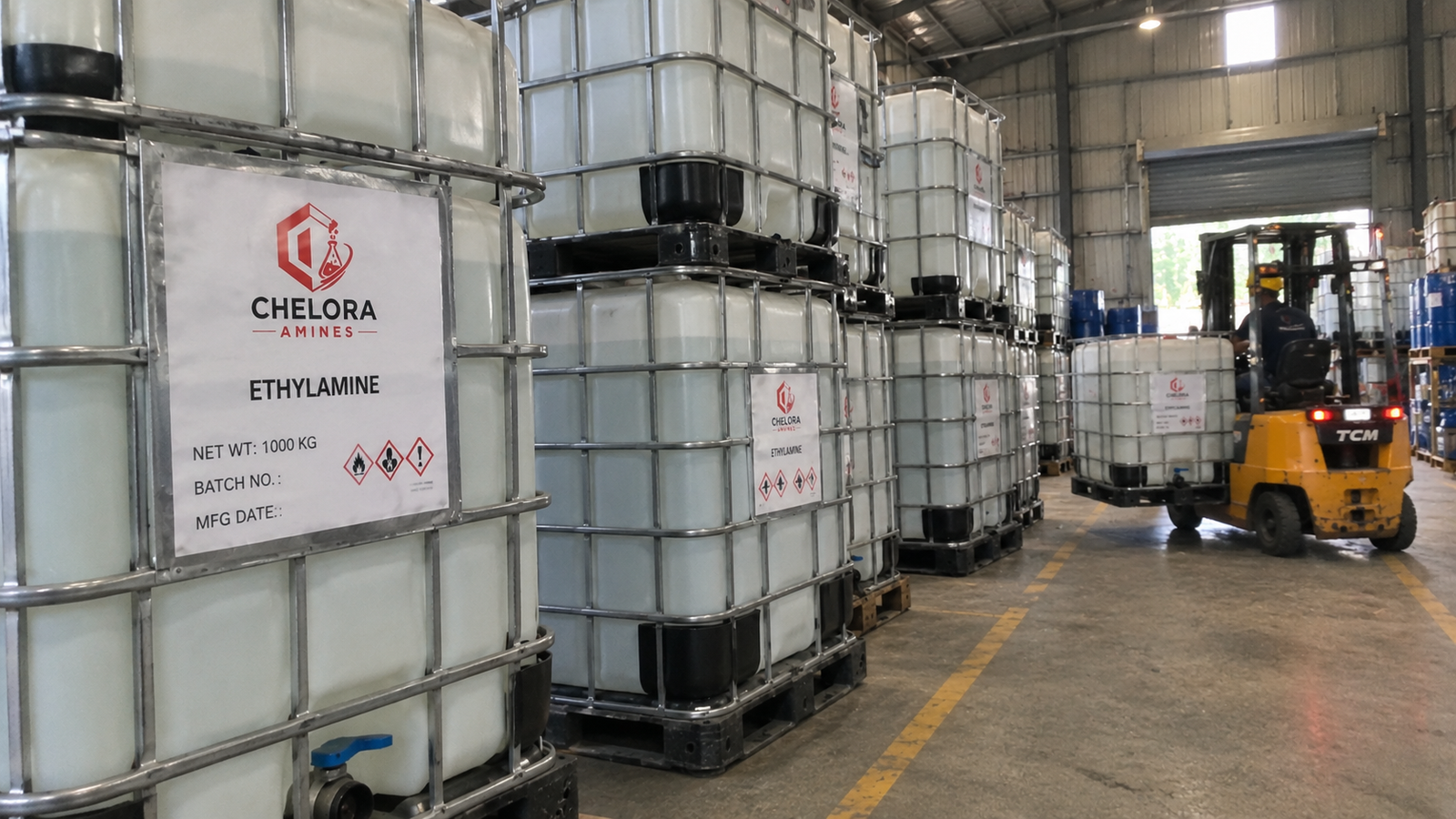
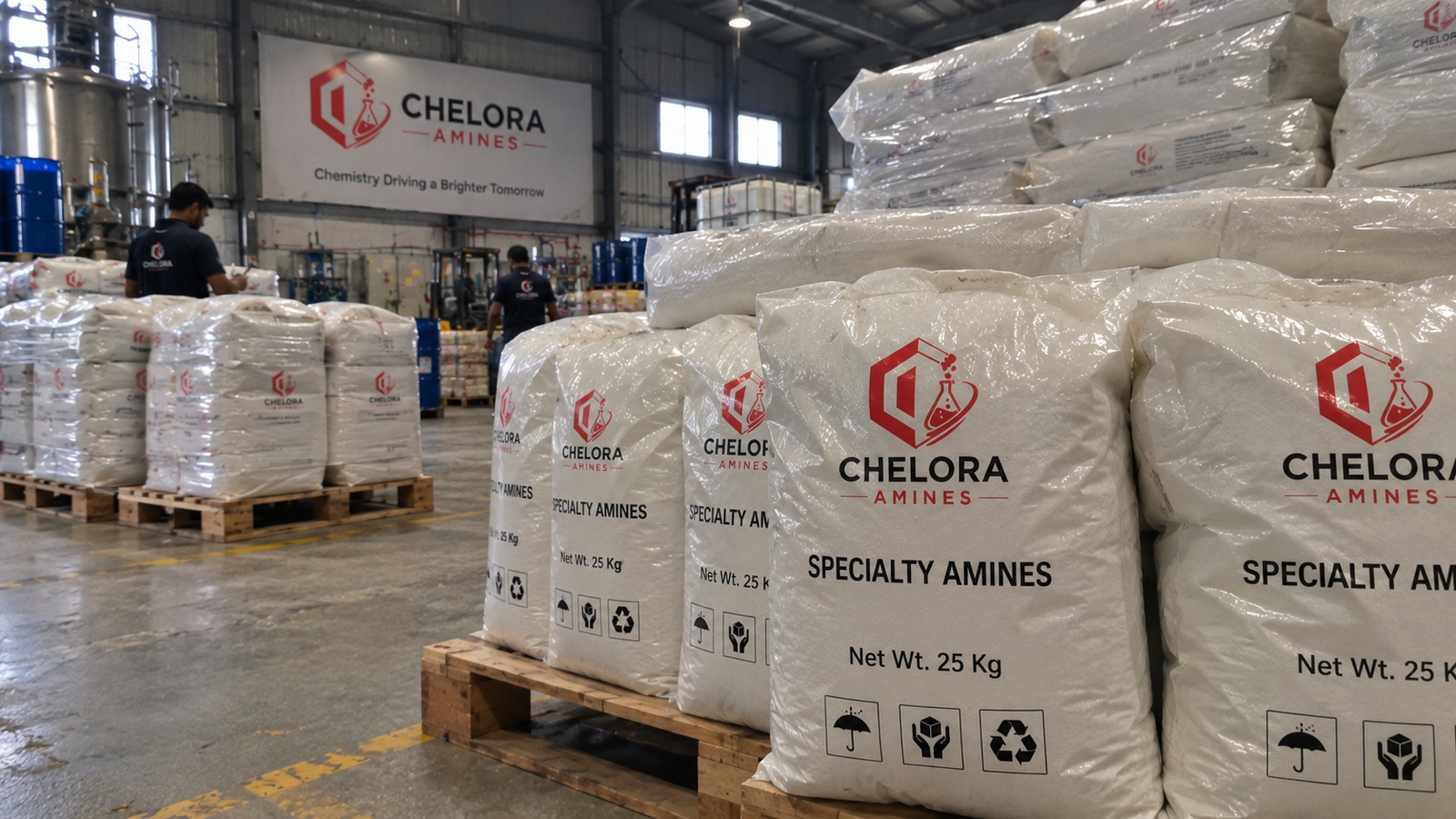
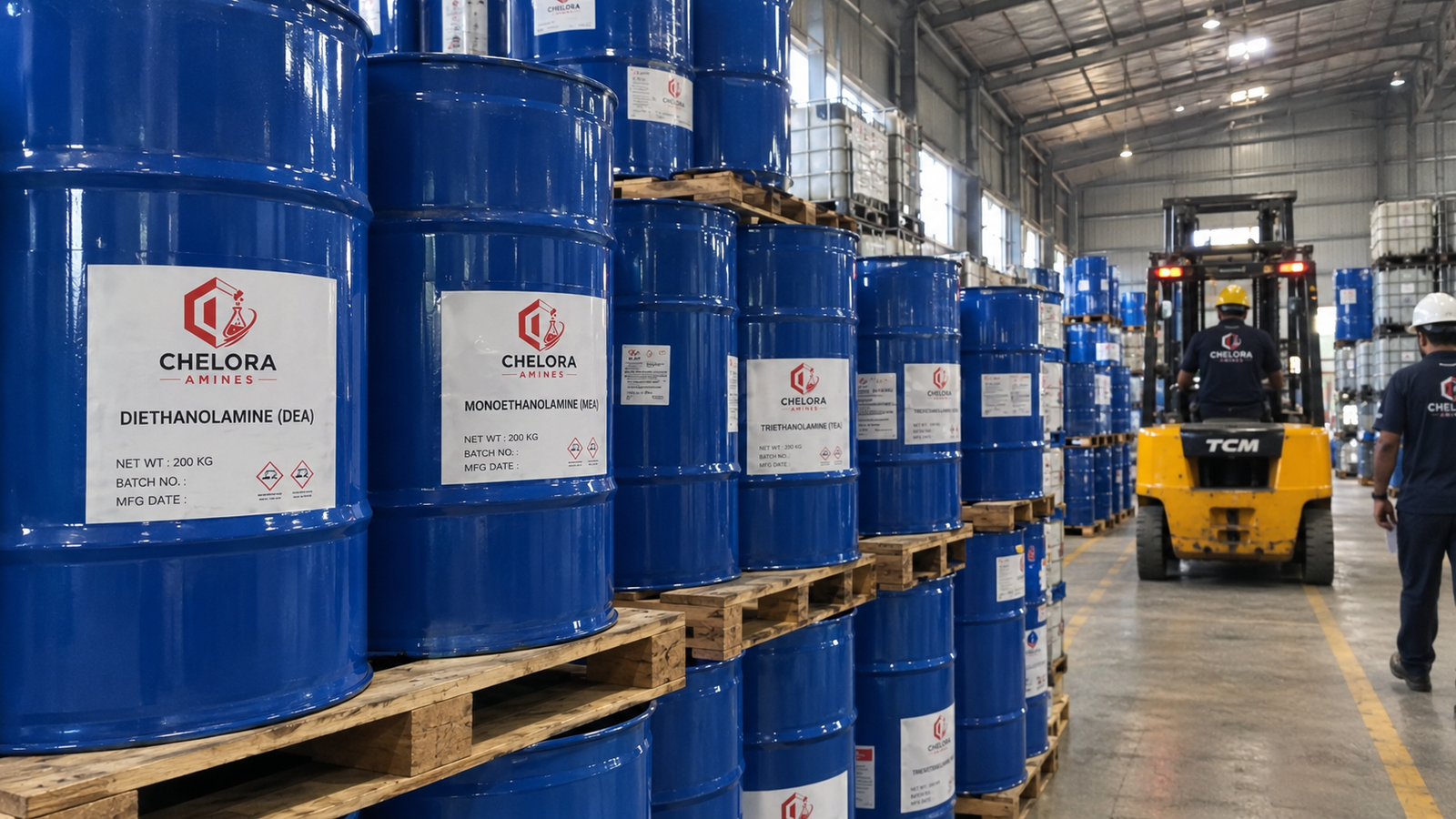
Every container carries the Chelora Amines label with product name, grade, net weight, batch number, manufacturing date, UN number where applicable and hazard pictograms.
UN-approved steel drums suitable for flammable, corrosive liquids.
UN-approved totes for regular users, with earthing points.
500 mL to 25 L packs for laboratory, pilot and qualification work.
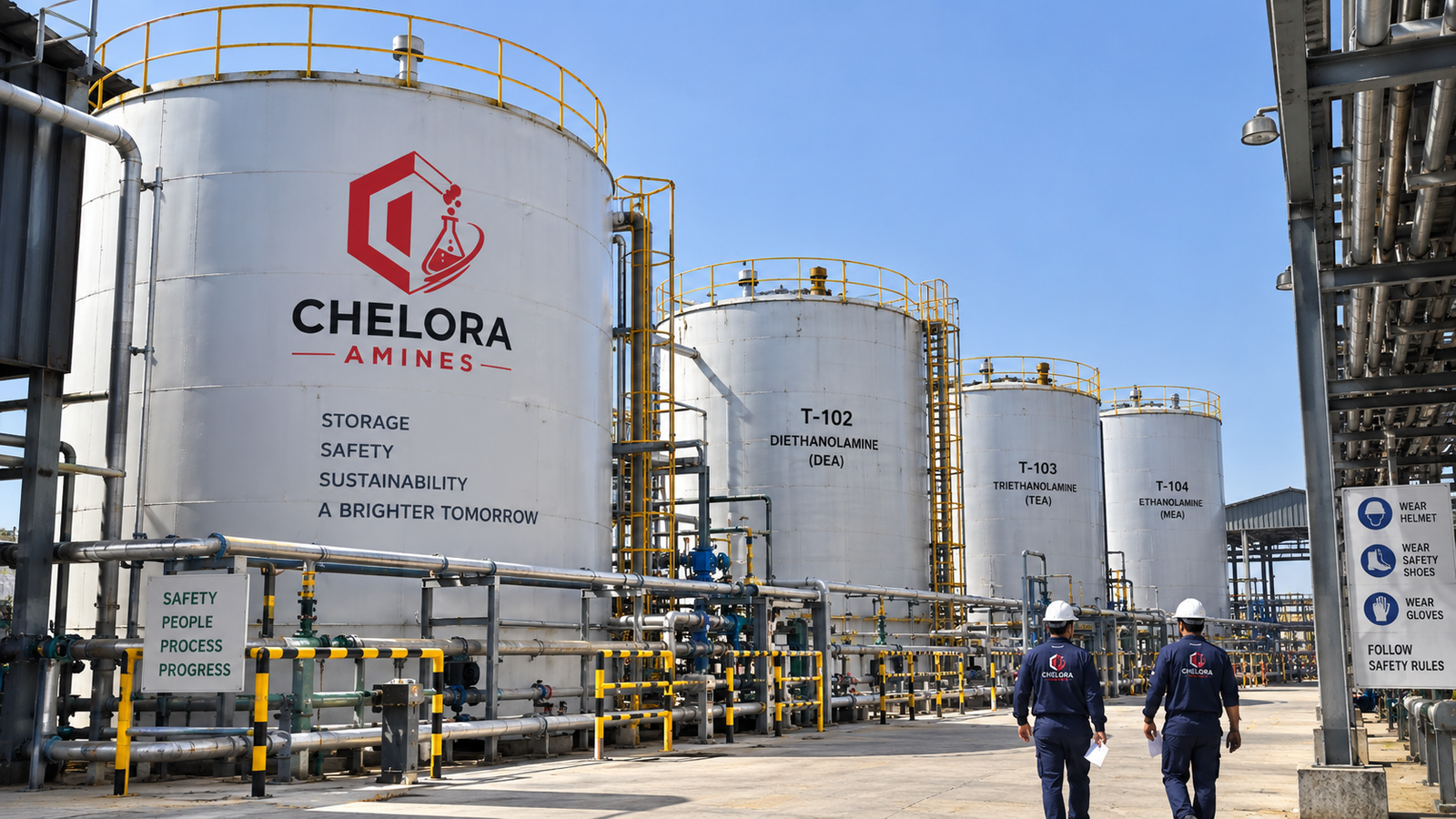
ISO tanks and tankers for monomer and polyurethane plants.
Share your monthly consumption, the application and your flammable-liquid storage capacity, and we will recommend the grade, pack size and delivery schedule that keeps your plant running without excess inventory. Export consignments are packed in UN-specification or export-grade containers, palletised and stretch-wrapped, and shipped FOB, CIF or CFR through Nhava Sheva and Mundra.
Plan my supplyN,N-Dimethylethanolamine is a flammable liquid that causes severe skin burns and eye damage and is harmful if swallowed, inhaled or in contact with skin. The notes below are a summary for planning only — always work to the Safety Data Sheet supplied with your consignment and your own site risk assessment.
DMEA ships as Class 8 corrosive with a Class 3 flammable subsidiary risk. That is routine for us, but it shapes the packing, labelling and paperwork before a first shipment moves.
| Item | Classification |
|---|---|
| Proper shipping name | 2-Dimethylaminoethanol |
| UN number | UN 2051 |
| Hazard class | Class 8, subsidiary risk 3 |
| Packing group | II |
| Labels | Corrosion and flame pictograms |
| Modes | Road, sea (IMDG) and air within dangerous goods quantity limits |
| Segregation | Away from acids, oxidisers and ignition sources |
DMEA is a flammable, corrosive dangerous good, and alkylethanolamines appear on chemical export-control lists in some jurisdictions. We supply it only against verified company credentials and a stated industrial end use, and we confirm any licence, declaration or inventory listing for your destination before the shipment is booked.
Start account opening| Parameter | Specification | Result |
|---|---|---|
| Appearance | Clear liquid | Complies |
| Purity (GC) | ≥ 99.5 % | Complies |
| Water (KF) | ≤ 0.2 % | Complies |
| Colour (APHA) | ≤ 15 | Complies |
| Density (20 °C) | 0.884 – 0.890 g/cm³ | Complies |
N,N-Dimethylethanolamine is checked before dispatch and each consignment leaves with the paperwork your QC, stores and accounts teams need on day one.
The numbers on a Certificate of Analysis are only useful if you know how they were produced. These are the methods behind the figures on ours, and the checks worth repeating at your own goods-inward.
Separates N,N-dimethylethanolamine from the related amines made in the same reactor, and gives the assay and impurity profile that matter most to your formulation.
An independent check on total amine content, useful as a quick goods-inward confirmation before a drum is released to production.
Water determination, which matters for anhydrous grades and confirms strength on aqueous grades.
A visual platinum–cobalt comparison. A rising colour value is the earliest sign that a pack has been exposed to air, heat or held too long.
Fast confirmation that the material is what the label says, and a simple way to spot dilution or the wrong pack.
Confirms the boiling range is tight around 134 °C, which flags light or heavy contaminants before a drum is released.
A sample from every dispatched batch is held here, so a query months later can be settled against the original material rather than an argument.
Batch number on the label ties back to the COA, the test record and the supply lot, which is what your auditor will ask to see.
Where your customer or regulator needs an independent result, we can arrange analysis at a NABL-accredited laboratory before dispatch.
Five steps for a first order of N,N-dimethylethanolamine. Repeat orders follow the same route on a schedule that matches your consumption.
Grade, quantity, pack size and delivery location or destination port.
We confirm the grade for your application and quote, usually within 24 hours.
The batch is tested and the COA, SDS and invoice details are prepared.
Labelled packs move by road, or in export packing for overseas buyers.
Material reaches your gate and repeat dispatches are scheduled to your usage.
N,N-Dimethylethanolamine is a commodity on a price list. What separates suppliers is grade flexibility, the paperwork and the answer you get when something is not routine.
N,N-Dimethylethanolamine sits alongside more than fifty other amines we stock, from ethanolamines to fatty amines. Your purchase team raises one enquiry, compares one quote and manages one vendor record instead of six.
Different purities and supply forms of N,N-dimethylethanolamine are available, so you are not forced to redesign a formulation around the only grade your supplier happens to carry.
COA, SDS, correct HSN and HS codes, transport declarations and certificates of origin are prepared with the consignment, not chased afterwards by your logistics team.
Tell us your limits on purity, related amines, water or colour and we quote against them, rather than sending the standard cut and letting your QC department find out.
Once we know your monthly draw we hold and release material on a schedule, so you carry less inventory than you otherwise would.
Describe the application rather than the product code and we will tell you which grade fits — and say so plainly when a different amine would serve you better.
Buyers who order N,N-dimethylethanolamine usually source these from the same list. Open any product for its specification, grades and packing, or see the full product range.
Container shipments to buyers on five continents, plus road dispatch inside India. Tell us your country and destination port and we will quote landed terms, transit time and the documentation your customs broker will ask for.
United Arab Emirates, Saudi Arabia, Oman, Qatar, Kuwait, Bahrain, Jordan, Egypt, Morocco, Kenya, Tanzania, Ethiopia, Nigeria, Ghana and South Africa.
Bangladesh, Sri Lanka, Nepal, Pakistan, Vietnam, Thailand, Indonesia, Malaysia, Singapore, the Philippines, South Korea, Japan, Taiwan, Australia and New Zealand.
Germany, the Netherlands, Belgium, France, Italy, Spain, Portugal, Poland, Czechia, the United Kingdom, Ireland, Türkiye, Russia, Ukraine, Kazakhstan and Uzbekistan.
United States, Canada, Mexico, Brazil, Argentina, Chile, Colombia, Peru, Ecuador and the Caribbean, shipped in UN-specification packaging with full DG documentation.
| Incoterms quoted | EXW, FOB, CFR, CIF and DAP, depending on your destination and preference |
| Load ports | Nhava Sheva (JNPT) and Mundra, with Chennai and Kolkata used for eastbound routings |
| Container options | Full container loads, and consolidated LCL shipments for smaller quantities |
| Typical container fill | Around 80 drums of 200 kg, or roughly 18 to 20 IBC totes, in a 20 ft container |
| Packing for export | UN-specification drums and totes, palletised, strapped and stretch-wrapped, with DG labelling |
| Air freight | Possible for small quantities, within dangerous goods limits where the product is classified |
| Payment terms | Advance, irrevocable letter of credit or agreed credit terms for established accounts |
| Before first shipment | Company credentials, end-use declaration and any import permit the destination country requires |
Most delays in quoting N,N-dimethylethanolamine come from a missing line in the enquiry, not from availability. Send these eight details and a firm price usually comes back the same day.
Not sure of some of it yet? Send what you have. A description of the application and an approximate monthly volume is enough for us to come back with a recommended grade, a pack plan and an indicative price.
Send an enquiryPlain definitions of the words that appear on a N,N-dimethylethanolamine specification, label and shipping document.
Short answers to what purchase, plant and QC teams ask us most about this product. Anything else, ask us directly.
Send the grade, quantity, pack size and your delivery address or destination port. We come back with a price, the documents that go with the batch and a dispatch or shipping plan, usually within 24 hours.