
Polyurethane Potting Helps Protect EV Battery Management Electronics from Failure: The Role of Amine Catalysts and Curing Agents
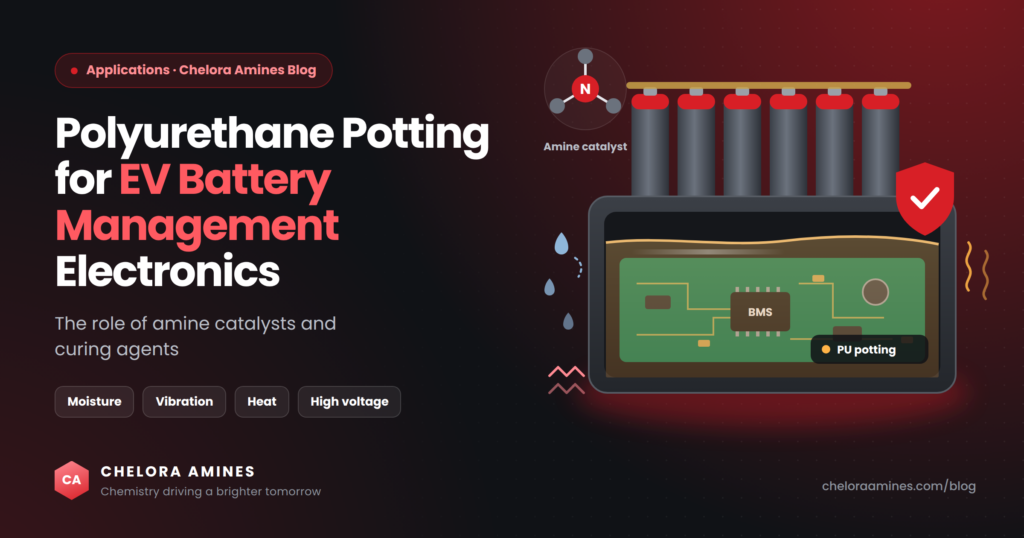
Home/ Blog/ Applications/ Polyurethane potting for EV BMS electronics Applications Polyurethane Potting Helps Protect EV Battery Management Electronics from Failure: The Role of Amine Catalysts and Curing Agents How polyurethane potting protects EV battery management electronics from moisture, vibration and heat, and which amines catalyse and cure the compound. Chelora Amines Technical Team · 26 September 2026 · 13 min read 10+ yearsHow long an EV battery, and the BMS board inside it, is expected to keep working 120–130 °CTypical upper continuous service temperature of polyurethane potting 3 roles for aminesCatalysts, curing agents and the precursors behind the isocyanate On this page What a BMS does, and why it is vulnerable How unprotected BMS electronics fail How polyurethane potting protects Polyurethane vs epoxy vs silicone Where amines fit into the compound What to check when buying amines How potting reached EV batteries Questions formulators are asking Amines in this article N-Methylmorpholine N,N-Dimethylethanolamine Triethanolamine MOCA (MBOCA) 4,4′-Methylenedianiline Isophorone Diamine Triethylenetetramine All products Sourcing for a potting line? Send the full chemical name, grade, quantity, pack size and delivery location. Request a quote Request a sample +91 98191 11179 Polyurethane potting protects the electronics of an electric vehicle’s battery management system (BMS) by filling the space around the circuit board with a cured resin that seals out moisture, damps vibration and insulates high-voltage tracks. The BMS is the part of a battery pack that measures every cell’s voltage and temperature, balances charge between cells and opens the contactors when something goes wrong, so a failed board can take the whole pack offline or, worse, stop it noticing a fault. Potting is one of the most reliable ways to keep that board working for the ten or more years an EV battery is expected to last. The resin itself is a piece of amine chemistry, and knowing it helps both formulators and anyone sourcing from an amines supplier in India: tertiary amines speed up the curing reaction, aromatic and cycloaliphatic diamines harden it, and the isocyanates at its core are made from amine precursors. This guide from Chelora Amines, which supplies industrial amines to formulators across India, explains why BMS electronics fail, how polyurethane compares with epoxy and silicone, which amines go into a potting compound, and what formulators should check before choosing raw materials. Polyurethane vs epoxy vs silicone potting at a glance Property Polyurethane Epoxy Silicone Hardness range Soft elastomer to semi-rigid Rigid Very soft gel to soft elastomer Stress on components Low to moderate Higher, due to rigidity Very low Low-temperature flexibility Good Limited Excellent Typical upper service temperature Around 120–130 °C Often 150 °C or more Often 180–200 °C Adhesion to housings Good Excellent Fair, often needs primer Moisture sensitivity during cure High (isocyanate reacts with water) Low Low to moderate Where it suits BMS work Vibration-prone boards and connectors Hot, rigid or chemically exposed parts Delicate or very hot assemblies What does a battery management system do, and why is it vulnerable? A battery management system is the electronic controller that keeps a lithium-ion pack within its safe operating limits. It is vulnerable because it sits inside, or right next to, one of the harshest environments in the vehicle. A typical EV pack uses a main BMS controller plus several cell-monitoring boards, each wired to a group of cells. Together they read cell voltages to a few millivolts, track temperatures, estimate state of charge and state of health, balance cells so they age evenly, and command the contactors and fuses that isolate the pack. The boards carry low-voltage logic next to connections that can sit at several hundred volts, and they are often mounted within centimetres of the cells, coolant plates and busbars. Inside the EV battery pack, that location exposes them to temperature swings from sub-zero mornings to hot summer charging, to road vibration and shock, to condensation when a cold pack meets humid air, and in some designs to coolant or salt-laden moisture if a seal fails. Unlike a failed infotainment screen, a failed BMS is a safety issue: if it misreads a cell, it may allow over-charging or miss the early signs of overheating. That is why the board’s protection matters as much as its design. How do BMS electronics fail without protection? BMS electronics without protection most often fail through moisture-driven corrosion, vibration fatigue and electrical leakage between closely spaced conductors. These mechanisms usually act together and worsen with age. Moisture is the most common culprit. A thin film of condensed water on a circuit board, especially if it dissolves flux residues or road salt, allows electrochemical migration: metal ions move between tracks under voltage and grow fine dendrites that eventually short them. Corrosion of solder joints and connector pins raises resistance and gives false voltage readings. Vibration and repeated shock crack solder joints and loosen heavy components such as relays, capacitors and transformers. Thermal cycling adds a further strain because the board, the components and the solder expand at different rates. At high voltage, contamination and humidity can also cause tracking and partial discharge across the board surface. Each of these problems can be slowed by good board design, cleaning and enclosure sealing. Potting goes a step further by removing the air gap altogether, so there is no space for condensation to form and no room for components to move. How does polyurethane potting protect BMS electronics? Polyurethane potting protects BMS electronics by electronic encapsulation of the assembly in a continuous, bonded layer of elastomer that blocks moisture, cushions components and electrically insulates the circuit. The liquid resin is dispensed into a housing or around the board, flows into gaps, and cures in place into a solid that is flexible, tough or semi-rigid depending on the formulation. Its protective effects fall into five groups: Moisture barrier The cured polymer keeps water and salt away from tracks and joints. Mechanical support It holds heavy parts in place and spreads vibration and shock. Electrical insulator It raises the voltage the board can withstand between
What Does BRICS 2026 Mean for India’s Chemical Industry and the Amines Supply Chain?
Home/ Blog/ Industry News/ BRICS 2026 and the amines supply chain Industry news What Does BRICS 2026 Mean for India’s Chemical Industry and the Amines Supply Chain? The New Delhi Declaration puts chemical manufacturing on the BRICS industrial agenda. Here is what that reaches inside an amines plant — and what it leaves exactly as it was. Chelora Amines Technical Team · 24 September 2026 · 10 min read 12–13 Sep18th BRICS Summit, New Delhi, under India’s chairship Paragraph 70The single paragraph that names the chemical industry Zero tariff cutsNo free trade agreement and no common currency either BRICS 2026 did not hand India’s chemical industry a tariff concession or a new market overnight, but it did something less common: the New Delhi Declaration, adopted on 12 September 2026, names chemical production as an area for joint work. In paragraph 70, leaders agree that chemical plants across the bloc should become more digital, more sustainable and more innovative, and they give that task to the BRICS Working Group on Chemical Industry; the paragraphs around it add commitments on industrial skills, product standards, value chains, customs and finance for small exporters. For companies that buy or ship industrial amines, those commitments land in very practical places. Amines feed gas-treating units, crop-protection formulations, pharmaceutical syntheses, epoxy flooring, boiler water programmes and rubber compounds, and each of those end uses is touched by a different part of the declaration. This guide from Chelora Amines reads the declaration from the angle of the amines supply chain: what the text actually says, which customer industries it reaches, what stays unchanged, and what purchase and export teams can sensibly do in the months ahead. What the declaration puts in motion A brief for the Working Group on Chemical Industry Industry 4.0 support through the BRICS Centre for Industrial Competencies Talks between national standards bodies Customs cooperation and digitised trade paperwork Credit principles and invoice discounting for exporting MSMEs What it leaves untouched Import duties on amines, in India and in every member market Dangerous-goods classification, packing and labelling REACH, CBAM and sanctions obligations India’s foreign exchange rules Your SDS, COA and grade specifications What this article covers Where chemicals appear in the declaration Which amine users are touched Industry and standards cooperation Trade, payments and customs MSMEs, traders and finance Milestone, or turning point? Six things to do now Questions buyers are asking Chemicals in the New Delhi Declaration at a glance Item Details Summit 18th BRICS Summit, New Delhi, 12–13 September 2026, under India’s chairship Direct chemical mention Paragraph 70: a more digital, sustainable and innovative chemical sector, pursued via the Working Group on Chemical Industry Industrial support Paragraph 72: BRICS Centre for Industrial Competencies with UNIDO; India Centre for BRICS Industrial Competencies established Standards Paragraph 118: progress towards an MoU between BRICS national standards bodies Value chains Paragraphs 84 and 86: resilient supply chains, higher-value manufacturing, GVC Action Plan 2026–2030 MSMEs Paragraphs 71 and 85: first BRICS SME Forum, credit assessment principles, Jaipur Consensus on invoice discounting What did not change No tariff cuts, no free trade agreement, no common currency Where does the chemical industry appear in the New Delhi Declaration? The chemical industry appears by name in paragraph 70 of the New Delhi Declaration, and indirectly in more than a dozen other paragraphs on industry, trade, agriculture, health and energy. The direct mention is short, but its placement tells you how BRICS now treats the sector. Paragraph 70 sits inside a section on industrial cooperation. It notes that BRICS runs seven specialised working groups under that track and names three of them: the Photovoltaic Industry Working Group, the Intelligent Manufacturing and Robotics Working Group, and the BRICS Working Group on Chemical Industry. In other words, chemicals are grouped with solar manufacturing and smart factories as an industrial capability the members want to build together, rather than being treated only as goods that cross borders. Leaders “acknowledge the importance” of a cleaner, more digital chemical sector. They do not announce a fund, a tariff schedule or a joint project for it. The value sits in the brief this gives the working group, and in the commitments around it. Anyone who wants to read the original wording can find the full text of the New Delhi Declaration on the Prime Minister of India’s website. Which amine-consuming industries are touched by BRICS 2026? BRICS 2026 touches at least four large groups of amine users: energy and gas processing, agriculture, pharmaceuticals, and infrastructure with water treatment. Each is linked to a separate part of the declaration, so the effect on the amines supply chain depends on which customers a supplier serves. Energy paragraphs Gas treating and carbon capture The energy paragraphs accept that fossil fuels will keep an important place in the energy mix of developing economies while calling for cleaner transitions, and they encourage joint work on standards for low-emission hydrogen. Both points matter to alkanolamine users. Monoethanolamine, diethanolamine and diisopropanolamine are the classic solvents for stripping carbon dioxide and hydrogen sulphide from natural gas, refinery streams and synthesis gas, and MEA remains the reference solvent for capturing carbon dioxide from flue gas. A bloc that expects gas processing to continue and wants to grow carbon markets is, in effect, a steady market for amine-based gas treating. Paragraph 60 Agriculture and crop protection Paragraph 60 looks forward to discussions on easing intra-BRICS trade in agricultural and food production inputs through resilient, non-discriminatory supply chains, and it names fertiliser shortages as a risk to food security. Several amines sit upstream of crop protection. Isopropylamine is used to make the isopropylamine salt found in many glyphosate formulations and, with ethylamine, goes into triazine herbicides such as atrazine. If intra-BRICS trade in agro-inputs becomes easier, Indian formulators and technical manufacturers serving BRICS markets will need a dependable flow of these amines behind them. Paragraph 52 Pharmaceuticals and medical products Paragraph 52 encourages BRICS medical products regulators to extend their cooperation to all member countries and welcomes a