Dimethylamine, Diethylamine and Triethylamine: Key Industrial Applications
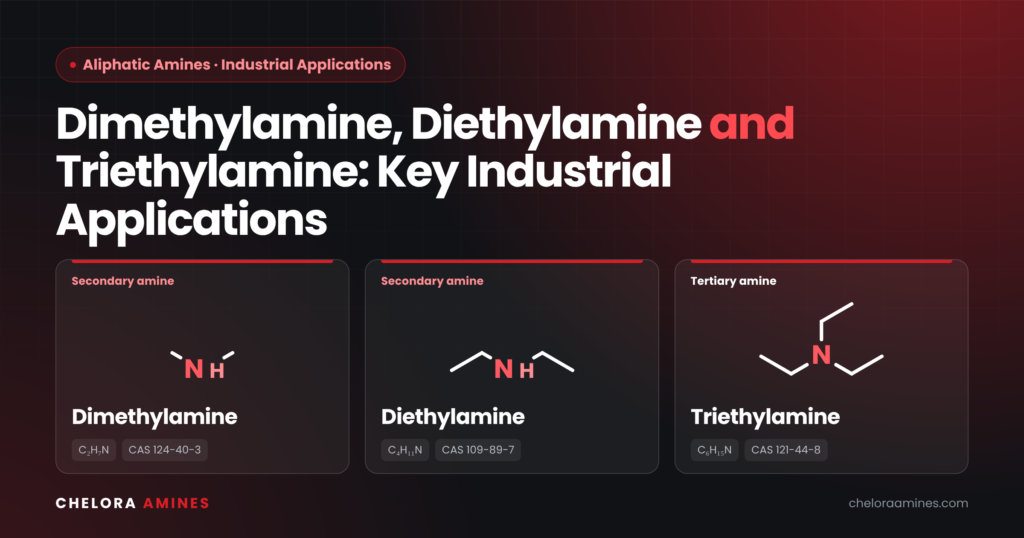
Dimethylamine, Diethylamine and Triethylamine Uses | Chelora Amines Home/Blog/Aliphatic Amines/Dimethylamine, Diethylamine and Triethylamine Uses Aliphatic Amines · Applications Guide Dimethylamine, Diethylamine and Triethylamine: Key Industrial Applications Dimethylamine, diethylamine and triethylamine uses in DMF, metformin, rubber accelerators, acid scavenging and foundry cores, with CAS numbers and safety. Chelora Amines Technical Team · 19 October 2026 · 13 min read 7 · 55.5 · 89.5 °CBoiling points of DMA, DEA and TEA: a gas, a volatile liquid and a heavier liquid 2 + 1Two secondary amines and one tertiary amine: the N–H bond decides the job 47 aminesAcross six chemistry families, every batch with its COA and SDS On this page At a glance What are they? Dimethylamine uses Diethylamine uses Triethylamine uses Diethylamine vs triethylamine How they are made Specification checks Hazards and storage Qualifying a supplier Frequently asked questions Related reading Dimethylamine (DMA) Diethylamine Triethylamine (TEA) Cyclohexylamine vs Dicyclohexylamine Ethyleneamines in Water Treatment All products Need DMA, DEA or TEA?Tell us the reaction and monthly consumption. We suggest the grade and pack and reply with price, lead time and delivery terms.Request a sample or quote+91 98191 11179 Dimethylamine, diethylamine and triethylamine are short-chain aliphatic amines made from methanol or ethanol and ammonia, and they sit at the start of many pharmaceutical, agrochemical, rubber, solvent and water treatment value chains. Dimethylamine (DMA, CAS 124-40-3) is a secondary amine best known as the feedstock for DMF, metformin and 2,4-D amine salt. Diethylamine (CAS 109-89-7) carries an N,N-diethyl group into rubber accelerators, DEET, lidocaine and corrosion inhibitors. Triethylamine (TEA, CAS 121-44-8) is a tertiary amine used mostly as an acid scavenger in API synthesis and as the vapour catalyst in foundry cold-box core making. For a buyer, the practical point is that dimethylamine, diethylamine and triethylamine look alike on a purchase order but behave very differently in a reactor. One N–H bond, or none, decides whether the amine ends up inside your molecule or gets washed out as a salt. Physical form matters too: DMA boils at about 7 °C, so it arrives as a solution or a pressurised gas. This guide covers where each amine is used, how to read a specification, how to store it and how to qualify a supplier. Dimethylamine, Diethylamine and Triethylamine at a Glance Secondary amineDMAC2H7N · 124-40-3 Secondary amineDEAC4H11N · 109-89-7 Tertiary amineTEAC6H15N · 121-44-8 Property Dimethylamine Diethylamine Triethylamine Chemical name (IUPAC) N-Methylmethanamine N-Ethylethanamine N,N-Diethylethanamine Common names and synonyms DMA, dimethyl amine DEA, diethyl amine TEA, Et3N, triethyl amine CAS number 124-40-3 109-89-7 121-44-8 Molecular formula C2H7N, (CH3)2NH C4H11N, (C2H5)2NH C6H15N, (C2H5)3N Molecular weight 45.08 g/mol 73.14 g/mol 101.19 g/mol Amine class Secondary (one N–H) Secondary (one N–H) Tertiary (no N–H) Boiling point About 7 °C About 55.5 °C About 89.5 °C Typical appearance and form Colourless gas; sold as an aqueous solution or a liquefied gas under pressure Colourless, volatile liquid, supplied neat Colourless liquid, supplied neat Chemical family Methylamines (aliphatic amines) Ethylamines (aliphatic amines) Ethylamines (aliphatic amines) Main applications DMF and DMAc solvents, metformin, 2,4-D amine salt, diuron, thiram, water treatment polymers, surfactants ZDEC rubber accelerators, DEET, lidocaine, diethylcarbamazine, DEEA, corrosion inhibitors Acid scavenger in API and agro synthesis, foundry cold-box catalyst, quaternary ammonium salts Key hazard (GHS) Danger: extremely flammable gas (solutions highly flammable); harmful if inhaled; serious eye damage Danger: highly flammable liquid; causes severe skin burns and eye damage; harmful if inhaled Danger: highly flammable liquid; toxic if inhaled or in contact with skin; causes severe burns UN number UN 1032 (anhydrous), UN 1160 (solution) UN 1154 UN 1296 Available from Chelora Amines Dimethylamine product page Diethylamine product page Triethylamine product page Typical literature values for orientation. The controlling figures are on the Certificate of Analysis and SDS for your batch. What Are Dimethylamine, Diethylamine and Triethylamine? Dimethylamine, diethylamine and triethylamine are aliphatic amines: ammonia molecules in which two or three hydrogens have been replaced by methyl or ethyl groups. Dimethylamine and diethylamine are secondary amines with one N–H bond left, while triethylamine is a tertiary amine with none. That single difference drives almost every application. A secondary amine can still be acylated, so it reacts with acid chlorides, carbon disulfide, isocyanates and ethylene oxide and becomes part of the product. A tertiary amine takes up a proton, forms a salt and leaves. All three are strong bases, with conjugate-acid pKa values close to 11. Volatility is the other big difference. Dimethylamine is a gas at room temperature, so most Indian plants buy it as an aqueous solution. Diethylamine is a light liquid that evaporates quickly in a warm store, while triethylamine boils higher and becomes less soluble in water as it warms, which matters during aqueous work-up. What Is Dimethylamine Used For in Industry? Dimethylamine is used mainly to make solvents, pharmaceuticals, herbicides, water treatment polymers and surfactants. It is the methylamine the market wants most, and the main dimethylamine uses fall into five groups. Solvents. Carbon monoxide or methyl formate converts it to dimethylformamide (DMF), and acetic acid to dimethylacetamide (DMAc), the polar solvents behind acrylic fibre spinning, PU synthetic leather and API synthesis. Pharmaceuticals. Dimethylamine hydrochloride condenses with dicyandiamide to give metformin hydrochloride, made in large tonnages by Indian API plants. Dimethylamino groups also appear in diphenhydramine and tramadol. Agrochemicals. It neutralises 2,4-D to give the water-soluble 2,4-D amine salt used against broadleaf weeds in wheat, rice and sugarcane, supplies the dimethylurea part of diuron and isoproturon, and with carbon disulfide gives thiram and ziram. Water treatment. It is a raw material for polyDADMAC and epichlorohydrin–dimethylamine polyamines, cationic coagulants for drinking water, effluent and paper retention. For how amines fit into boiler and cooling programmes, see our guide to ethyleneamines in water treatment. Surfactants and coatings. Fatty alkyldimethylamines are oxidised to amine oxides for detergents, and ethoxylation gives N,N-dimethylethanolamine, a neutraliser for waterborne coatings and a polyurethane catalyst. Thiram doubles as a rubber accelerator, so dimethylamine also reaches tyre and footwear plants. In the Vapi, Ankleshwar and Dahej belts it is mostly bought as an agrochemical or API raw material. What Is
Cyclohexylamine vs Dicyclohexylamine: Differences and Applications
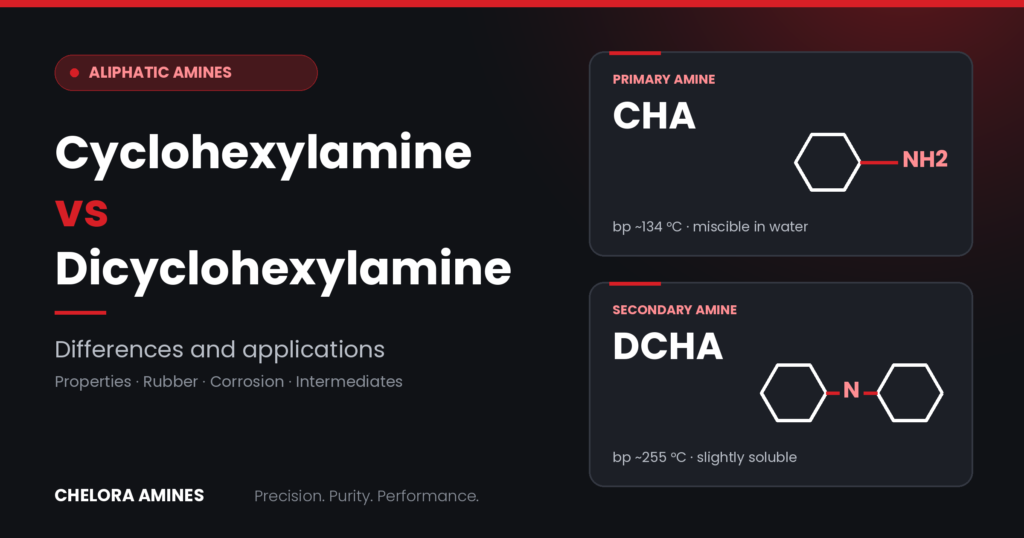
Cyclohexylamine vs Dicyclohexylamine: Differences & Uses | Chelora Amines Home/Blog/Aliphatic Amines/Cyclohexylamine vs Dicyclohexylamine Aliphatic Amines · Comparison Cyclohexylamine vs Dicyclohexylamine: Differences and Applications Compare cyclohexylamine (CHA) and dicyclohexylamine (DCHA): properties, applications in rubber, corrosion control and intermediates, and how to choose and handle each. Chelora Amines Technical Team · 17 October 2026 · 5 min read 134 vs 255 °CBoiling points of CHA and DCHA: one volatile, one low-volatility 1 vs 2 ringsCyclohexyl rings on nitrogen: primary amine versus secondary amine Miscible vs slightWater solubility, which decides how each amine is handled and used On this page What are CHA and DCHA? The key differences Applications of CHA Applications of DCHA Which one do you need? What buyers should specify Handling and safety Frequently asked questions Related reading Cyclohexylamine (CHA) Dicyclohexylamine (DCHA) Ethyleneamines in Water Treatment Octadecylamine All products Need CHA or DCHA?Tell us the product, grade, quantity and delivery address. We reply with price, lead time and delivery terms.Request a quote+91 98191 11179 Cyclohexylamine and dicyclohexylamine sound like near-identical products, and buyers sometimes treat them as interchangeable. They are not. One is a small, volatile, water-miscible amine; the other is a heavier, oily, low-volatility amine with a very different set of jobs. Both come from the same chemistry and often from the same plant, but they are specified, handled and used differently. This article sets out how they differ, where each is used, and what to check before ordering. What Are CHA and DCHA? Cyclohexylamine (CHA, CAS 108-91-8) has one cyclohexyl ring attached to an amino group. Dicyclohexylamine (DCHA, CAS 101-83-7) has two cyclohexyl rings on the same nitrogen, making it a secondary amine. Both are typically produced by hydrogenating aniline over a catalyst, with the process conditions steering the split between the two products. One feedstock, two products Aniline→hydrogenationCHA · primary amine Aniline→hydrogenationDCHA · secondary amine Process conditions steer the split between the two products. Primary amineCHAC6H13N · 108-91-8 Secondary amineDCHAC12H23N · 101-83-7 Property Cyclohexylamine (CHA) Dicyclohexylamine (DCHA) CAS number 108-91-8 101-83-7 Formula / mol. weight C6H13N / about 99 C12H23N / about 181 Amine type Primary Secondary Appearance Colourless to yellowish liquid, strong fishy amine odour Colourless to pale yellow liquid, milder amine odour Boiling point About 134 °C About 255 °C Volatility High; flammable liquid Low; much higher flash point Water solubility Miscible Slightly soluble Basicity Strong base Strong base Values are typical and should be confirmed on the batch certificate and safety data sheet. The Key Differences in Practice Volatility. CHA evaporates readily. That is useful when the amine has to travel with steam, and a nuisance for storage and odour control. DCHA stays put, which suits applications that need a persistent, low-vapour amine. Water behaviour. CHA mixes freely with water. DCHA does not, so it is handled as an oil-phase or organic-phase amine. Flammability. CHA is a flammable liquid with a low flash point and needs flammable-liquid storage practice. DCHA has a considerably higher flash point, though it is still combustible and corrosive. Steric bulk. Two bulky rings around the nitrogen make DCHA a hindered amine. That changes how it reacts and why it works as a salt-forming agent and as a building block for hindered products. Applications of Cyclohexylamine Steam and boiler condensate treatment. CHA is a volatile neutralising amine. It travels with steam and raises the pH of condensate to protect return lines from acid corrosion. For how this sits alongside other boiler and cooling programmes, see our guide to ethyleneamines in water treatment. Rubber chemicals. CHA is a raw material for sulfenamide vulcanisation accelerators used in tyre and technical rubber compounds. Agrochemical and fine chemical intermediates. Its primary amine group is used to build ureas, amides and other structures. Other uses. Corrosion inhibitor formulations, textile and dye auxiliaries, plasticiser and surfactant chemistry. Applications of Dicyclohexylamine Rubber chemicals. DCHA is a raw material for hindered sulfenamide accelerators that give delayed-action cure. Corrosion inhibition. DCHA salts have been used in vapour-phase and contact corrosion inhibitor packages for metal protection. Check current regulation on the specific salt, since some counter-ions face restrictions. Salt formation in peptide chemistry. DCHA is widely used to convert oily protected amino acids into crystalline salts that are easier to purify and store. Intermediates and additives. Antioxidant and stabiliser intermediates, catalysts, and auxiliaries for coatings, textiles and fuels. Which One Do You Need? If you need… Consider Why A volatile amine for steam or condensate treatment CHA It carries over with steam and neutralises acidity along the line A primary amine building block CHA The NH2 group reacts cleanly in acylation and urea formation A low-volatility, hindered amine DCHA Bulky, persistent and less prone to evaporation A crystallising counter-ion for protected amino acids DCHA Forms crystalline salts that purify well Delayed-action rubber acceleration Depends on the accelerator Both feed sulfenamide chemistry with different cure profiles What Buyers Should Specify Product and CAS number. State cyclohexylamine (108-91-8) or dicyclohexylamine (101-83-7) explicitly. Assay. Set a minimum purity suited to your downstream use. Cross-contamination. CHA grades can contain some DCHA and the reverse; if either matters, request a limit. Residual aniline. Both come from aniline, so ask for a limit on unreacted material, which affects odour, colour and downstream toxicity. Water content. Important for moisture-sensitive reactions and for anhydrous formulations. Colour (APHA). Amines darken on exposure to air, so a colour limit also checks storage and handling. Handling, Safety and Regulatory Points ! Important Both amines are corrosive and toxic, and both need careful handling. CHA is also flammable. DCHA is harmful to aquatic life. Always work from the current safety data sheet. Provide gloves, eye and face protection and effective ventilation; avoid skin contact, since both can be absorbed. Store CHA as a flammable liquid, away from ignition sources, acids and oxidisers; store DCHA cool and dry in tightly closed containers, segregated from acids and oxidisers. Use materials compatible with amines, and keep both out of drains. Industrial chemical inventories, import notifications and transport classification vary by country, so confirm the position for your
Ethyleneamines in Water Treatment: Uses, Selection and Performance Factors
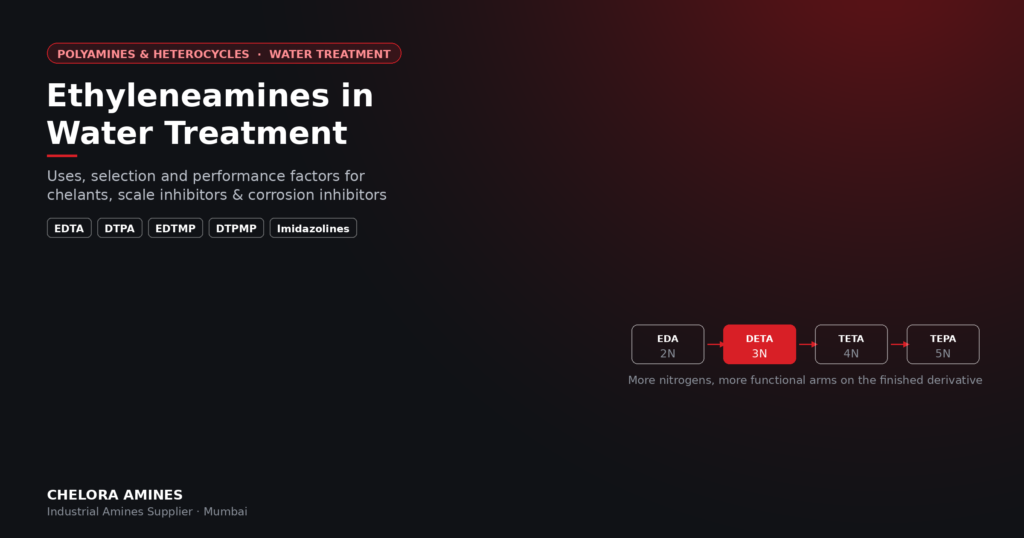
Ethyleneamines in Water Treatment: Uses & Selection | Chelora Amines Home/ Blog/ Polyamines & Heterocycles/ Ethyleneamines in Water Treatment Polyamines & Heterocycles · Water Treatment Ethyleneamines in Water Treatment: Uses, Selection and Performance Factors How ethyleneamines in water treatment become chelants, phosphonate scale inhibitors, corrosion inhibitors and membranes, and how to select the right grade. Chelora Amines Technical Team · 13 October 2026 · 11 min read 5 → ManyFive core ethyleneamines become chelants, phosphonates, inhibitors, coagulants and membranes 4 / 5 armsAcetate arms on EDTA (from EDA) versus DTPA (from DETA) — nitrogen count sets chelant capacity 5-step qualificationFrom defining the derivative and water to a locked, plant-trialled specification On this page At a glance What are ethyleneamines? How they’re used in water treatment Chelants & phosphonate inhibitors Corrosion inhibitors, coagulants & membranes Selecting the right ethyleneamine Performance factors Qualifying a new amine source How the chemistry developed What buyers should check Hazard and storage Choosing a supplier Questions formulators ask Related reading Ethyleneamines on the products page Ethylenediamine (EDA) Diethylenetriamine (DETA) Triethylenetetramine (TETA) Piperazine All products Need a quote today? Tell us the derivative you’re formulating and the amine, grade and quantity you need. Request a quote +91 98191 11179 Ethyleneamines are aliphatic polyamines built from repeating –CH2CH2NH– units, such as ethylenediamine (EDA, CAS 107-15-3) and diethylenetriamine (DETA, CAS 111-40-0). Their main job in water treatment is as building blocks, not as chemicals dosed straight into the water. Ethyleneamines in water treatment end up inside EDTA and DTPA chelants, aminophosphonate scale inhibitors such as DTPMP, imidazoline corrosion inhibitors, polyamine coagulants, ion-exchange resins and the piperazine-based layers of nanofiltration membranes. The number of nitrogen atoms in the backbone decides how many functional “arms” the finished molecule carries, and that shapes how strongly it binds calcium, iron or barium. For a formulator blending cooling-water programmes in Vapi, or an RO antiscalant maker serving ZLD plants in Tiruppur, picking the right amine and the right grade affects active content, scale control at high pH, effluent phosphorus and batch-to-batch consistency. This guide from Chelora Amines explains where each ethyleneamine fits, how to choose between them and which factors decide field performance. 2 nitrogensEDA107-15-3 3 nitrogensDETA111-40-0 4 nitrogensTETA112-24-3 5 nitrogensTEPA112-57-2 Cyclic, solidPiperazine110-85-0 Ethyleneamines in Water Treatment at a Glance Ethyleneamine CAS / formula Main water treatment role Ethylenediamine (EDA) 107-15-3 / C2H8N2 Backbone of EDTA and EDTMP; branching agent in some polyamine coagulants Diethylenetriamine (DETA) 111-40-0 / C4H13N3 Backbone of DTPA and DTPMP; some cationic decolourising condensates Triethylenetetramine (TETA) 112-24-3 / C6H18N4 Imidazoline corrosion inhibitors; epoxy hardeners for tank and pipe linings; polyamine resins Tetraethylenepentamine (TEPA) 112-57-2 / C8H23N5 Imidazoline and amidoamine corrosion inhibitors for oilfield and pipeline water Piperazine 110-85-0 / C4H10N2 Active-layer monomer for polypiperazine-amide nanofiltration membranes What Are Ethyleneamines, and Why Do They Matter in Water Treatment? Ethyleneamines are a family of linear, branched and cyclic amines made from ethylene-based feedstocks, and they matter in water treatment because their nitrogen atoms are ideal anchor points for metal-binding and surface-active groups. Ask a formulator what are ethyleneamines and you will hear a list: ethylenediamine (EDA), diethylenetriamine (DETA), triethylenetetramine (TETA), tetraethylenepentamine (TEPA), heavier polyamines, and cyclic relatives such as piperazine. Each step up the chain adds one nitrogen. EDA carries two, DETA three, TETA four and TEPA five. All are water-soluble, strongly basic liquids except piperazine, which is a solid. In water treatment, that string of nitrogens is converted into acetate arms for chelants, phosphonate arms for scale inhibitors, or an imidazoline ring for corrosion inhibitors. How Are Ethyleneamines Used in Water Treatment? The main ethyleneamines uses in this sector fall into five groups: chelants, scale inhibitors, corrosion inhibitors, coagulants and separation materials. With ethyleneamines in water treatment, the amine is reacted first, and the derivative is what reaches the boiler, cooling tower, RO plant or pipeline. The table below maps each group to its usual backbone. Where Each Derivative Is Used Derivative group Typical backbone Where it works Aminocarboxylate chelants (EDTA, DTPA) EDA, DETA Boiler cleaning, metal control, industrial cleaners Aminophosphonates (EDTMP, DTPMP) EDA, DETA Cooling towers, RO antiscalants, oilfield scale squeeze Imidazoline corrosion inhibitors DETA, TETA, TEPA Produced water, pipelines, refinery water systems Polyamine coagulants and decolourants EDA, DETA Clarification, dye-house effluent colour removal Membranes, resins and linings Piperazine, TETA, DETA Nanofiltration, ion exchange, epoxy tank linings How Do Ethyleneamines Become Chelants and Phosphonate Scale Inhibitors? Ethyleneamines become chelants when their N–H positions are carboxymethylated, and scale inhibitors when they are phosphonomethylated. EDA gives EDTA with four acetate arms, and DETA gives DTPA with five. Those EDTA and DTPA chelants hold calcium, magnesium, iron and copper in solution, which is why they appear in boiler cleaning, chemical cleaning of heat exchangers and metal-ion control. DTPA generally binds iron more strongly and holds up better at higher pH than EDTA. Nitrogen count sets the number of acetate or phosphonate arms EDA→2 nitrogens Carboxymethylation →4 acetate arms EDTA DETA→3 nitrogens Carboxymethylation →5 acetate arms DTPA The same backbones, phosphonomethylated instead of carboxymethylated, give EDTMP and DTPMP — the aminophosphonate scale inhibitors used in cooling towers and RO antiscalants. Aminophosphonates work differently. Reacting EDA or DETA with formaldehyde and phosphorous acid gives EDTMP or DTPMP, which work at “threshold” doses well below the amount needed to bind every hardness ion. They distort crystal growth so calcium carbonate, calcium sulfate and barium sulfate stay dispersed instead of forming hard scale. DTPMP, built on diethylenetriamine CAS 111-40-0, is widely used where water runs hot, alkaline or rich in sulfate, which makes it a common choice in RO antiscalants and oilfield squeeze treatments. How Are Ethyleneamines Used in Corrosion Inhibitors, Coagulants and Membranes? Beyond chelants, heavier ethyleneamines build corrosion inhibitors, while EDA, DETA and piperazine help build coagulants and separation materials. Condensing tall-oil or other fatty acids with DETA, TETA or TEPA gives amidoamines that close into imidazolines. These film-forming molecules protect carbon steel in produced water, pipelines and refinery systems, and they are often quaternised or ethoxylated to improve water dispersibility. Boiler and condensate
Diethylenetriamine (DETA) vs Triethylenetetramine (TETA): Applications in Industrial Manufacturing
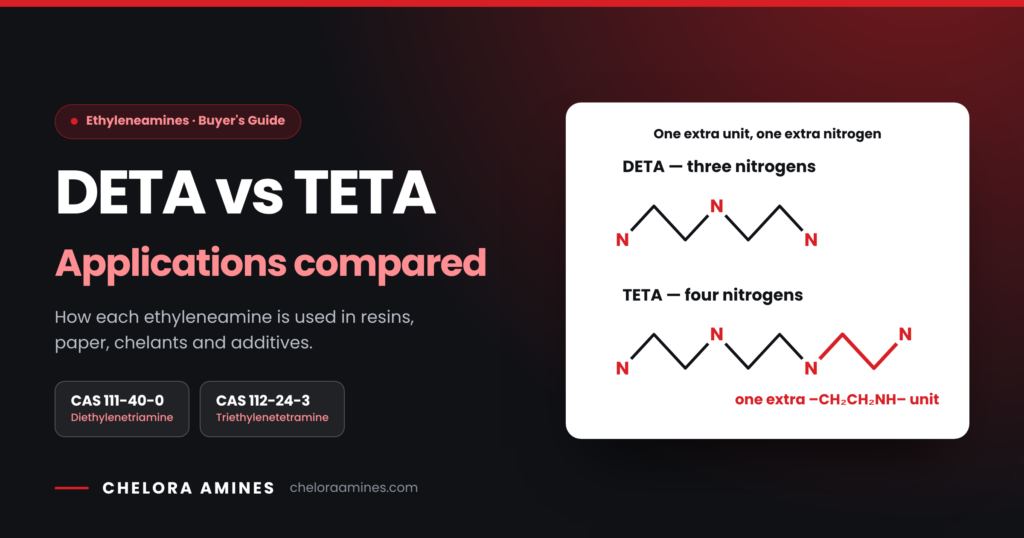
Home/ Blog/ Buyer’s Guides/ DETA vs TETA Ethyleneamines · Resins, paper & chelants Diethylenetriamine (DETA) vs Triethylenetetramine (TETA): Applications in Industrial Manufacturing DETA vs TETA compared: how each ethyleneamine is used in resins, paper, chelating agents, additives and coatings, and which suits your process. Chelora Amines Technical Team · 12 October 2026 · 11 min read 3 N → 4 NOne extra –CH2CH2NH– unit is the whole difference between DETA and TETA 20.6 / 24.4Amine hydrogen equivalent weights, which is why the dose per 100 parts of resin differs 6 steps → 1 gradeFrom naming the downstream product to a trialled, approved amine On this page DETA vs TETA at a glance Structural and physical differences Epoxy curing and coatings Paper wet-strength resins Chelating agents Fuel, lubricant and corrosion control Which one fits which application How to source DETA and TETA How ethyleneamines developed Questions buyers ask Related reading DETA and TETA Ethyleneamines for epoxy curing Chemicals suppliers in Telangana Morpholine vs cyclohexylamine guide All products Need a quote today? Send the amine, grade, quantity, pack size and delivery location. Request a quote +91 98191 11179 DETA vs TETA is a comparison most buyers first meet in the epoxy aisle, but the two ethyleneamines do far more work than curing resins. Diethylenetriamine (DETA, CAS 111-40-0) and triethylenetetramine (TETA, CAS 112-24-3) are neighbouring members of the polyethylene polyamine family — DETA carries three nitrogen atoms and TETA four — and that one extra –CH2CH2NH– unit changes volatility, viscosity, reactivity and the products each one is best placed to build. DETA is the backbone of paper wet-strength resins and the parent amine of the DTPA chelating agent; TETA is favoured where a heavier, lower-volatility polyamine is wanted for resins, additives and corrosion-control chemistry. Both feed epoxy hardeners, polyamide resins, fuel and lubricant additives and mineral-processing chemicals. This article maps the main diethylenetriamine applications and triethylenetetramine applications across industrial manufacturing and how to choose between them. For epoxy-specific dosage and cure behaviour, see our companion guide, EDA, DETA, TETA and TEPA Explained: Choosing an Ethyleneamine for Epoxy Curing. Chelora Amines supplies both amines alongside related industrial amines, chelating agents and phosphonates. Defined triamine DETA Diethylenetriamine · 3 nitrogens C4H13N3 · CAS 111-40-0 A comparatively clean single component — the reference amine for paper wet-strength resins and the parent amine of DTPA. Heavier tetraamine TETA Triethylenetetramine · 4 nitrogens C6H18N4 · CAS 112-24-3 Usually a mixture of linear, branched and cyclic isomers — lower volatility suits additives, inhibitors and TTHA. DETA vs TETA at a Glance Property DETA TETA CAS number 111-40-0 112-24-3 Formula C4H13N3 C6H18N4 Molecular weight 103.2 g/mol 146.2 g/mol Active amine hydrogens 5 6 Amine hydrogen equivalent weight About 20.6 About 24.4 Approx. boiling point About 207 °C About 270 °C (mixture of isomers) Composition Single, well-defined component Usually linear, branched and cyclic isomers Signature uses Wet-strength resins, DTPA, epoxy hardener Resins, additives, corrosion inhibitors, TTHA Available from Chelora Amines DETA on the products page TETA on the products page How Do DETA and TETA Differ Structurally and Physically? DETA and TETA are both aliphatic polyamines built from repeating ethylene-amine units, but TETA has one more unit than DETA, which raises its molecular weight from about 103 to about 146, adds a fourth nitrogen, and increases viscosity and boiling point. DETA — three nitrogens, five active amine hydrogensH2N–CH2CH2–NH–CH2CH2–NH2 TETA — four nitrogens, six active amine hydrogensH2N–CH2CH2–NH–CH2CH2–NH–CH2CH2–NH2 Both are produced by the same ethyleneamine chemistry, in which ammonia reacts with ethylene dichloride or is reductively aminated from ethanolamine feedstocks, yielding a family of products that is then separated by distillation. DETA comes out as a comparatively clean, single compound. Commercial TETA, by contrast, is typically a blend of linear TETA with branched and piperazine-containing (cyclic) isomers, so two TETA lots from different producers can behave slightly differently even at the same nominal purity. For process buyers this matters: where a downstream reaction or cure schedule is tuned to a specific isomer balance, the certificate of analysis should be checked for more than a single assay number, whichever ethyleneamines supplier in India or overseas is chosen. The higher boiling point and lower vapour pressure of TETA make it somewhat less volatile and less odorous in open handling than DETA, while DETA’s lower viscosity makes it easier to pump, meter and blend. Both are strongly basic, corrosive and hygroscopic, and both react readily with carbon dioxide in air. How Are DETA and TETA Used in Epoxy Curing and Coatings? DETA and TETA are both used as hardeners that react through their active amine hydrogens with the epoxide groups of epoxy resin, and they are also widely converted into modified hardeners such as amine adducts and polyamide curing agents. Because their amine hydrogen equivalent weights differ, the dosage per 100 parts of resin differs too. As an illustration only, with a standard bisphenol-A resin of epoxide equivalent weight 190, stoichiometry points to roughly 11 parts of DETA or roughly 13 parts of TETA per 100 parts of resin; real formulations are adjusted from the supplier datasheet and trial cures. DETA cures faster and hotter; TETA gives a little more working time and is somewhat easier to handle. In industrial practice neat DETA and TETA are often replaced by adducts with epoxy resins or by polyamide hardeners made from them, which have lower volatility, milder odour and better handling. In this polyamide resin amine chemistry, the polyamine is reacted with dimerised fatty acids or other dibasic acids, and the choice between DETA and TETA helps set the viscosity, amine value and reactivity of the finished resin. The detailed cure comparison, including EDA and TEPA, is covered in the companion guide. Why Is DETA the Backbone of Paper Wet-Strength Resins? DETA is the standard amine for paper wet-strength resins: it is reacted with a dicarboxylic acid such as adipic acid to form a polyaminoamide, which is then cross-linked with epichlorohydrin to give polyamidoamine-epichlorohydrin (PAE) resin. From amine to wet-strength paper DETA→+ adipic acid Polyaminoamide →+ epichlorohydrin
Dodecylamine, Octadecylamine and Oleylamine: How Fatty Amines Work in Flotation and Corrosion Control
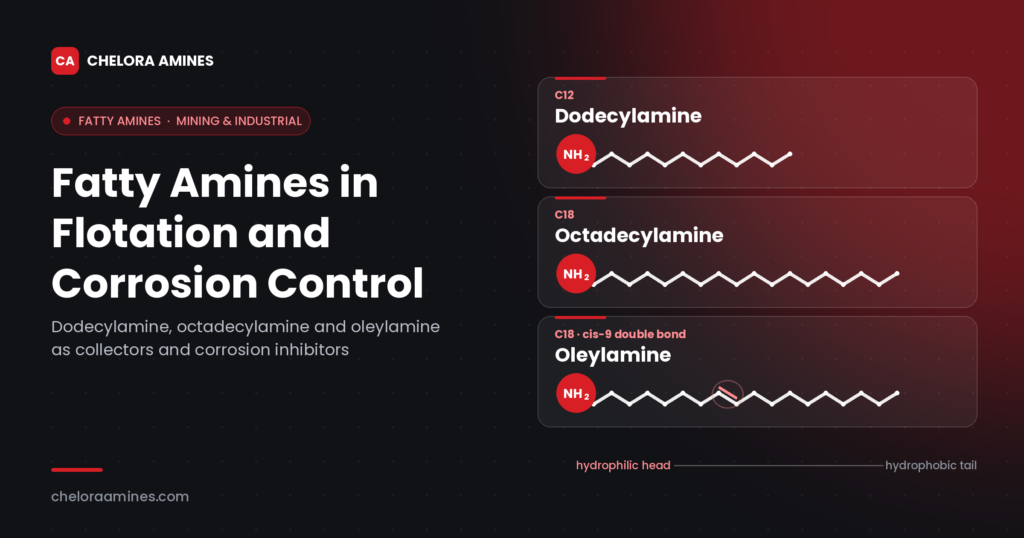
Home/ Blog/ Fatty Amines/ Fatty Amines in Flotation and Corrosion Control Fatty amines · Mining & industrial Dodecylamine, Octadecylamine and Oleylamine: How Fatty Amines Work in Flotation and Corrosion Control How dodecylamine, octadecylamine and oleylamine work as flotation collectors and corrosion inhibitors. Technical guide by Chelora Amines. Chelora Amines Technical Team · 05 October 2026 · 17 min read C12 → C18Chain length sets the balance between brine solubility and hydrophobicity 50–54 °COctadecylamine melts as a waxy solid; oleylamine stays liquid below 25 °C 5 steps → 1 gradeFrom spec review and bench tests to an approved plant-scale collector On this page Fatty amines at a glance What fatty amines are How they work in flotation How the three differ as collectors How they inhibit corrosion How to qualify a new amine Industrial history What to check in a specification How to choose a supplier in India Questions buyers ask Related reading Dodecylamine Octadecylamine Oleylamine Morpholine vs cyclohexylamine guide All products Need a quote today? Send the amine, grade, quantity, pack size and delivery location. Request a quote +91 98191 11179 Dodecylamine (laurylamine, CAS 124-22-1), octadecylamine (stearylamine, CAS 124-30-1) and oleylamine (CAS 112-90-3) are long-chain fatty amines that bring two valuable properties to industrial chemistry: a hydrophilic amine head that bonds selectively to mineral surfaces or metal oxides, and a hydrophobic alkyl tail that repels water. In mineral flotation, these fatty amines act as collectors, adsorbing onto the target mineral and making it air-attachable so it floats to the froth, separate from gangue. In corrosion control, the same amphiphilic structure lets them form protective monolayers on steel, copper and aluminium, cutting metal dissolution by blocking the electrochemical reactions that drive rust. Whether you are optimising a potash or phosphate flotation circuit or formulating a long-life rust preventive, the choice between dodecylamine, octadecylamine and oleylamine, and the grade and form factor, decides both performance and process economics. Chelora Amines supplies these three grades and related industrial amines. If your steam and condensate lines also need pH control, our guide to morpholine vs cyclohexylamine covers the neutralising amines that work alongside filming amines such as octadecylamine. Versatile C12 Dodecylamine Saturated primary amine C12H27N · CAS 124-22-1 Balanced solubility and hydrophobicity — the standard sylvite collector, also used in metalworking emulsions. Dense C18 film Octadecylamine Saturated primary amine C18H39N · CAS 124-30-1 Most hydrophobic of the three — high-selectivity collector and filming inhibitor for condensate lines. Liquid C18 Oleylamine Mono-unsaturated primary amine C18H37N · CAS 112-90-3 Liquid at ambient temperature — easy metering for dosing pumps and rust-preventive formulations. Fatty Amines at a Glance Property Dodecylamine Octadecylamine Oleylamine IUPAC name Dodecan-1-amine Octadecan-1-amine (Z)-octadec-9-en-1-amine CAS number 124-22-1 124-30-1 112-90-3 Molecular formula C12H27N C18H39N C18H37N Molecular weight 185.35 g/mol 269.51 g/mol 267.49 g/mol Typical appearance White waxy solid White crystalline solid Yellow oily liquid Chain length / saturation C12, saturated C18, saturated C18, mono-unsaturated (cis-Δ9) Main uses Flotation collector, corrosion inhibitor, bitumen emulsification Flotation collector, rust preventive, anti-stripping agent Corrosion inhibitor, surfactant intermediate, flotation modifier Key hazard (check the SDS) Corrosive; hazardous to aquatic life Corrosive; hazardous to aquatic life Corrosive; hazardous to aquatic life; combustible liquid Available from Chelora Amines Dodecylamine product page Octadecylamine product page Oleylamine product page What Are Fatty Amines, and Why Do They Matter in Industrial Chemistry? Fatty amines are primary, secondary or tertiary amines derived from natural fatty acids, typically palm, tallow, coconut or rapeseed oil, or from their synthetic equivalents. The primary fatty amines, which include dodecylamine, octadecylamine and oleylamine, carry a single –NH2 group at the end of a straight carbon chain. This pairing of a reactive amine head with a long hydrophobic tail makes them effective at interfaces: they orient themselves at mineral–water or metal–water boundaries, bonding chemically or electrostatically through the amine while the alkyl chain faces outward, disrupting wettability or blocking electrode reactions. In India’s mining and metallurgical sector, fatty amines have been in industrial use since phosphate and potash beneficiation plants expanded in the 1970s, largely through imported supply. Domestic production and distribution grew significantly after 1991 as the speciality chemicals sector liberalised. Today, fatty amines from suppliers in Maharashtra and Gujarat serve phosphate beneficiation around Udaipur and Jhamarkotra, iron ore plants in Odisha and Jharkhand, and the metalworking fluids industry clustered around Pune, Chennai and the NCR. Chelora Amines, a Mumbai-based fatty amine supplier, supplies these three grades with in-house testing and full documentation on every lot. How Do Fatty Amines Work as Collectors in Mineral Flotation? A flotation collector adsorbs selectively onto the target mineral surface and makes it hydrophobic, so air bubbles attach to the particles and carry them to the froth layer, while gangue minerals, which stay hydrophilic, sink to the tailings. Fatty amine collectors are cationic: at the slightly acidic to neutral pH of many flotation circuits, the amine group accepts a proton and becomes positively charged. Protonation of a primary fatty amineR–NH2 + H+ → R–NH3+ That cationic head is attracted to the negatively charged surfaces of silicate gangue minerals or, at the right pH, to the anionic surfaces of target minerals such as potassium chloride (sylvite) or calcium phosphate phases. How the amphiphilic molecule does the work Mineral surface→adsorbs –NH3+ head →tail out Hydrophobic particle →air bubble Froth The amine head bonds to the surface and the alkyl tail faces the water, so the particle attaches to air bubbles and floats; gangue that stays hydrophilic sinks to tailings. For sylvite (KCl) flotation from halite (NaCl), the core separation in potash beneficiation, dodecylamine acetate is the standard collector. The C12 chain gives a useful balance between water solubility and hydrophobicity, and the acetate form dissolves readily in the saturated brine of the flotation cell. The –NH3+ head adsorbs onto KCl in preference to NaCl, creating a hydrophobic coating that lets the sylvite float. Octadecylamine, with its C18 chain, is less soluble in cold brine and is typically used in warmer circuits or formulated with a short-chain modifier to aid dispersion. In phosphate flotation, the amine collector
Morpholine vs Cyclohexylamine: Choosing a Neutralising Amine for Boiler Water
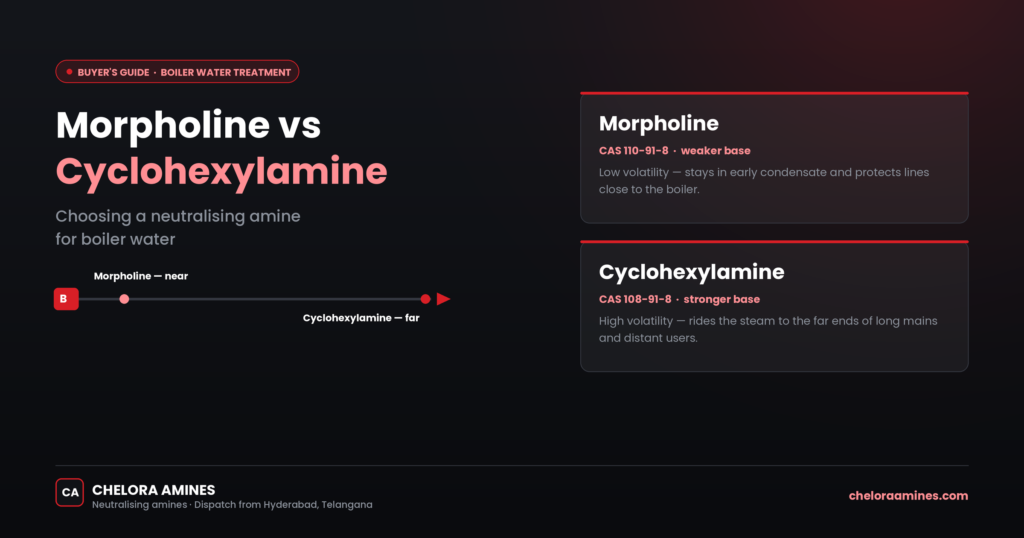
Home/ Blog/ Buyer’s Guides/ Morpholine vs Cyclohexylamine Buyer’s guide Morpholine vs Cyclohexylamine: Choosing a Neutralising Amine for Boiler Water Morpholine vs cyclohexylamine for boiler water: how basicity, volatility and system layout decide which neutralising amine protects your condensate lines. Chelora Amines Technical Team · 03 October 2026 · 9 min read 8.4 → 10.6 pKaBasicity climbs from morpholine to the much stronger cyclohexylamine ~0.4 → ~4Vapour-liquid distribution ratio: morpholine stays, cyclohexylamine travels 2 amines → 1 blendMany plants dose both to protect the whole steam circuit On this page Morpholine vs cyclohexylamine at a glance What a neutralising amine does What morpholine and cyclohexylamine are How they behave in a steam system When to choose each, or a blend How to select and qualify an amine What to check in a specification Hazards and storage How the chemistry developed How to choose a supplier in India Questions buyers ask Related reading Morpholine Cyclohexylamine EDA, DETA, TETA & TEPA guide MEA vs DEA vs TEA guide All products Need a quote today? Send the amine, grade, quantity, pack size and delivery location. Request a quote +91 98191 11179 Morpholine (CAS 110-91-8), a cyclic secondary amine, and cyclohexylamine (CAS 108-91-8), a primary alicyclic amine, are the two most widely used neutralising amines for boiler water, and the choice between them depends on how far your steam travels before it condenses. Morpholine is a weaker, low-volatility base that protects condensate close to the boiler. Cyclohexylamine is a stronger, highly volatile base that rides with the steam to the far end of long mains. In the morpholine vs cyclohexylamine decision, compact plants usually lean towards morpholine, sprawling sites towards cyclohexylamine, and many dose a blend. The stakes are practical. Carbonic acid in unprotected condensate thins return lines, and the iron it picks up goes back to the boiler as deposits that cut heat transfer. For a textile processor in Surat, a sugar mill in western Maharashtra or a chemical unit in Ankleshwar, that means leaking traps, lost condensate and unplanned shutdowns. Chelora Amines supplies morpholine, cyclohexylamine and related industrial amines for water treatment and process use. If you also work with the epoxy side of the amine family, our guide to EDA, DETA, TETA and TEPA compares the ethyleneamine hardeners, and MEA vs DEA vs TEA covers the ethanolamines used in gas treating. Stays near Morpholine Cyclic secondary amine C4H9NO · CAS 110-91-8 Weaker base, low volatility — protects condensate close to the boiler, deaerators and feedwater heaters. Travels far Cyclohexylamine Primary alicyclic amine C6H13N · CAS 108-91-8 Stronger base, high volatility — rides the steam to the far ends of long mains and distant users. Morpholine vs Cyclohexylamine at a Glance Property Morpholine Cyclohexylamine Chemical name (IUPAC) Morpholine (systematic: tetrahydro-1,4-oxazine) Cyclohexanamine Common names / synonyms Tetrahydro-1,4-oxazine; 1-oxa-4-azacyclohexane Aminocyclohexane; hexahydroaniline; CHA CAS number 110-91-8 108-91-8 Molecular formula C4H9NO C6H13N Molecular weight 87.12 g/mol 99.18 g/mol Typical appearance Colourless, hygroscopic liquid; mild ammonia-like odour Colourless to pale yellow liquid; strong fishy amine odour Boiling point About 129 °C About 134.5 °C Basicity (pKa of conjugate acid) About 8.4 (weaker base) About 10.6 (stronger base) Volatility in steam Low distribution ratio; stays in early condensate High distribution ratio; travels far with steam Main boiler applications Compact systems, deaerators, feedwater heaters, turbine cycles Long steam mains, distant process users, tracer lines Key hazard (GHS) Danger: flammable; severe burns; harmful if swallowed, on skin or inhaled Danger: flammable; severe burns; harmful if swallowed or on skin; suspected of damaging fertility Available from Chelora Amines Morpholine product page Cyclohexylamine product page What Is a Neutralising Amine, and Why Does Boiler Water Need One? A neutralising amine is a volatile alkaline chemical that travels with steam and neutralises carbonic acid wherever the steam condenses, holding condensate at a mildly alkaline pH where carbon steel corrodes slowly. It does not coat the metal and does nothing against dissolved oxygen; its one job is pH control. The acid comes from the feedwater. Bicarbonate and carbonate alkalinity left after softening break down under boiler heat and release carbon dioxide, which leaves with the steam and dissolves as carbonic acid the moment the steam condenses. Condensate corrosion of this kind shows up as grooving along the bottom of horizontal return lines, thinned trap bodies and red-brown iron in the returned condensate. Boiler water treatment chemicals fall into three broad groups: internal treatment for the boiler, oxygen scavengers for the feedwater, and steam-side chemicals for the condensate. A neutralising amine for boiler water belongs to the third group, alongside filming amines such as octadecylamine. Ammonia also neutralises CO2, but with oxygen present it attacks copper alloys, which is why organic amines took over in most plants. So what is a neutralising amine choice really about? Matching the amine’s volatility and strength to where your condensate forms. What Are Morpholine and Cyclohexylamine? Morpholine (CAS 110-91-8) Morpholine is a six-membered ring with one oxygen and one nitrogen atom opposite each other, making it a cyclic secondary amine; its systematic name is tetrahydro-1,4-oxazine. It is a colourless, hygroscopic liquid with a mild ammonia-like odour, fully miscible with water and boiling at about 129 °C. The ring oxygen draws electron density from the nitrogen, so morpholine is a weaker base than simple aliphatic amines. It is made industrially from diethylene glycol and ammonia over a catalyst, or by dehydrating diethanolamine. Cyclohexylamine (CAS 108-91-8) Cyclohexylamine, IUPAC name cyclohexanamine, is a primary amine with an –NH2 group on a saturated six-carbon ring. Plant chemists also call it aminocyclohexane, hexahydroaniline or CHA. It is a colourless to pale yellow liquid with a strong fishy odour, miscible with water and boiling at about 134.5 °C. Nothing in the ring pulls electrons from the nitrogen, so it is a much stronger base than morpholine. It is produced by catalytic hydrogenation of aniline, and its largest use outside boiler work is in sulfenamide rubber accelerators. Morpholine vs Cyclohexylamine: How Do They Behave in a Steam System? They differ on three properties: basicity, which sets
EDA, DETA, TETA and TEPA Explained: Choosing an Ethyleneamine for Epoxy Curing
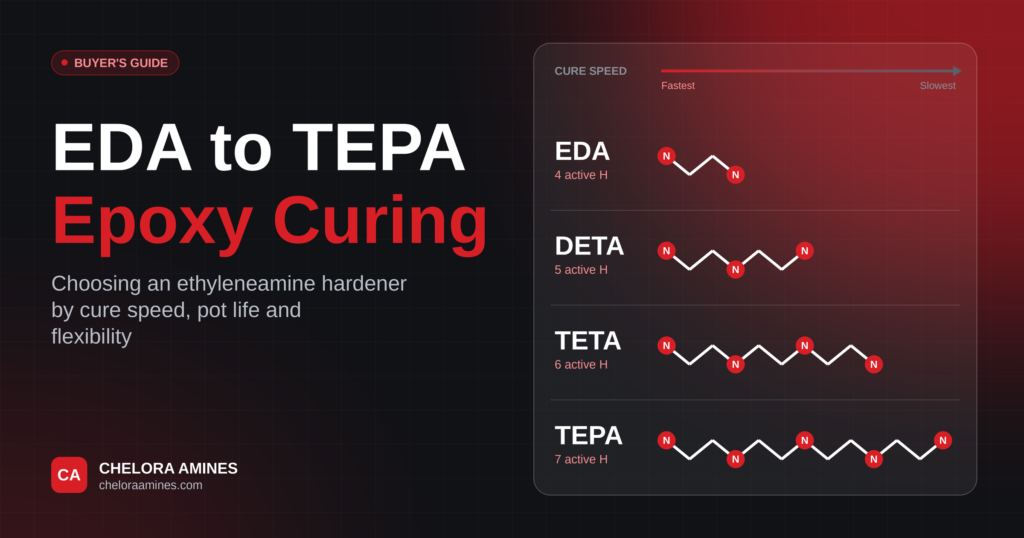
Home/ Blog/ Buyer’s Guides/ EDA, DETA, TETA and TEPA Buyer’s guide EDA, DETA, TETA and TEPA Explained: Choosing an Ethyleneamine for Epoxy Curing EDA, DETA, TETA and TEPA compared: how each ethyleneamine cures epoxy differently, and how to choose the right hardener for your system. Chelora Amines Technical Team · 29 September 2026 · 6 min read 4 → 7Active amine hydrogens per molecule, from EDA to TEPA 60 → 189 g/molMolecular weight climbs with every added –CH2CH2NH– unit 1 kg → tankerPack sizes available from trial packs to road tankers On this page EDA vs DETA vs TETA vs TEPA at a glance What ethyleneamines are Chain length, cure speed and pot life EDA as an epoxy curing agent DETA as an epoxy curing agent TETA as an epoxy curing agent TEPA as an epoxy curing agent Which ethyleneamine to choose How to source ethyleneamines How the chemistry developed Questions formulators ask Related reading MEA vs DEA vs TEA guide How MEA removes CO₂ and H₂S Chemicals suppliers in Telangana All products Need a quote today? Send the amine, grade, quantity, pack size and delivery location. Request a quote +91 98191 11179 Choosing the right ethyleneamine for epoxy curing comes down to four closely related molecules: EDA (ethylenediamine, CAS 107-15-3), DETA (diethylenetriamine, CAS 111-40-0), TETA (triethylenetetramine, CAS 112-24-3) and TEPA (tetraethylenepentamine, CAS 112-57-2). All four are produced from the same ethylenediamine and 1,2-dichloroethane/ammonia chemistry and form a homologous series, each one molecule longer than the last, and all four are used as crosslinking hardeners that react with epoxy resin at room or elevated temperature to form a cured thermoset network. The difference between them is not what they do, but how fast, how hot, and with what final properties they do it. EDA reacts quickly and sharply; TEPA reacts more gently and flexibly; DETA and TETA sit between the two. For formulators of coatings, adhesives, composites and flooring systems, picking the wrong ethyleneamine can mean a pot life too short to work with, an exotherm that cracks a casting, or cured properties that fall short of the application’s chemical or mechanical demands. This guide compares EDA, DETA, TETA and TEPA directly and sets out what buyers should check before choosing between them. Chelora Amines supplies ethyleneamines and related industrial amines from Hyderabad, serving formulators across Telangana — see our overview of chemicals suppliers in Telangana. If you also work with the ethanolamine side of the amine family, our guide to MEA vs DEA vs TEA compares those three, and how monoethanolamine removes CO2 and H2S shows another place amine chemistry does heavy industrial work. Fastest EDA Ethylenediamine C2H8N2 · 4 active H Fast-set adhesives, small castings Fast DETA Diethylenetriamine C4H13N3 · 5 active H General-purpose hardener Moderate TETA Triethylenetetramine C6H18N4 · 6 active H Coatings, flooring, composites Slowest TEPA Tetraethylenepentamine C8H23N5 · 7 active H Flexible systems, longer pot life EDA vs DETA vs TETA vs TEPA at a Glance Property EDA DETA TETA TEPA CAS number 107-15-3 111-40-0 112-24-3 112-57-2 Formula C2H8N2 C4H13N3 C6H18N4 C8H23N5 Molecular weight 60.1 g/mol 103.2 g/mol 146.2 g/mol 189.3 g/mol Active amine hydrogens 4 5 6 7 Relative viscosity Lowest Low Medium Higher Relative cure speed Fastest, sharpest exotherm Fast Moderate Slowest, mildest exotherm Typical epoxy role Fast-set adhesives, small castings General-purpose hardener Coatings, flooring, composites Flexible systems, longer pot life What Are Ethyleneamines and How Are They Related to Each Other? Ethyleneamines are a family of aliphatic amines built from repeating –CH2CH2NH– units, produced commercially from the reaction of ammonia with 1,2-dichloroethane, a single process route that yields the entire series: ethylenediamine, diethylenetriamine, triethylenetetramine, tetraethylenepentamine and piperazine as a cyclic by-product. Each step up the series adds one more –CH2CH2NH– unit, which adds molecular weight, viscosity and one additional active amine hydrogen available for crosslinking with epoxy resin. EDA has four active amine hydrogens, DETA has five, TETA has six, and TEPA has seven, and this growing functionality is exactly why longer-chain ethyleneamines can build denser crosslink networks at the right stoichiometry, even though they react more slowly than EDA on a per-molecule basis. One route, four hardeners Ammonia + 1,2-dichloroethane→ EDA→+ unit DETA→+ unit TETA→+ unit TEPA Each unit added is one –CH2CH2NH– group. Piperazine forms alongside the series as a cyclic by-product. How Does Chain Length Affect Curing Speed and Pot Life? Chain length affects curing speed and pot life because shorter, lighter molecules like EDA diffuse and react with epoxide groups faster and generate a sharper exotherm, while longer, more viscous molecules like TEPA react more gradually and spread heat release over a longer working window. This is why EDA-cured epoxy systems often gel within minutes at room temperature and are prone to a fast, sometimes dramatic exotherm in anything beyond a thin film, which limits EDA to small castings, quick-set adhesives and applications where a short pot life is actually wanted. TEPA, at the other end of the series, offers a noticeably longer pot life and a gentler exotherm, making it easier to work with in larger pours or where application time matters more than ultimate cure speed. DETA and TETA sit between these extremes and are the most common general-purpose and coatings-grade choices in the series. Cure profile, fastest to slowest EDAFastest, sharp exotherm→ DETAFast→ TETAModerate→ TEPASlowest, mildest exotherm EDA as an Epoxy Curing Agent: Strengths and Limitations EDA is the fastest-curing, lowest-viscosity ethyleneamine in this series, offering strong chemical resistance and hardness in the cured epoxy but with a short pot life and a sharp exotherm that limits it to thin sections and small, quick-set applications. Because EDA has the highest concentration of active amine hydrogens per gram among the four, it builds a tight, rigid crosslinked network quickly, which gives excellent solvent and chemical resistance but can also make the cured epoxy more brittle than systems cured with longer-chain amines. EDA’s volatility and strong amine odour are additional practical considerations in open workshop environments. DETA as an Epoxy Curing Agent: Strengths and Limitations DETA
Why Triethanolamine Is Used in Cement Grinding Aids
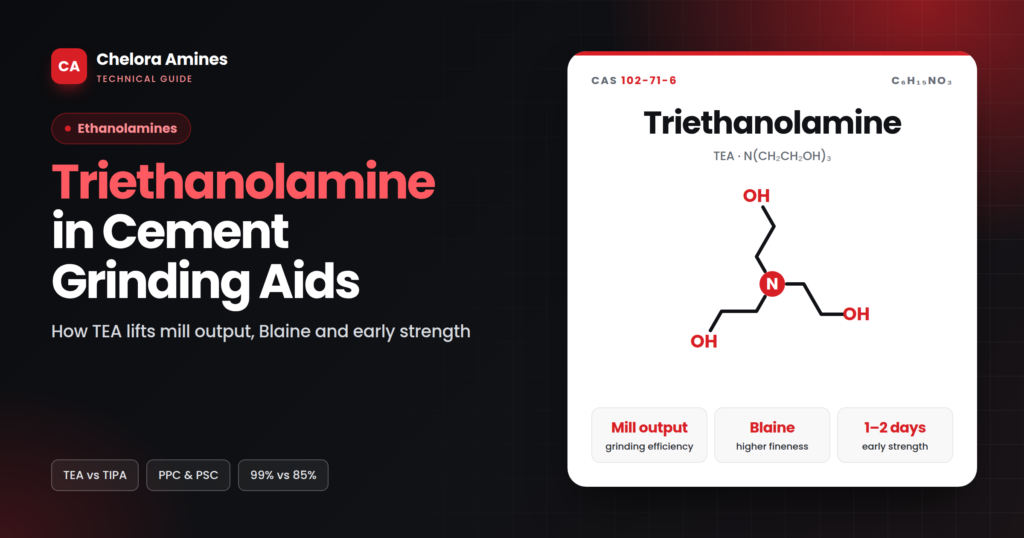
Home/ Blog/ Ethanolamines/ Triethanolamine in Cement Grinding Aids Ethanolamines Why Triethanolamine Is Used in Cement Grinding Aids Why triethanolamine (TEA) works in cement grinding aids: mill output, Blaine, early strength, TEA vs TIPA and glycols, grades, storage and sourcing. Chelora Amines Technical Team · 30 September 2026 · 11 min read N + 3 OHOne nitrogen and three hydroxyethyl arms that grip freshly broken clinker surfaces 1–2 daysAges where the early-strength lift shows; the benefit is smaller at 28 days 99% vs 85%The two grades commonly traded; always check what makes up the balance On this page Triethanolamine at a glance Why TEA is used in grinding aids Properties that matter in a mill Mill output, Blaine and early strength TEA vs TIPA, DEIPA and glycols PPC and PSC blended cements Running a plant trial What to check in a specification Storage and handling How TEA became a standard additive Choosing a supplier Questions buyers ask Related in this article Triethanolamine Diethanolamine MEA vs DEA vs TEA guide MEA in gas treating All products Need triethanolamine? Tell us the grade (99% or 85%), pack size, monthly volume and delivery location. Request a sample +91 98191 11179 Triethanolamine (TEA, 2,2′,2″-nitrilotriethanol, CAS 102-71-6) is a tertiary alkanolamine from the ethanolamines family, and it is used in cement grinding aids because it clings to freshly broken clinker surfaces, stops fine particles clumping and keeps them off the balls and liners. The mill then grinds faster, or reaches a higher Blaine at the same rate, while the same molecule gives a modest lift to early strength by speeding the reaction of the aluminate phase. That double role is why triethanolamine remains the reference active against which TIPA, DEIPA and glycols are judged. For a cement plant the stakes are practical: power per tonne, separator load, silo and packer flow, and the one-day and two-day results that decide whether a PPC or PSC batch clears the laboratory. This guide covers the mechanism, the alternatives, the grades on offer, winter handling and what to ask of a supplier. If you are still choosing between ethanolamines, our companion guide MEA vs DEA vs TEA compares all three, and our technical guide on how monoethanolamine removes CO2 and H2S shows another large use of the same family. In the millGrindingCharge masking on fresh clinkerFewer clumps, less media coatingMore output, or a higher Blaine at the same rate After water is addedEarly strengthAluminate reaction speeds upC3A + gypsum → ettringite soonerBetter one-day and two-day results In the storeWinterFreezing and handlingMelts at about 21 °CWarm drums evenly; heat bulk tanks gently Triethanolamine at a Glance Property Triethanolamine (TEA) Chemical name (IUPAC) 2,2′,2″-Nitrilotri(ethan-1-ol); also written 2-[bis(2-hydroxyethyl)amino]ethan-1-ol Common names and synonyms TEA, trolamine, tris(2-hydroxyethyl)amine, triethylolamine CAS number 102-71-6 Molecular formula C6H15NO3, written structurally as N(CH2CH2OH)3 Molecular weight 149.19 g/mol Typical appearance Colourless to pale yellow, viscous, hygroscopic liquid with a faint ammoniacal odour; solidifies in cool weather (melting point about 21 °C) Chemical family Ethanolamines (tertiary alkanolamine) Main applications Cement grinding aids and early-strength additives; gas treating blends; surfactant and personal-care salts; metalworking fluids; textile auxiliaries Key hazard Classification differs between supplier SDSs; commonly labelled Warning for serious eye irritation (H319) Grades commonly traded TEA 99% and TEA 85% (balance usually diethanolamine; some low-freeze products use water) Available from Chelora Amines Chelora Amines products Why Is Triethanolamine Used in Cement Grinding Aids? The job of triethanolamine in cement grinding aids is to mask the surface charges that make freshly ground particles stick to each other and to the grinding media. Each impact opens new clinker surface with broken calcium–oxygen and silicon–oxygen bonds. In a hot, dry mill those charged sites pull the finest particles into loose clusters and plaster a thin layer onto balls and liner plates, so the media cushion each blow and energy turns into heat instead of fracture. A TEA grinding aid works at the scale of single molecules. The nitrogen atom and three hydroxyl groups are strongly polar, so the molecule adsorbs onto active sites almost as soon as they form. With the charge neutralised, the powder flows freely and the separator draws finished product out of the circuit instead of returning clumped fines as rejects. Plants typically see less media coating and a lower circulating load. In the mill Fresh clinker→Charged sites→TEA adsorbs→Free flow→Output or Blaine up After water is added Water added→TEA + C3A + gypsum→Ettringite sooner→Early strength up Grinding effect first, hydration effect second: the same molecule does both jobs. What Is Triethanolamine, and Which Properties Matter in a Cement Mill? Triethanolamine is a tertiary amine with three 2-hydroxyethyl arms on one nitrogen atom, which makes it both a weak base and a triol. Also sold under the pharmacopoeia name trolamine, it mixes with water in all proportions, has very low volatility and is syrupy at room temperature. Producers make it by reacting ethylene oxide with ammonia, then separate the resulting mono-, di- and tri-substituted amines by distillation. Four properties matter to a cement maker. Low volatility lets the additive survive a hot closed-circuit mill. Strong polarity gives firm adsorption on clinker. Its ability to complex calcium, aluminium and iron ions lets it act on the cement phases once water is added. And water miscibility makes blending with glycols or acetic acid easy. The drawbacks follow from the same chemistry: it absorbs moisture, freezes in a cold store and can disturb setting when overdosed. How Does a TEA Grinding Aid Affect Mill Output, Blaine Fineness and Early Strength? A well-matched TEA grinding aid lets a plant either raise mill output at the same Blaine fineness or push fineness higher without losing throughput. Gains vary with clinker mineralogy, mill design, separator efficiency and the fly ash or slag share, so treat any figure quoted without a site trial with caution. The strength effect is chemical. Once water is added, TEA speeds the reaction between tricalcium aluminate (C3A) and gypsum, so ettringite forms sooner, and it helps dissolve the ferrite phase (C4AF). That is why TEA-based
How Monoethanolamine Removes CO₂ and H₂S in Gas Treating and Carbon Capture
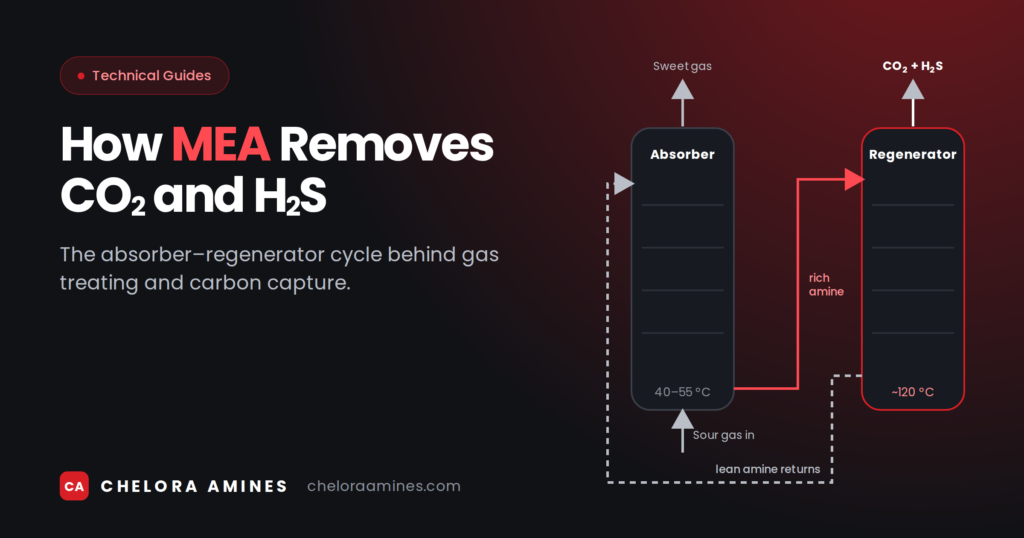
Home/ Blog/ Technical Guides/ How Monoethanolamine Removes CO2 and H2S Technical guide How Monoethanolamine Removes CO2 and H2S in Gas Treating and Carbon Capture How monoethanolamine (MEA) removes CO2 and H2S in gas treating and carbon capture: the chemistry, process design, plant types, degradation, and what to check when buying MEA. Chelora Amines Technical Team · 29 September 2026 · 15 min read 15–35 wt%Typical strength of aqueous MEA circulated through the absorber ~120 °CRegenerator temperature at which the carbamate and bicarbonate reactions reverse <0.15 → 0.5mol CO2 per mol MEA, from lean to rich amine loading On this page Gas treating at a glance Why MEA absorbs CO2 and H2S How MEA reacts with CO2 How MEA reacts with H2S The absorber–regenerator cycle CO2 vs H2S removal Natural gas, refinery and carbon capture Degradation and how it is controlled How MEA became the standard What to check when buying Questions engineers ask Amines in this article Monoethanolamine Diethanolamine Triethanolamine Diisopropanolamine MEA vs DEA vs TEA guide All products Need a quote today? Send the full chemical name, grade, quantity, pack size and delivery location. Request a quote +91 98191 11179 How monoethanolamine removes CO2 and H2S comes down to one chemical fact: monoethanolamine (MEA) is a primary amine, and primary amines react directly with carbon dioxide to form a carbamate, the fastest and most efficient acid-gas absorption route known in the ethanolamine family. MEA (CAS 141-43-5, formula C2H7NO) has been the workhorse amine in gas treating for nearly a century because it combines the highest basicity of the three ethanolamines, the lowest molecular weight, and therefore the largest moles of amine per kilogram of solvent. When dissolved in water at 15 to 35 per cent by weight and circulated through an absorber column, MEA pulls both CO2 and H2S out of natural gas, refinery off-gas and power-plant flue gas, and releases them in a heated regenerator so the lean amine can be reused. Getting the chemistry, concentrations and plant design right determines whether your unit meets its gas specification, controls degradation and keeps operating costs in check. This guide explains the reaction mechanisms, the absorber–regenerator cycle, the differences between natural gas treating, refinery applications and post-combustion carbon capture, the main degradation pathways, and what to specify when you buy MEA for a gas treating application. If you are still choosing between amines, our companion guide MEA vs DEA vs TEA compares all three. Fast route CO2 Carbamate formation CO2 + 2 MEA → carbamate + MEA·H+ Direct reaction with the primary amine group Very fast route H2S Amine bisulphide salt H2S + MEA → MEA·H+HS− Simple proton transfer, no covalent bond formed Regeneration ~120 °C Stripping in the regenerator Heat reverses the reactions Gas is released and lean MEA is reused Monoethanolamine (MEA) in gas treating at a glance Property Monoethanolamine (MEA) Chemical name 2-Aminoethanol CAS number 141-43-5 Formula / MW C2H7NO / 61.08 g/mol Amine type Primary amine Appearance Colourless, slightly viscous liquid Odour Mild ammonia-like odour Density ~1.018 g/cm3 at 20 °C Freezing point ~10 °C Boiling point ~170 °C Viscosity ~21 mPa·s at 20 °C Relative basicity Highest of the three ethanolamines (pKa ~9.5) Typical absorber concentration 15–30 wt% aqueous solution in gas treating Leading gas treating uses CO2 removal, H2S removal, carbon capture (post-combustion) Key watch-out Corrosive; degrades with O2, COS, CS2; highest regeneration energy of common amines What is monoethanolamine, and why does it absorb CO2 and H2S? Monoethanolamine is the simplest member of the ethanolamine family. Its molecule contains a primary amine group (–NH2) and a hydroxyl group (–OH) on a two-carbon chain. The amine group carries two hydrogen atoms on the nitrogen, which is the structural feature that makes MEA so reactive with acid gases. Carbon dioxide and hydrogen sulphide are both acid gases: they dissolve in water to give acidic solutions, and they react with bases. MEA, as a strong base with a pKa of about 9.5, accepts protons from both gases readily. The key difference between the two reactions is the mechanism. How MEA reacts with CO2 Carbon dioxide reacts with primary amines by two routes. In the first, and faster, route, CO2 reacts directly with the amine to form a carbamate: Carbamate route (zwitterion mechanism)CO2 + 2 MEA → MEA-carbamate + MEA·H+ This reaction is fast and does not require water. The carbamate is a stable salt in which the carbon dioxide is chemically bound. In the second, slower route, CO2 dissolves in water to form carbonic acid, which then reacts with MEA to form a bicarbonate: Bicarbonate routeCO2 + H2O → H2CO3 → HCO3− + MEA·H+ The carbamate route is the one that matters most in the absorber. It accounts for the high rate of CO2 uptake that makes MEA faster than secondary amines (such as diethanolamine) and far faster than tertiary amines (such as methyldiethanolamine, MDEA), which cannot form carbamates and rely entirely on the slower bicarbonate route. How MEA reacts with H2S Hydrogen sulphide reacts with MEA by a simpler acid-base mechanism. H2S is a weak acid, and the amine immediately accepts its proton to form an amine bisulphide salt: Amine bisulphide formationH2S + MEA → MEA·H+HS− This reaction is very fast — faster than the CO2 carbamate reaction — because it is a simple proton transfer with no covalent bond formation. The selectivity between CO2 and H2S therefore depends mainly on whether CO2 has time to complete its slower carbamate or bicarbonate reaction. In a short-contact-time absorber designed for selective H2S removal, the CO2 reaction may be kinetically limited while H2S removal is essentially complete. For most natural gas treating applications, however, both gases need to be removed, and selectivity is less important than total removal capacity. i Note MEA is non-selective between CO2 and H2S when contact time is sufficient. If you need to remove H2S selectively while leaving CO2 largely in the gas (for example, to preserve CO2 for enhanced oil recovery), a tertiary amine such as MDEA or a tertiary-amine blend is
MEA vs DEA vs TEA: Which Ethanolamine Is Right for Your Application?
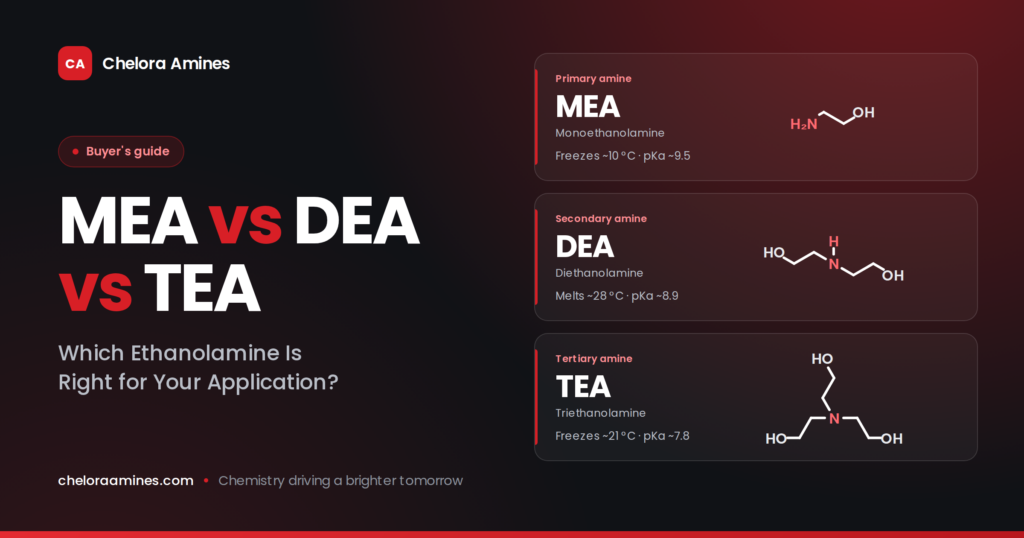
Home/ Blog/ Buyer’s Guides/ MEA vs DEA vs TEA Buyer’s guide MEA vs DEA vs TEA: Which Ethanolamine Is Right for Your Application? MEA vs DEA vs TEA compared: properties, uses in gas treating, detergents, cement, metalworking and personal care, and how to pick the right grade. Chelora Amines Technical Team · 28 September 2026 · 12 min read 1 · 2 · 3Hydroxyethyl groups on the nitrogen of MEA, DEA and TEA pKa 9.5 → 7.8Basicity falls from MEA to TEA, with DEA at about 8.9 10 / 28 / 21 °CApproximate freezing points of MEA, DEA and TEA: plan for winter storage On this page What ethanolamines are and how they are made How MEA, DEA and TEA differ Where MEA is the best choice Where DEA performs best When to choose TEA Which to choose for your application Grades of MEA, DEA and TEA Safety and regulatory points How ethanolamines became industrial What to check when buying Questions buyers ask Amines in this article Monoethanolamine Diethanolamine Triethanolamine Triisopropanolamine Aminoethylethanolamine Dimethylethanolamine All products Need a quote today? Send the full chemical name, grade, quantity, pack size and delivery location. Request a quote +91 98191 11179 MEA vs DEA vs TEA comes down to one structural difference: monoethanolamine (MEA) carries one hydroxyethyl group on its nitrogen, diethanolamine (DEA) carries two, and triethanolamine (TEA) carries three. That single change turns MEA into a reactive primary amine, DEA into a secondary amine and TEA into a mild, tertiary base, and it decides where each one performs best. MEA is the fastest absorber of carbon dioxide and the strongest base of the three, so it leads in gas treating and neutralising acidic detergent ingredients. DEA is the classic partner for fatty acids in foam-boosting surfactants and a workhorse in refinery gas units. TEA, the gentlest and least volatile, is favoured in cement grinding aids, metalworking fluids and personal-care formulations. Getting the MEA vs DEA vs TEA decision wrong can mean slow reactions, unwanted by-products, freezing drums or regulatory trouble. This guide from Chelora Amines, which stocks all three ethanolamines in Mumbai, compares their chemistry, properties, main uses, grades and handling so you can pick the right one with confidence. Primary amine MEA Monoethanolamine H2N–CH2CH2OH Gas treating, carbon capture, detergent neutralisation Secondary amine DEA Diethanolamine HN(CH2CH2OH)2 Fatty amides for surfactants, refinery gas treating Tertiary amine TEA Triethanolamine N(CH2CH2OH)3 Cement grinding aids, metalworking fluids, personal care MEA vs DEA vs TEA at a glance Property MEA DEA TEA Chemical name 2-Aminoethanol 2,2′-Iminodiethanol 2,2′,2″-Nitrilotriethanol CAS number 141-43-5 111-42-2 102-71-6 Formula / MW C₂H₇NO / 61.08 C₄H₁₁NO₂ / 105.14 C₆H₁₅NO₃ / 149.19 Amine type Primary Secondary Tertiary Approx. freezing point 10 °C 28 °C 21 °C Approx. boiling point 170 °C 268 °C 335 °C Relative basicity Highest Medium Lowest Leading uses Gas treating, carbon capture, detergent neutralisation, synthesis Fatty amides for surfactants, refinery gas treating, textile auxiliaries Cement grinding aids, metalworking fluids, personal care, coatings Key watch-out Corrosive; attacks copper and aluminium Nitrosamine risk; solid at room temperature Freezes in cool weather; check DEA content What are ethanolamines, and how are MEA, DEA and TEA made? Ethanolamines are organic compounds that contain both an amine group and one or more alcohol groups, which lets them behave as bases and as alcohols at the same time. MEA, DEA and TEA are the three members of the family, and they are made together in one process. Manufacturers react ethylene oxide with ammonia, usually in water. Each molecule of ethylene oxide adds a hydroxyethyl group (–CH₂CH₂OH) to the nitrogen. One addition gives monoethanolamine, a second gives diethanolamine, and a third gives triethanolamine. The ratio of ammonia to ethylene oxide controls the mix: a large excess of ammonia favours MEA, while less ammonia pushes the reaction towards DEA and TEA. The crude mixture is then separated by distillation into the three products. One reactor, three products Ammonia+ Ethylene oxide→ MEA→+ EO DEA→+ EO TEA Excess ammonia favours MEA; less ammonia pushes the mix towards DEA and TEA. Distillation then separates the three. Because all three come from the same reactor, their supply is linked, which is one practical reason the MEA vs DEA vs TEA decision is best made across your whole product range. When demand for one rises sharply, producers adjust their ratios, which can tighten availability of the others. Buyers who use more than one ethanolamine often benefit from sourcing them together and planning volumes across the family rather than product by product. MEA vs DEA vs TEA: how do they differ in structure and properties? In the MEA vs DEA vs TEA comparison, the key difference is the number of hydrogen atoms left on the nitrogen, which falls from two to one to none. That shift reduces basicity and reactivity from MEA to TEA while raising boiling point, viscosity and molecular weight. Two hydrogen atoms on the nitrogen in MEA, one in DEA, none in TEA. That one count sets basicity, reactivity, boiling point and viscosity across the family. Basicity and reactivity MEA is the strongest base of the three; the pKa of its protonated form is about 9.5, compared with roughly 8.9 for DEA and 7.8 for TEA. As a primary amine, MEA reacts quickly with carbon dioxide, acids, aldehydes and acylating agents. DEA, a secondary amine, reacts more moderately and still forms amides with fatty acids. TEA has no hydrogen on its nitrogen, so it cannot form amides or carbamates directly; it acts as a mild base, buffer and complexing agent instead, and it reacts through its three hydroxyl groups to form esters. Physical form, freezing and volatility MEA is a clear, slightly viscous liquid that freezes at about 10 °C and boils at about 170 °C. DEA melts at about 28 °C, so it is a solid or a thick semi-solid at typical room temperatures, and many buyers use a low-freeze grade blended with water to keep it pourable. TEA freezes at about 21 °C and boils at around 335 °C; it is