Epoxy curing
Each N–H opens an epoxide ring; with four per molecule IPDA builds a dense, rigid network.
AHEW ≈ 42.6 g/eq
3-Aminomethyl-3,5,5-trimethylcyclohexylamine · IPDA · ≥99.5% standard, low-colour and LR grades
Isophorone diamine is a cycloaliphatic diamine with one amino group on the ring and one on a methylene arm, supplied as a cis/trans mixture. It is the workhorse hardener for light-stable, chemically resistant epoxy flooring, coatings, composites and adhesives, and the raw material for isophorone diisocyanate (IPDI). Chelora Amines supplies it worldwide and across India, in UN-specification packaging with a batch-wise COA and SDS.
120.11 + 18.14 + 28.01 + 4.03 ≈ 170.30 g/mol
Isophorone diamine, usually shortened to IPDA and also named 3-aminomethyl-3,5,5-trimethylcyclohexylamine, is a clear, colourless to pale yellow, low-viscosity liquid with a mild amine odour. It boils at about 247 °C, freezes at around 10 °C, and mixes with water, alcohols and most epoxy resins.
Like Cyclohexylamine it is cycloaliphatic, but it carries four reactive N–H hydrogens on two primary amino groups that react at different rates: the aminomethyl group is faster, the ring-bound amine slower and more hindered. That built-in stagger gives epoxy systems a workable pot life, a high glass transition temperature and good chemical resistance, and because there is no aromatic ring the cured film resists yellowing far better than aromatic or araliphatic hardeners.
It is made from isophorone, itself derived from acetone: adding hydrogen cyanide gives isophorone nitrile, which is converted to the diamine by reductive amination with ammonia and hydrogen. Purity, isomer ratio, the amino-alcohol by-product, water and colour are the controlled parameters.
| Chemical name | Isophorone diamine (3-aminomethyl-3,5,5-trimethylcyclohexylamine) |
| Common synonyms | IPDA, isophoronediamine, 5-amino-1,3,3-trimethylcyclohexanemethylamine |
| CAS number | 2855-13-2 |
| EC / EINECS number | 220-666-8 |
| HS / HSN code | 2921 30 (cyclanic, cyclenic or cycloterpenic amines) |
| Molecular formula | C₁₀H₂₂N₂ |
| Molecular weight | 170.30 g/mol |
| Appearance | Clear, colourless to pale yellow liquid |
| Odour | Mild, amine-like |
| Isomer composition | cis/trans mixture, typically about 75:25 |
| Melting point | About 10 °C |
| Boiling point | About 247 °C |
| Density | About 0.92 g/cm³ at 20 °C |
| Viscosity | About 18 mPa·s at 20 °C |
| Vapour pressure | Below 0.02 mbar at 20 °C |
| Flash point | About 117 °C (closed cup) |
| Solubility in water | Completely miscible |
| Amine value | About 650–670 mg KOH/g (theory ≈ 659) |
| AHEW | ≈ 42.6 g/eq |
| UN number | UN 2289, Class 8, packing group III |
Figures are typical literature values for orientation. Values for the material you order are stated on its Certificate of Analysis and Safety Data Sheet.
IPDA is a diamine with four reactive N–H hydrogens and two primary amino groups of different reactivity. Almost everything it is used for follows from that: crosslinking epoxy resins, building polyamides and ureas, and phosgenation to IPDI.
Each N–H opens an epoxide ring; with four per molecule IPDA builds a dense, rigid network.
AHEW ≈ 42.6 g/eqAgainst a standard liquid bisphenol-A resin (EEW ≈ 190), about 22–23 parts IPDA per 100 parts resin.
phr = AHEW × 100 ÷ EEWReaction with phosgene converts both amines to isocyanates, giving IPDI for light-stable polyurethanes.
IPDA + 2 COCl₂ → IPDICondenses with dicarboxylic acids to give amorphous, transparent polyamides.
diacid + IPDA → polyamidePre-reacted with part of an epoxy resin to make adduct hardeners with lower volatility and less blush.
epoxy + excess IPDA → adductReacts with phenols and formaldehyde to Mannich-base hardeners for low-temperature and damp cure.
phenol + HCHO + IPDA → baseCondenses with ketones such as MIBK to ketimines, moisture-triggered latent hardeners.
IPDA + 2 R₂CO → ketimineFree amine at the surface reacts with CO₂ and moisture to form carbamates — the cause of blush and greasy films.
IPDA + CO₂ + H₂O → carbamateProcess notes. IPDA freezes at about 10 °C and reacts with atmospheric CO₂. Store and use it above 15 °C, keep containers closed and nitrogen blanketed, and mix epoxy formulations in controlled batch sizes — the cure is exothermic and large masses can overheat.
Discuss your processIPDA is made from isophorone in two catalytic steps, and the route sets the specification: the cis/trans ratio comes from the hydrogenation, and amino-alcohol and secondary-amine by-products from side reactions.
Isophorone, made by condensing acetone, is reacted with hydrogen cyanide to give isophorone nitrile (IPN).
IPN is reacted with excess ammonia, usually over an acidic catalyst, to convert the ketone into an imine.
Over a cobalt catalyst at elevated pressure, hydrogen reduces the imine and the nitrile together to give the diamine as a cis/trans mixture.
Ammonia is recycled; vacuum distillation takes the IPDA cut away from isophorone amino alcohol (IPAA), secondary-amine by-products and heavies.
Product is tested for purity, isomer ratio, amine value, water and colour, then filled under nitrogen into drums, totes or bulk containers.
The cis/trans ratio changes reactivity: cis-IPDA reacts faster in epoxy systems, so a shift in ratio shows up as a change in pot life and cure speed. Isophorone amino alcohol (IPAA), formed where the ketone is reduced instead of aminated, carries only two N–H hydrogens and dilutes the crosslink density.
Water and colour matter most to coating formulators, because both affect film appearance and blush. Where a formulation, a registration or a validated process names limits, send them with the enquiry and we will match the batch rather than send the standard cut.
Twelve months in sealed original packing, kept at 15–30 °C and out of sunlight, is the normal working figure. Below about 10 °C IPDA can crystallise; warm the whole drum gently and mix before use so the melt is uniform.
Keep drums closed between draws and blanket tanks with nitrogen — CO₂ pickup shows as haze or a crust at the drum mouth. Re-check purity, water and colour before a critical batch from older stock. A retained sample of every batch is held here.
Tell us the formulation and the limits that matter and we will confirm the grade. Standard grade covers most epoxy and polyamide work; low-colour and tighter-isomer material is available for clear coats and demanding applications.
The standard grade for epoxy hardeners, adducts, polyamides and general synthesis.
A tighter colour limit for clear coats, light-coloured floors and decorative work.
For formulation development, resin testing and pilot work.
Batches selected or sourced against limits you name, such as isomer ratio, water or colour.
| Parameter | Test method | Typical specification |
|---|---|---|
| Appearance | Visual | Clear, colourless to pale yellow liquid |
| Purity (IPDA, cis + trans) | GC | ≥ 99.5 % |
| cis/trans isomer ratio | GC | 70/30 – 80/20 |
| Isophorone amino alcohol | GC | ≤ 0.3 % |
| Amine value | Titration | 650–670 mg KOH/g |
| Water | Karl Fischer | ≤ 0.2 % w/w |
| Colour | APHA | ≤ 20 |
Indicative specification for planning. The controlling document is the Certificate of Analysis issued for your batch. If your process needs tighter limits, say so at enquiry stage and we will quote against your specification.
Four amines dominate cycloaliphatic and araliphatic epoxy curing. They differ in equivalent weight, speed of cure and resistance to yellowing, so a formulation built on one does not transfer directly to another.
| Property | IPDA | PACM | 1,3-BAC | MXDA |
|---|---|---|---|---|
| Full name | Isophorone diamine | 4,4'-Diaminodicyclohexylmethane | 1,3-Bis(aminomethyl)cyclohexane | m-Xylylenediamine |
| CAS number | 2855-13-2 | 1761-71-3 | 2579-20-6 | 1477-55-0 |
| Type | Cycloaliphatic, one ring and one CH₂ amine | Cycloaliphatic, two ring amines | Cycloaliphatic, two CH₂ amines | Araliphatic, CH₂ amines on a benzene ring |
| Molecular weight | 170.3 | 210.4 | 142.2 | 136.2 |
| AHEW (g/eq) | ≈ 42.6 | ≈ 52.6 | ≈ 35.6 | ≈ 34.1 |
| Form at 20 °C | Liquid (mp ≈ 10 °C) | Liquid or paste, depends on isomer mix | Liquid | Liquid (mp ≈ 14 °C) |
| Cure speed | Moderate | Slow | Fast | Fast |
| Yellowing on UV exposure | Low | Low | Low | Higher |
| Typical outlets | Floors, coatings, composites, IPDI | Tough coatings, composites | Fast-cure coatings, adhesives | Fast cure, marine and tank coatings |
Order by full name and CAS number. State Isophorone diamine (IPDA) and CAS 2855-13-2 on the enquiry and the purchase order, with any isomer-ratio or colour limit. Formulated "IPDA hardeners" are blends and are not the same as the pure diamine.
See the full amine rangeEpoxy flooring and protective coatings take most of the volume, followed by composites, adhesives and IPDI production.
Hardener in self-levelling floors, screeds and mortars for factories, warehouses, hospitals and car parks.
Light-stable, chemical-resistant coatings for tanks, pipes, concrete and steel.
Infusion, filament-winding and prepreg systems for wind blades, pipes and pressure vessels.
Structural adhesives, anchoring grouts and crack-injection resins.
Phosgenated to IPDI for light-stable PU coatings, elastomers and dispersions.
Co-monomer for transparent amorphous polyamides and hot-melt adhesives.
Chain extender and co-reactant in polyurea and hybrid spray coatings.
Reference hardener for resin testing, method work and formulation development.
If you are mapping a value chain, or looking for the product one step down from where you are, this is where Isophorone Diamine ends up. Several of these are chemicals we can also source for you.
| Derivative | Made by | End use |
|---|---|---|
| Cured epoxy networks | Stoichiometric reaction with epoxy resins | Floors, coatings, composites, adhesives |
| IPDI (isophorone diisocyanate) | Phosgenation | Light-stable PU coatings and elastomers |
| Epoxy–IPDA adducts | Partial pre-reaction with epoxy resin | Low-blush hardeners |
| Mannich-base hardeners | Reaction with phenols and formaldehyde | Low-temperature and damp cure |
| Ketimines | Condensation with MIBK or other ketones | Moisture-cure latent hardeners |
| Transparent polyamides | Polycondensation with diacids | Optical and engineering polymers |
| Polyamidoamines | Reaction with fatty or dimer acids | Flexible epoxy hardeners |
| Polyureas | Reaction with isocyanates | Spray coatings and elastomers |
| N-Alkylated IPDA | Reductive alkylation | Slower, lower-blush hardeners |
| Salts and carbamates | Reaction with acids or CO₂ | Latent and water-borne hardeners |
Looking for one of these rather than the amine itself? Ask us — several sit within our sourcing network, and we can quote the derivative and the raw material together.
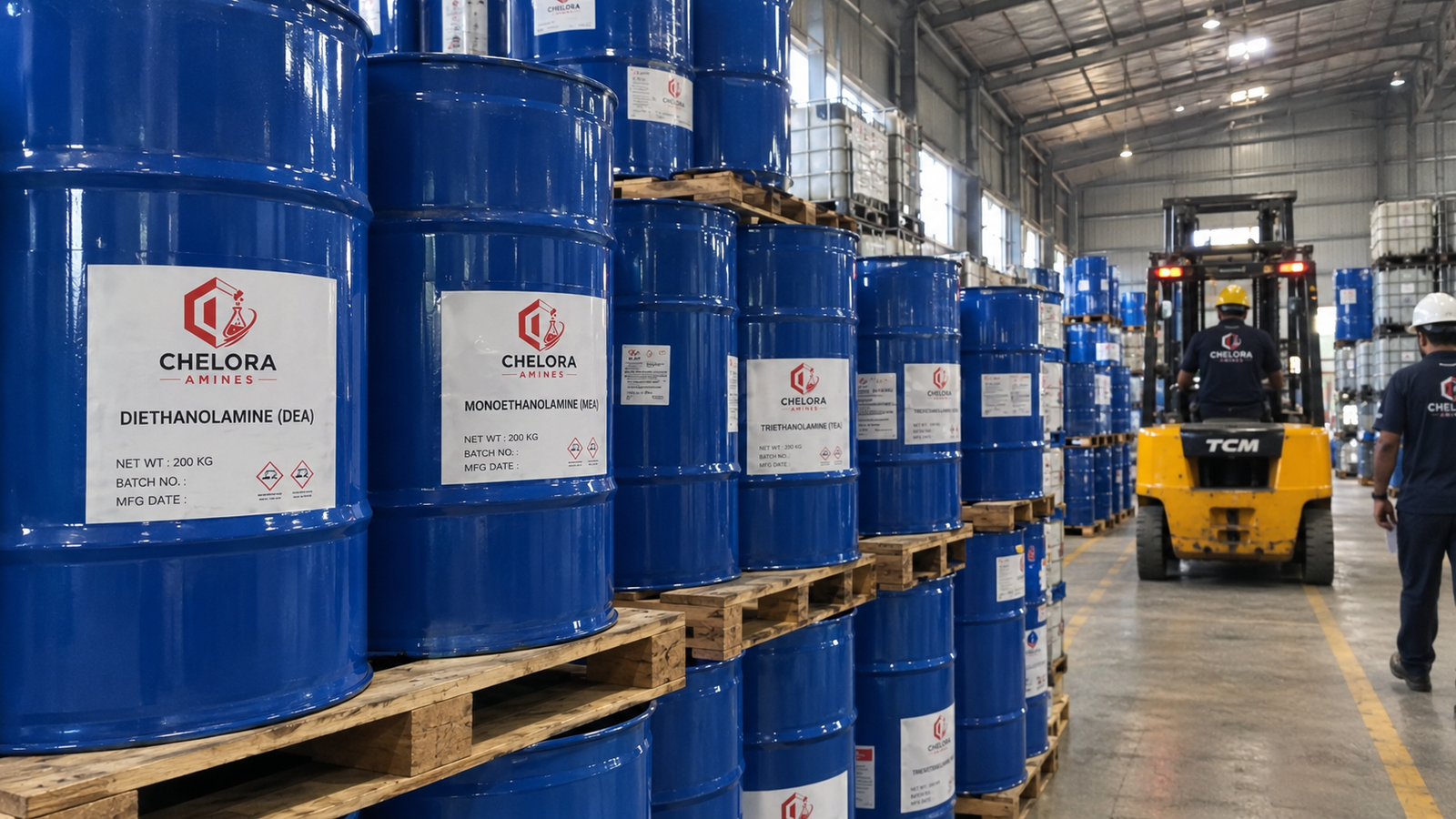
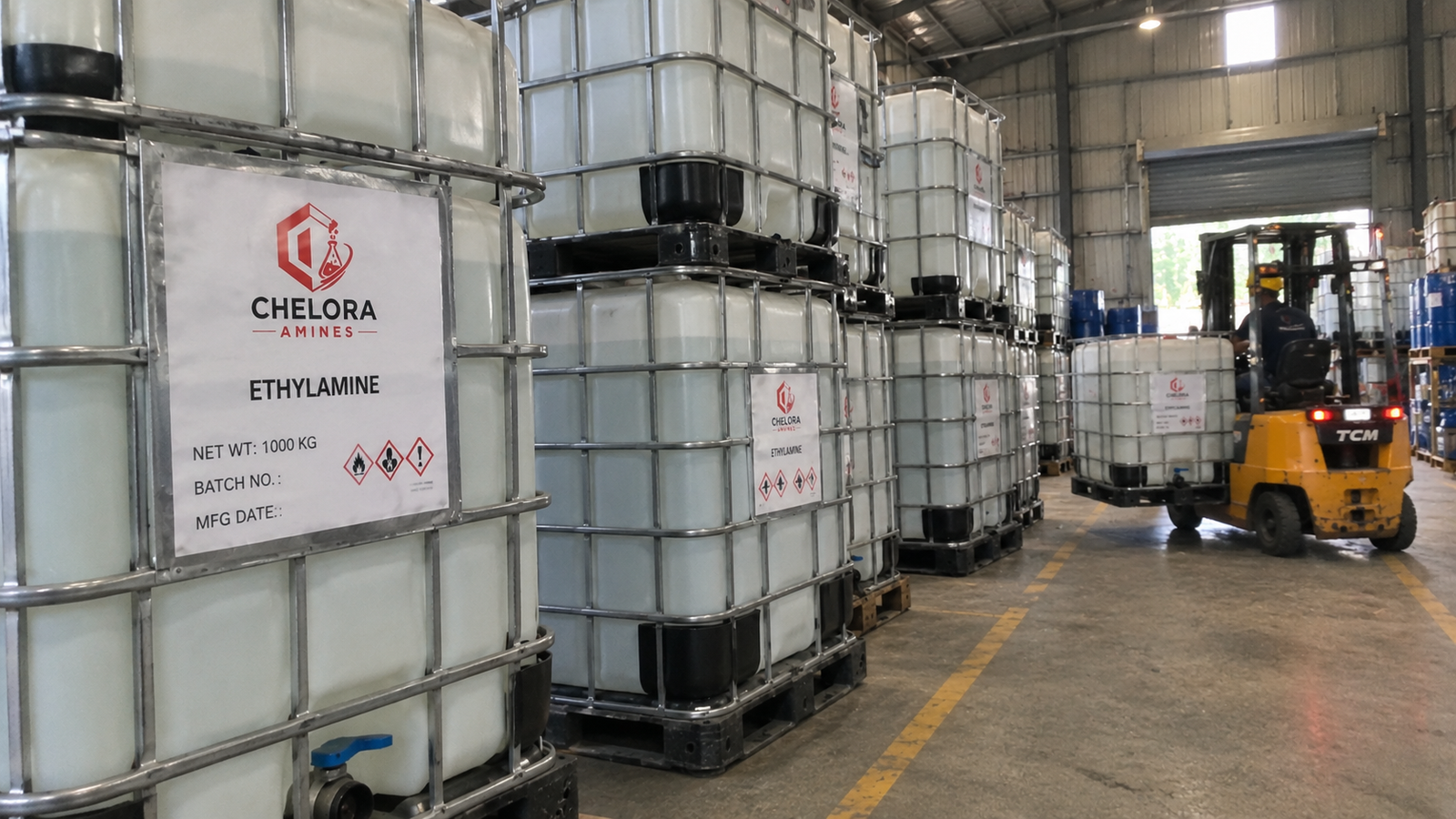
Every container carries the Chelora Amines label with product name, net weight, batch number, manufacturing date, UN number and hazard pictograms.
HDPE carboys for lab qualification, pilot batches and low-consumption users.
MS and HDPE drums, the standard production pack, with tamper-evident closures.
Forklift-ready totes with bottom valves for plants drawing material every week.
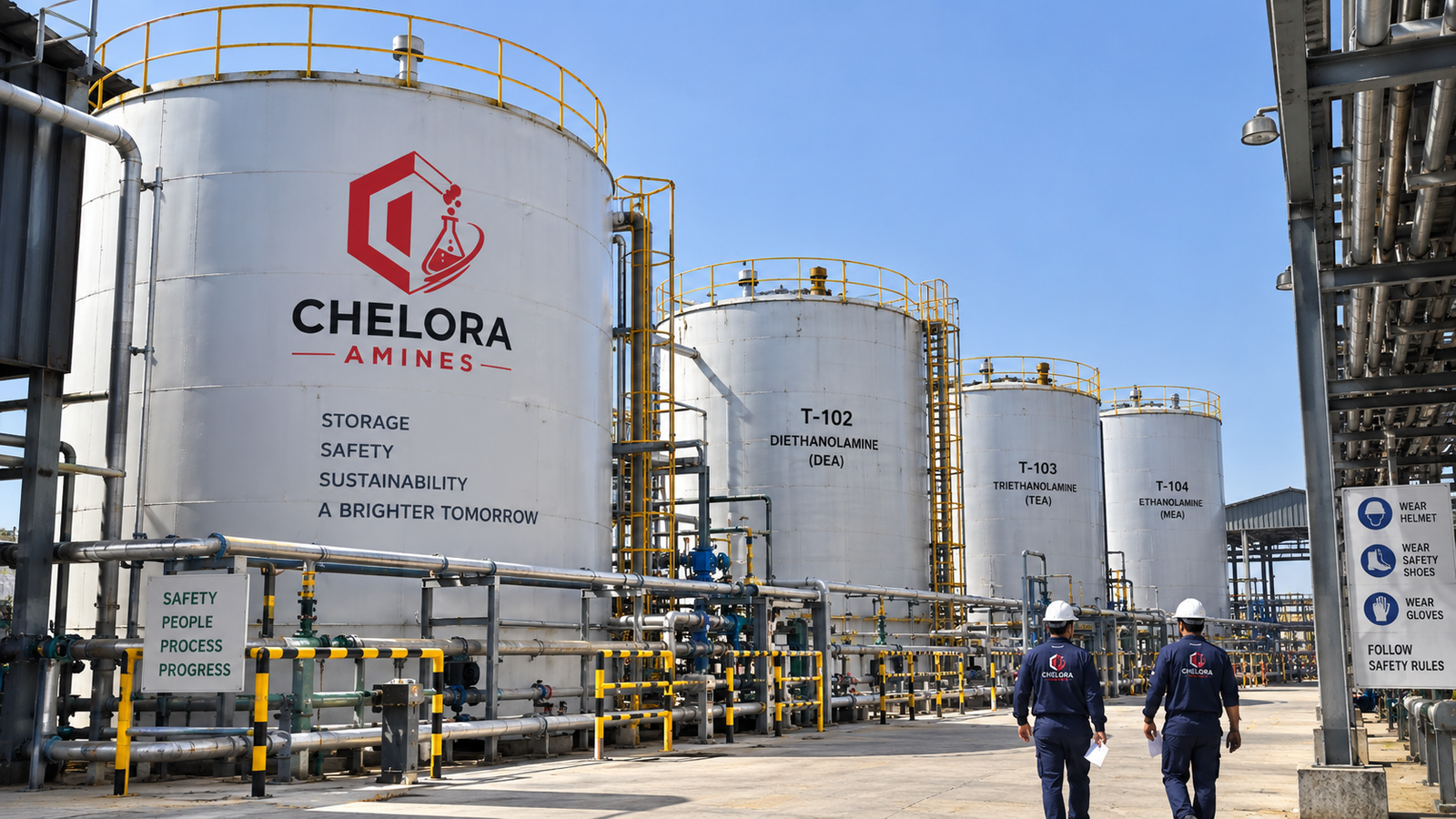
Bulk loads and ISO tank containers for continuous plants and large campaigns.
Tell us the monthly draw and how you store hazardous liquids, and we will recommend the grade, pack size and delivery schedule. Export consignments are packed in UN-specification drums and totes, palletised and stretch-wrapped, and shipped FOB, CIF or CFR through Nhava Sheva and Mundra.
Plan my supplyIPDA is a corrosive base and a skin sensitiser. It is not flammable at normal handling temperatures — the flash point is about 117 °C — but it causes severe burns and can trigger allergic skin reactions that last for life. The notes below are a summary for planning only — work to the Safety Data Sheet supplied with your consignment and to your own site risk assessment.
Isophorone Diamine is a regulated dangerous good in transport. That is routine for us, but it shapes what we need from you before a first shipment moves.
| Proper shipping name | Isophoronediamine |
| UN number / class | UN 2289 · Class 8 |
| Packing group | III |
| Labels | Corrosive label |
| Modes | Road, rail and sea (IMDG); air movement within dangerous goods quantity limits |
| Segregation | Away from acids, oxidisers and foodstuffs |
| Packaging | UN-specification drums, carboys and IBC totes, palletised and strapped for export |
We supply business to business only, against verified company credentials, consignee details and a signed end-use declaration, plus any import permit the destination country requires.
Start account opening| Parameter | Specification | Result |
|---|---|---|
| Appearance | Clear, colourless to pale yellow liquid | Complies |
| Purity (IPDA, cis + trans) | ≥ 99.5 % | Complies |
| cis/trans isomer ratio | 70/30 – 80/20 | Complies |
| Water | ≤ 0.2 % w/w | Complies |
| Colour | ≤ 20 | Complies |
Isophorone Diamine is checked before dispatch and each consignment leaves with the paperwork your QC, stores and accounts teams need on day one.
The numbers on a Certificate of Analysis are only useful if you know how they were produced. These are the methods behind the figures on ours, and the checks worth repeating at your own goods-inward.
Separates the amine from related amines and residual solvents in one run, and gives both the assay and the impurity profile that matter to your reaction.
An independent check on total amine content, useful as a quick goods-inward confirmation before a drum is released to production.
Water determination, which matters wherever the next step is moisture sensitive or the amine feeds an anhydrous reaction.
A visual platinum–cobalt comparison. A rising colour value is the earliest sign that a pack has been exposed to air or held too long.
Fast confirmation of identity and strength, and a simple way to spot a wrong pack or a contaminated drum.
Gravimetric residue and trace metal checks, which matter for catalytic steps and regulated formulations.
A sample from every dispatched batch is held here, so a query months later can be settled against the original material.
The batch number on the label ties back to the COA, the test record and the supply lot, which is what your auditor will ask to see.
Where your customer or regulator needs an independent result, we can arrange analysis at a NABL-accredited laboratory before dispatch.
Five steps for a first order of Isophorone Diamine. Repeat orders follow the same route on a schedule that matches your consumption.
Grade, quantity, pack size and delivery location.
We confirm the grade for your process and quote, usually within 24 hours.
The batch is tested and the COA, SDS and invoice details are prepared.
Labelled packs move by road, or in UN-spec packaging for export.
Material reaches your gate and repeat dispatches are scheduled to your usage.
Isophorone Diamine is a line on a price list and a headache in a warehouse. What separates suppliers is the grade flexibility, the paperwork and the answer you get when something is not routine.
Isophorone Diamine sits alongside the rest of our amine range, from ethanolamines to fatty amines. Your purchase team raises one enquiry, compares one quote and manages one vendor record instead of six.
Standard, low-colour and LR grades are available, so you are not forced to redesign a step around the only grade your supplier happens to carry.
COA, SDS, correct HSN and HS codes, dangerous goods declarations and certificates of origin are prepared with the consignment, not chased afterwards.
Tell us your limits on purity, isomer ratio, amine value, water and colour and we quote against them, rather than sending the standard cut and letting your QC find out.
Once we know your monthly draw we hold and release material on a schedule, so you carry less inventory of a hazardous product.
Describe the reaction or formulation rather than the product code and we will tell you which grade fits — and say so plainly when a different amine would serve you better.
Buyers who order Isophorone Diamine usually source these from the same list. Open any product for its specification, grades and packing, or see the full product range.
Container shipments to buyers on five continents, plus road dispatch inside India. Tell us your country and destination port and we will quote landed terms, transit time and the documentation your customs broker will ask for.
United Arab Emirates, Saudi Arabia, Oman, Qatar, Kuwait, Bahrain, Jordan, Egypt, Morocco, Kenya, Tanzania, Ethiopia, Nigeria, Ghana and South Africa.
Bangladesh, Sri Lanka, Nepal, Pakistan, Vietnam, Thailand, Indonesia, Malaysia, Singapore, the Philippines, South Korea, Japan, Taiwan, Australia and New Zealand.
Germany, the Netherlands, Belgium, France, Italy, Spain, Portugal, Poland, Czechia, the United Kingdom, Ireland, Türkiye, Russia, Ukraine, Kazakhstan and Uzbekistan.
United States, Canada, Mexico, Brazil, Argentina, Chile, Colombia, Peru, Ecuador and the Caribbean, shipped in UN-specification packaging with full DG documentation.
| Incoterms quoted | EXW, FOB, CFR, CIF and DAP, depending on your destination and preference |
| Load ports | Nhava Sheva (JNPT) and Mundra, with Chennai and Kolkata used for eastbound routings |
| Container options | Full container loads, and consolidated LCL shipments for smaller quantities |
| Typical container fill | Around 80 drums, or roughly 18 to 20 IBC totes, in a 20 ft container |
| Packing for export | UN-specification drums and totes, palletised, strapped and stretch-wrapped, with DG labelling |
| Air freight | Possible for small quantities within dangerous goods limits; most volume moves by sea |
| Payment terms | Advance, irrevocable letter of credit or agreed credit terms for established accounts |
| Before first shipment | Company credentials, end-use declaration and any import permit the destination country requires |
Most delays in quoting Isophorone Diamine come from a missing line in the enquiry, not from availability. Send these details and a firm price usually comes back the same day.
Not sure of some of it yet? Send what you have. A description of the reaction step and an approximate monthly volume is enough for us to come back with a recommended grade, a pack plan and an indicative price.
Send an enquiryPlain definitions of the words that appear on a Isophorone Diamine specification, label and shipping document.
Short answers to what purchase, plant and QC teams ask us most about this product. Anything else, ask us directly.
Send the grade, quantity, pack size and your delivery address or destination port. We come back with a price, the documents that go with the batch and a dispatch or shipping plan, usually within 24 hours.