Amide formation
Reacts with carbon monoxide or methyl formate to give dimethylformamide, and with acetic anhydride to give dimethylacetamide — the two largest single outlets.
HCOOCH₃ + (CH₃)₂NH → DMF
DMA · N-methylmethanamine · 40% and 60% aqueous solution, and anhydrous liquefied gas
Dimethylamine is the simplest secondary aliphatic amine and one of the highest-volume amine intermediates in the world. It is a gas at ordinary temperature, so it is traded either as an aqueous solution — most commonly 40% w/w — or as an anhydrous liquefied gas in pressure containers. Almost none of it is used as such: it is consumed to make dimethylformamide, dimethylacetamide, DMAPA for betaine surfactants, dithiocarbamate rubber accelerators and water-treatment polymers. Chelora Amines supplies it across India and worldwide, with a batch-wise COA, SDS and the dangerous-goods paperwork each form requires.
24.02 + 6.05 + 14.01 + 1.01 = 45.08 g/mol
Dimethylamine is a colourless gas at room temperature with a sharp, fishy ammoniacal odour detectable at very low concentration. It liquefies at 7 °C, so in practice it is handled either as a pressurised liquefied gas or, far more often, as a clear aqueous solution at 40% or 60% w/w.
It is the middle member of the methylamine family. Compared with Methylamine, which is primary, and Trimethylamine, which is tertiary and has no N–H at all, dimethylamine is the one with two alkyl groups donating electron density to nitrogen and a single hydrogen left to react. That combination gives it the highest basicity of the three — a conjugate-acid pKa near 10.7 — and makes it the preferred nitrogen source wherever a dimethylamino group has to be installed.
All three methylamines are produced together by reacting methanol with ammonia over an alumina or zeolite catalyst, then separated by distillation. Because the reaction gives a mixture, plants adjust the ammonia-to-methanol ratio and recycle to shift the split toward whichever amine is in demand.
| Chemical name | Dimethylamine (N-methylmethanamine) |
| Common synonyms | DMA, dimethylamine solution, N-methylmethanamine |
| CAS number | 124-40-3 |
| EC / EINECS number | 204-697-4 |
| HS / HSN code | 2921 11 (methylamine, di- or trimethylamine and their salts) |
| Molecular formula | C₂H₇N |
| Molecular weight | 45.08 g/mol |
| Appearance | Colourless gas; clear colourless liquid as aqueous solution |
| Odour | Sharp, fishy, ammoniacal |
| Melting point | About −93 °C (anhydrous) |
| Boiling point | 7 °C (anhydrous); about 52 °C for 40% solution |
| Density | About 0.89 g/cm³ at 20 °C for 40% solution |
| Flash point | Flammable gas; about 20 °C for 40% aqueous solution |
| Solubility in water | Completely miscible |
| pKa of conjugate acid | About 10.7 at 25 °C |
| Vapour pressure | About 170 kPa at 20 °C (anhydrous) |
| UN number | UN 1032 anhydrous, Class 2.1; UN 1160 solution, Class 3 (8), packing group II |
Figures are typical literature values for orientation. Values for the material you order are stated on its Certificate of Analysis and Safety Data Sheet.
Dimethylamine is a strong, compact secondary amine with exactly one N–H. Nearly all of its industrial chemistry is about transferring the dimethylamino group onto a larger molecule.
Reacts with carbon monoxide or methyl formate to give dimethylformamide, and with acetic anhydride to give dimethylacetamide — the two largest single outlets.
HCOOCH₃ + (CH₃)₂NH → DMFAdds across acrylonitrile and is then hydrogenated to DMAPA, the backbone of cocamidopropyl betaine surfactants.
CH₂=CHCN + DMA → DMAPNAdds to carbon disulfide with a base or metal salt to give ZDMC, TMTD and related ultra-accelerators for rubber.
CS₂ + DMA → dithiocarbamateReacts with ethylene oxide to give N,N-dimethylethanolamine, the catalyst and neutralising amine.
EO + DMA → DMEAAlkylation of dimethylamino derivatives with methyl chloride or benzyl chloride gives quats for flocculants and biocides.
R–Cl + R′₂NMe → quatNeutralises mineral and organic acids to dimethylammonium salts used as intermediates and phase-transfer agents.
HCl + DMA → saltCondenses with formaldehyde and an enolisable carbonyl to install a dimethylaminomethyl group in one step.
HCHO + DMA + C–H → Mannich baseDisplaces halides and activated leaving groups to build dimethylamino-substituted intermediates for pharma and agro.
R–X + DMA → R–NMe₂Process notes. Anhydrous DMA is a flammable gas handled only in pressure-rated, earthed equipment with nitrogen purging; the 40% solution is a flammable, corrosive liquid that still evolves amine vapour from the headspace. Dose into exothermic steps with cooling, keep the system closed, and remember that the solution's strength drifts if containers are left open.
Discuss your processDimethylamine is never made alone. It comes out of a methylamines plant alongside its mono and tri relatives, and the specification is mostly about how cleanly the three were separated.
Methanol and anhydrous ammonia, the two bulk feedstocks behind the whole methylamine family.
Over an alumina or shape-selective zeolite catalyst at elevated temperature and pressure, ammonia and methanol give mono-, di- and trimethylamine with water.
The reactor delivers all three amines, unreacted ammonia and water in an equilibrium mixture.
An extractive distillation train recovers ammonia for recycle and splits the three amines; the unwanted ones are returned to the reactor.
Product is taken as anhydrous liquefied gas or diluted to 40% or 60% w/w, tested, and filled into drums, cylinders or bulk containers.
Residual monomethylamine and trimethylamine are the impurities to watch. Monomethylamine has two N–H bonds and can over-react in alkylation and amidation steps; trimethylamine has none and simply carries through as an odorous dead load that shows up in the finished product's smell.
Free ammonia is the other common carry-over, and it competes directly for electrophiles. Where your process or registration dossier sets limits on these, send them with the enquiry so the batch and the paperwork can be matched before dispatch rather than afterwards.
Twelve months in sealed original packing is the normal working figure for the aqueous solution, kept cool and tightly closed. The assay is a solution strength, not a purity, so an open or warm drum loses amine to the headspace and the solution drifts below specification.
Anhydrous material is a liquefied gas under its own vapour pressure: containers must be pressure-rated, protected from heat and never filled beyond their stated capacity. A retained sample of every batch is held here, so a query months later can be settled against the original material.
The first question is always the form: aqueous solution or anhydrous. Tell us which your equipment is built for, the strength you dose at, and the limits that matter, and we will confirm the grade and the paperwork together.
The standard commercial form, handled as an ordinary flammable corrosive liquid.
Higher strength for users who want fewer drums and less water in the reactor.
Liquefied gas in pressure containers for moisture-sensitive and anhydrous chemistry.
Batches selected or sourced against limits you name, such as MMA, TMA or ammonia.
| Parameter | Test method | Typical specification |
|---|---|---|
| Appearance | Visual | Clear, colourless liquid, free of suspended matter |
| Dimethylamine content | Titration / GC | 40.0 ± 0.5 % w/w |
| Monomethylamine | GC | ≤ 0.5 % w/w on amine basis |
| Trimethylamine | GC | ≤ 0.5 % w/w on amine basis |
| Ammonia | GC | ≤ 0.1 % w/w |
| Colour | APHA | ≤ 20 |
| Non-volatile matter | Gravimetric | ≤ 0.05 % w/w |
Indicative specification for planning. The controlling document is the Certificate of Analysis issued for your batch. If your process needs tighter limits, say so at enquiry stage and we will quote against your specification.
The three methylamines share a CAS heading, a plant and an abbreviation style, and they are ordered wrongly more often than almost any other amine group. The number of N–H bonds is what separates them in a reaction.
| Property | Dimethylamine | Methylamine | Trimethylamine | Diethylamine |
|---|---|---|---|---|
| CAS number | 124-40-3 | 74-89-5 | 75-50-3 | 109-89-7 |
| Amine class | Secondary | Primary | Tertiary | Secondary |
| N–H bonds | One | Two | None | One |
| Boiling point | 7 °C | −6 °C | 3 °C | 55 °C |
| pKa of conjugate acid | ≈ 10.7 | ≈ 10.6 | ≈ 9.8 | ≈ 11.0 |
| Usual supply form | 40% solution or liquefied gas | 40% solution or liquefied gas | Solution or liquefied gas | Neat liquid |
| Typical outlets | DMF, DMAC, DMAPA, rubber accelerators, polymers | Agrochemicals, pharma, solvents | Choline chloride, quats, cationic polymers | Pharma, rubber chemicals, corrosion inhibitors |
Order by full name, CAS number and form. State Dimethylamine, CAS 124-40-3, and whether you need the aqueous solution or anhydrous material on every enquiry and purchase order. "DMA" alone is also used for dimethylacetamide and for N,N-dimethylaniline, which are different products entirely.
See the full amine rangeSolvent manufacture and surfactant intermediates take the largest share, with rubber chemicals, water-treatment polymers and agrochemicals accounting for most of the rest.
The feed for dimethylformamide and dimethylacetamide, used in acrylic fibre spinning, pharma synthesis and polyurethane solutions.
Converted through acrylonitrile to DMAPA, the amine behind cocamidopropyl betaine in shampoos and personal care.
Feed for ZDMC, TMTD and related dimethyldithiocarbamate ultra-accelerators used at low dose in rubber compounding.
Raw material for cationic flocculants and polyDADMAC-type coagulants used in municipal and industrial water plants.
Builds the dimethylamino group in herbicide and fungicide actives, and forms the amine salts of acid herbicides.
A standard nitrogen source for antihistamines, local anaesthetics and other dimethylamino-bearing actives.
If you are mapping a value chain, or looking for the product one step down from where you are, this is where Dimethylamine ends up. Several of these are chemicals we can also source for you.
| Derivative | Made by | End use |
|---|---|---|
| Dimethylformamide (DMF) | Carbonylation, or reaction with methyl formate | Acrylic fibre spinning, pharma and PU solvent |
| Dimethylacetamide (DMAC) | Reaction with acetic acid or anhydride | Fibre and film solvent, pharma processing |
| Dimethylaminopropylamine (DMAPA) | Cyanoethylation then hydrogenation | Betaine surfactants, epoxy curing agents |
| N,N-Dimethylethanolamine (DMEA) | Reaction with ethylene oxide | PU catalyst, waterborne coatings, boiler treatment |
| Zinc and tetramethyl dithiocarbamates | Reaction with carbon disulfide and a metal salt | Rubber ultra-accelerators, fungicides |
| Dimethylamine salts of herbicides | Neutralisation of the acid herbicide | Water-soluble agrochemical formulations |
Looking for one of these rather than the amine itself? Ask us — several sit within our sourcing network, and we can quote the derivative and the raw material together.
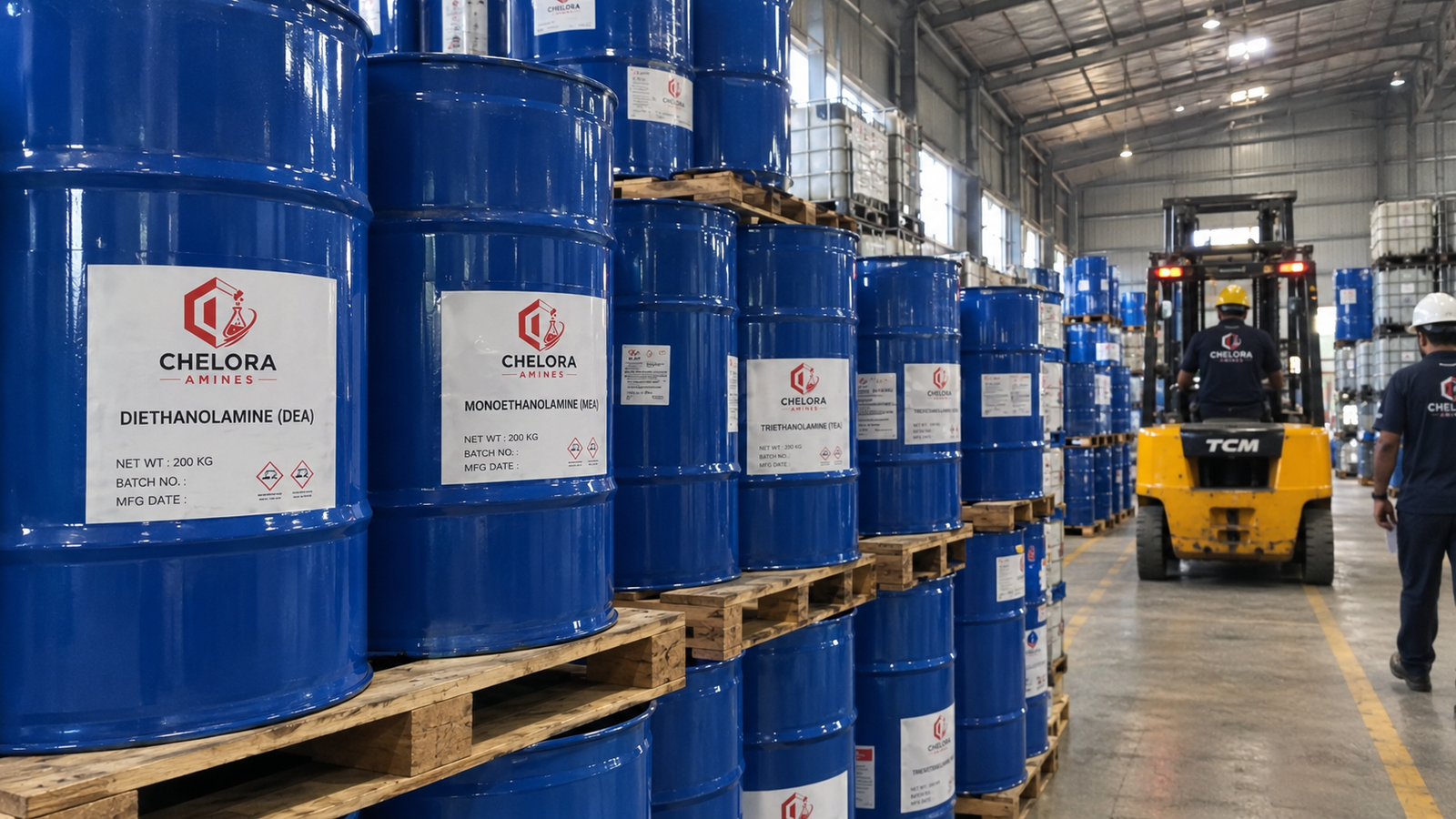
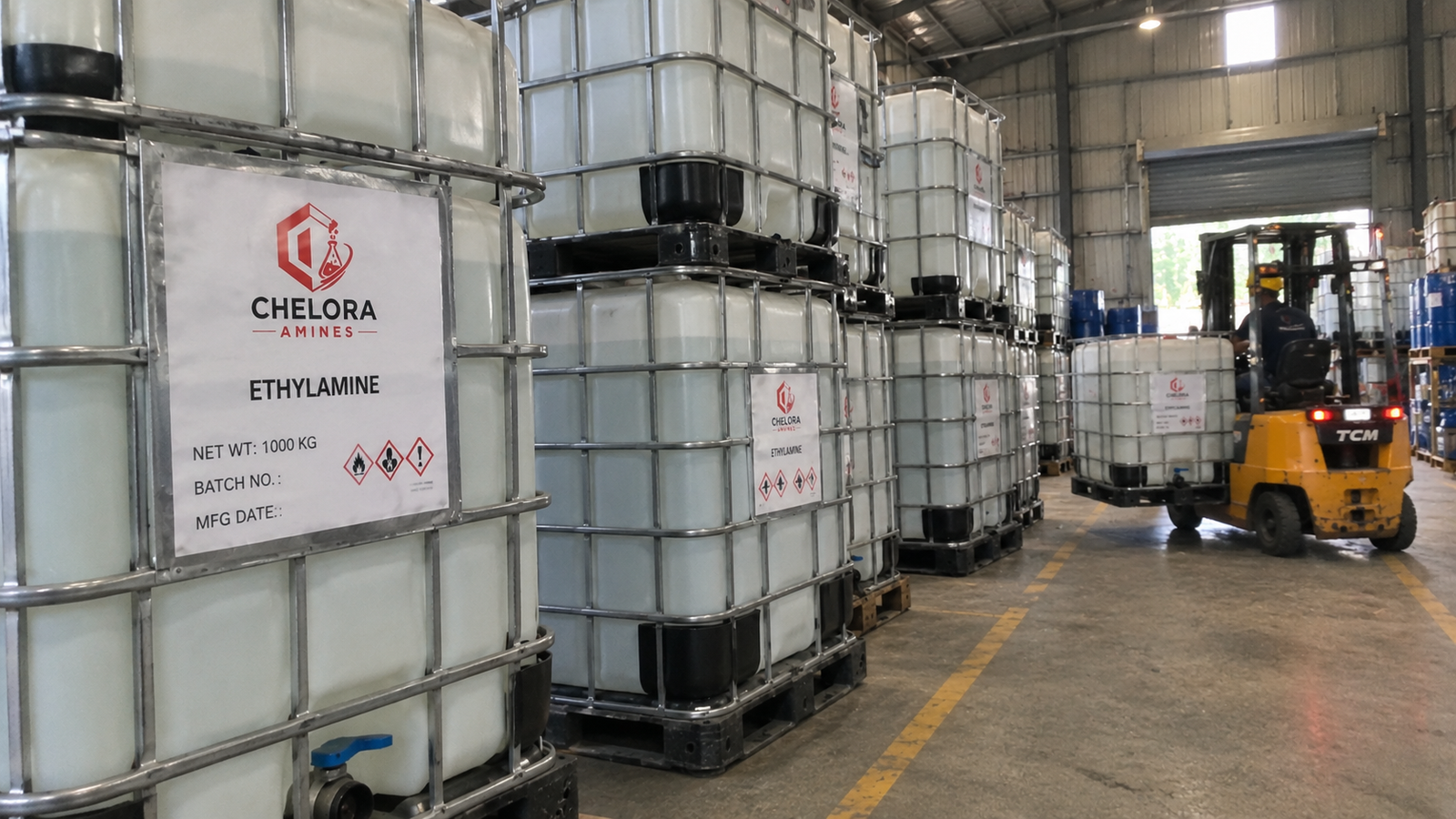
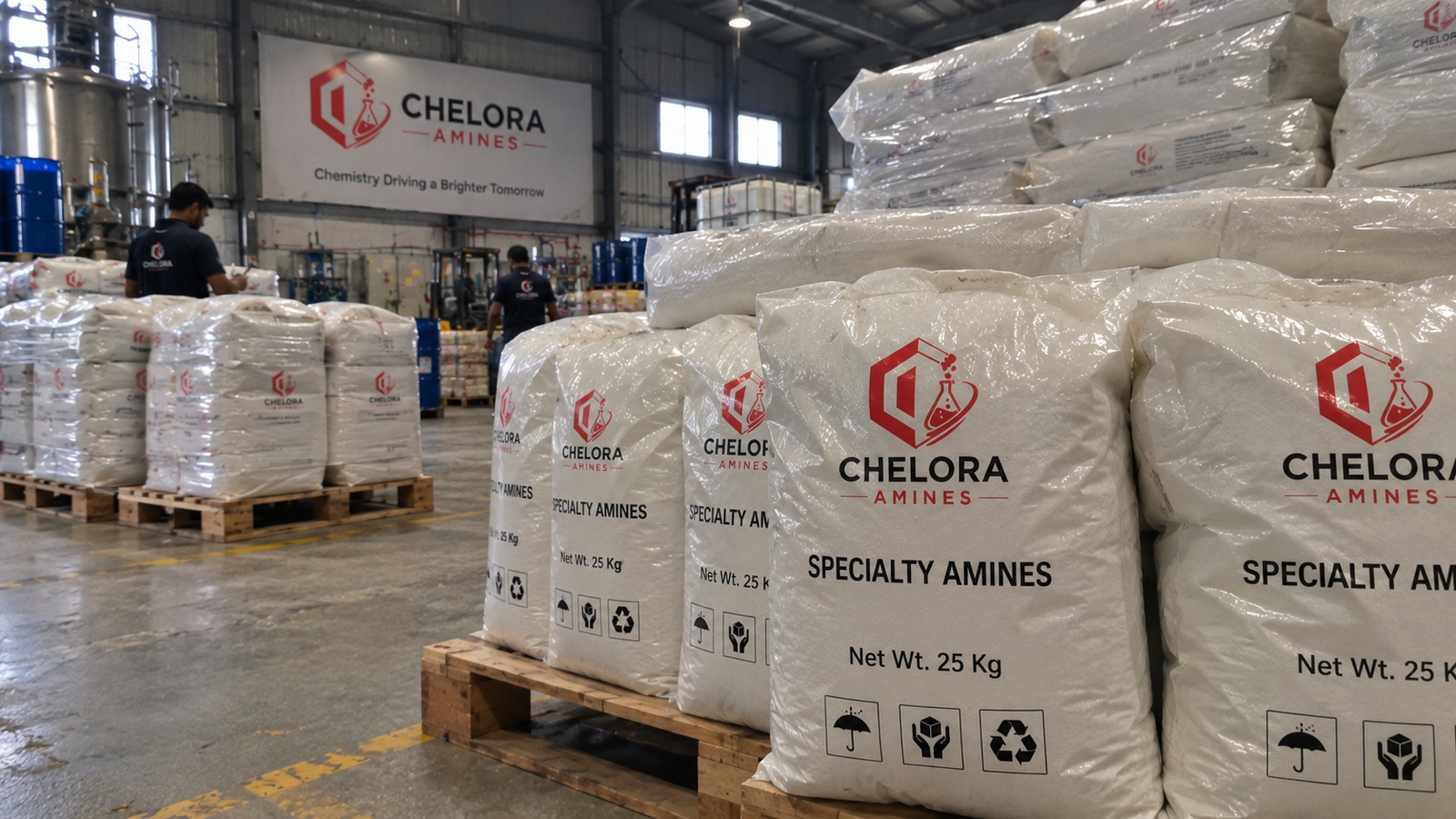
Every container carries the Chelora Amines label with product name, net weight, batch number, manufacturing date, UN number and hazard pictograms. Anhydrous material moves only in pressure-rated containers.
HDPE carboys of the aqueous solution for lab qualification and pilot batches.
MS and HDPE drums, the standard production pack for 40% and 60% solution.
Forklift-ready totes with bottom valves for plants drawing solution every week.
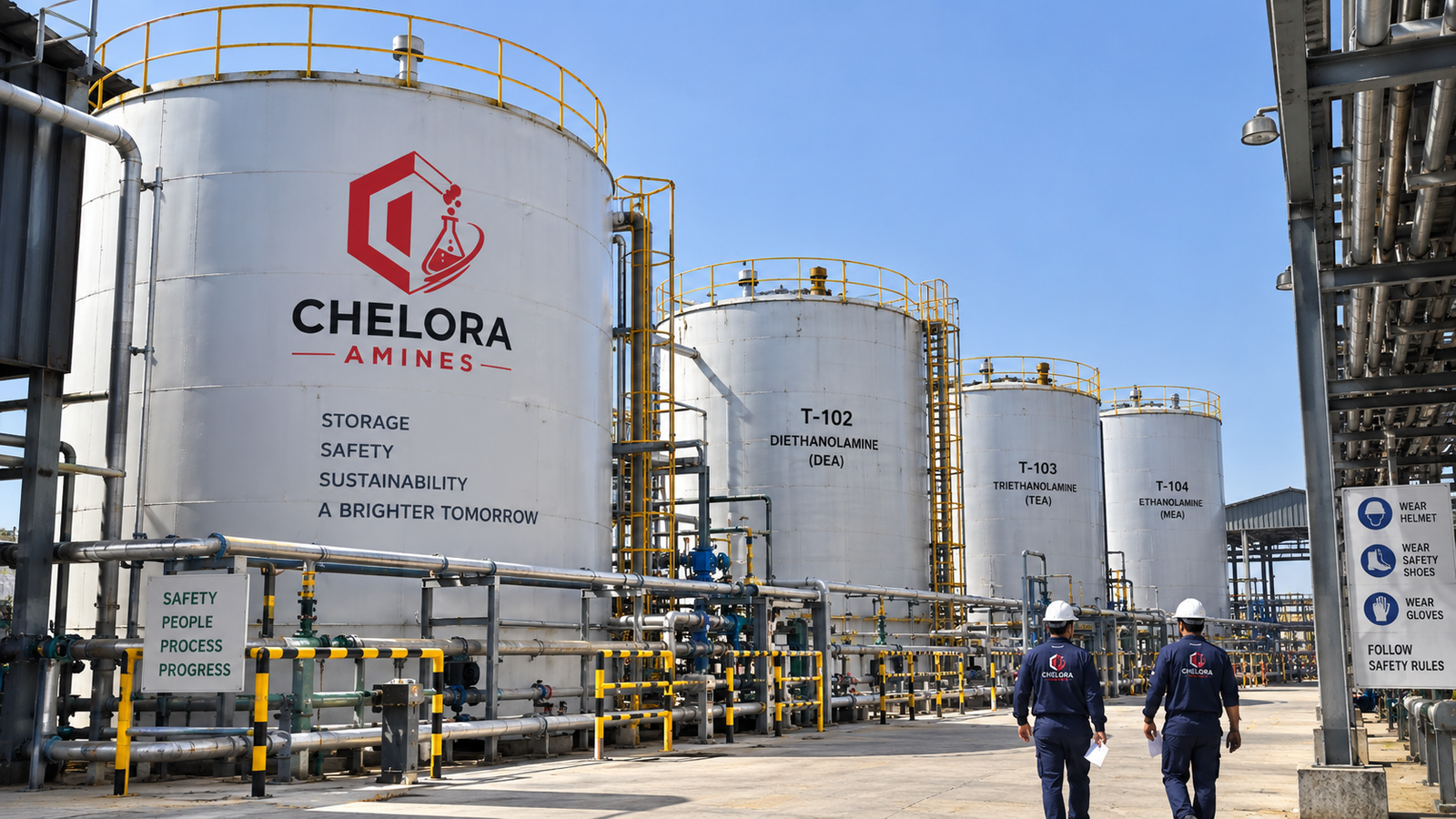
ISO tanks for solution; pressure cylinders and tonners for anhydrous gas.
Tell us the monthly draw, the strength you dose at and whether your site is equipped for pressurised gas, and we will recommend the form, pack size and delivery schedule. Export consignments are packed in UN-specification containers, palletised and stretch-wrapped, and shipped FOB, CIF or CFR through Nhava Sheva and Mundra.
Plan my supplyAnhydrous dimethylamine is a flammable gas; the aqueous solution is a flammable corrosive liquid that gives off the same amine vapour. Both are detectable by smell far below harmful levels, which is useful but is not a substitute for monitoring. The notes below are a summary for planning only — work to the Safety Data Sheet supplied with your consignment and your own site risk assessment.
Dimethylamine is a regulated dangerous good in both its forms, and they are classified differently. Getting the form right on the enquiry is what keeps a first shipment on schedule.
| Proper shipping name | Dimethylamine, anhydrous — or Dimethylamine, aqueous solution |
| UN number / class | UN 1032 · Class 2.1 (anhydrous); UN 1160 · Class 3, subsidiary risk 8 (solution) |
| Packing group | Not applicable for the gas; II for the solution |
| Labels | Flammable gas; or flammable liquid and corrosive labels |
| Modes | Road, rail and sea (IMDG); air movement within dangerous goods quantity limits |
| Segregation | Away from acids, oxidisers, halogens and foodstuffs |
| Packaging | UN-specification drums and totes, or approved pressure receptacles for anhydrous |
We supply business to business only, against verified company credentials and consignee details, plus any import permit or licence the destination country requires for amines of this class.
Start account opening| Parameter | Specification | Result |
|---|---|---|
| Appearance | Clear, colourless liquid | Complies |
| Dimethylamine content | 40.0 ± 0.5 % w/w | Complies |
| Monomethylamine | ≤ 0.5 % w/w | Complies |
| Trimethylamine | ≤ 0.5 % w/w | Complies |
| Colour | ≤ 20 | Complies |
Dimethylamine is checked before dispatch and each consignment leaves with the paperwork your QC, stores and accounts teams need on day one.
The numbers on a Certificate of Analysis are only useful if you know how they were produced. These are the methods behind the figures on ours, and the checks worth repeating at your own goods-inward.
Separates dimethylamine from its mono and tri relatives and from ammonia in one run, which is the only reliable way to see the amine split.
The working method for solution strength, and a quick goods-inward confirmation before a drum is released to production.
Water determination on anhydrous material, where even a small carry-over changes the behaviour of a moisture-sensitive step.
A visual platinum–cobalt comparison. A rising colour value is the earliest sign that a pack has been exposed to air or held too long.
Fast confirmation of solution strength, and a simple way to spot a wrong pack or a drum that has lost amine to the headspace.
Gravimetric residue and trace metal checks, which matter for catalytic steps and regulated formulations.
A sample from every dispatched batch is held here, so a query months later can be settled against the original material.
The batch number on the label ties back to the COA, the test record and the supply lot, which is what your auditor will ask to see.
Where your customer or regulator needs an independent result, we can arrange analysis at a NABL-accredited laboratory before dispatch.
Five steps for a first order of Dimethylamine. Repeat orders follow the same route on a schedule that matches your consumption.
Form, strength, quantity, pack size and delivery location.
We confirm the form for your process and quote, usually within 24 hours.
The batch is tested and the COA, SDS and invoice details are prepared.
Labelled packs move by road, or in UN-spec packaging for export.
Material reaches your gate and repeat dispatches are scheduled to your usage.
Dimethylamine is a line on a price list and a headache in a warehouse. What separates suppliers is the form flexibility, the paperwork and the answer you get when something is not routine.
Dimethylamine sits alongside the rest of our amine range, from ethanolamines to fatty amines. Your purchase team raises one enquiry, compares one quote and manages one vendor record instead of six.
Aqueous solution at 40% or 60%, and anhydrous liquefied gas, so you are not forced to redesign a step around the only form your supplier happens to carry.
COA, SDS, correct HSN and HS codes, dangerous goods declarations and certificates of origin are prepared with the consignment, not chased afterwards.
Tell us your limits on amine split, ammonia and colour and we quote against them, rather than sending the standard cut and letting your QC find out.
Once we know your monthly draw we hold and release material on a schedule, so you carry less inventory of a hazardous product.
Describe the reaction or formulation rather than the product code and we will tell you which form fits — and say so plainly when a different amine would serve you better.
Buyers who order Dimethylamine usually source these from the same list. Open any product for its specification, grades and packing, or see the full product range.
Container shipments to buyers on five continents, plus road dispatch inside India. Tell us your country and destination port and we will quote landed terms, transit time and the documentation your customs broker will ask for.
United Arab Emirates, Saudi Arabia, Oman, Qatar, Kuwait, Bahrain, Jordan, Egypt, Morocco, Kenya, Tanzania, Ethiopia, Nigeria, Ghana and South Africa.
Bangladesh, Sri Lanka, Nepal, Pakistan, Vietnam, Thailand, Indonesia, Malaysia, Singapore, the Philippines, South Korea, Japan, Taiwan, Australia and New Zealand.
Germany, the Netherlands, Belgium, France, Italy, Spain, Portugal, Poland, Czechia, the United Kingdom, Ireland, Türkiye, Russia, Ukraine, Kazakhstan and Uzbekistan.
United States, Canada, Mexico, Brazil, Argentina, Chile, Colombia, Peru, Ecuador and the Caribbean, shipped in UN-specification packaging with full DG documentation.
| Incoterms quoted | EXW, FOB, CFR, CIF and DAP, depending on your destination and preference |
| Load ports | Nhava Sheva (JNPT) and Mundra, with Chennai and Kolkata used for eastbound routings |
| Container options | Full container loads, and consolidated LCL shipments for smaller quantities |
| Typical container fill | Around 80 drums, or roughly 18 to 20 IBC totes, in a 20 ft container |
| Packing for export | UN-specification drums and totes, palletised, strapped and stretch-wrapped, with DG labelling |
| Air freight | Rarely practical for this product; most volume moves by sea |
| Payment terms | Advance, irrevocable letter of credit or agreed credit terms for established accounts |
| Before first shipment | Company credentials, consignee details and any import permit the destination country requires |
Most delays in quoting Dimethylamine come from a missing line in the enquiry, not from availability. Send these details and a firm price usually comes back the same day.
Not sure of some of it yet? Send what you have. A description of the reaction step and an approximate monthly volume is enough for us to come back with a recommended form, a pack plan and an indicative price.
Send an enquiryPlain definitions of the words that appear on a Dimethylamine specification, label and shipping document. The full list is in our CAS glossary.
Short answers to what purchase, plant and QC teams ask us most about this product. Anything else, ask us directly.
Send the form, strength, quantity, pack size and your delivery address or destination port. We come back with a price, the documents that go with the batch and a dispatch or shipping plan, usually within 24 hours.